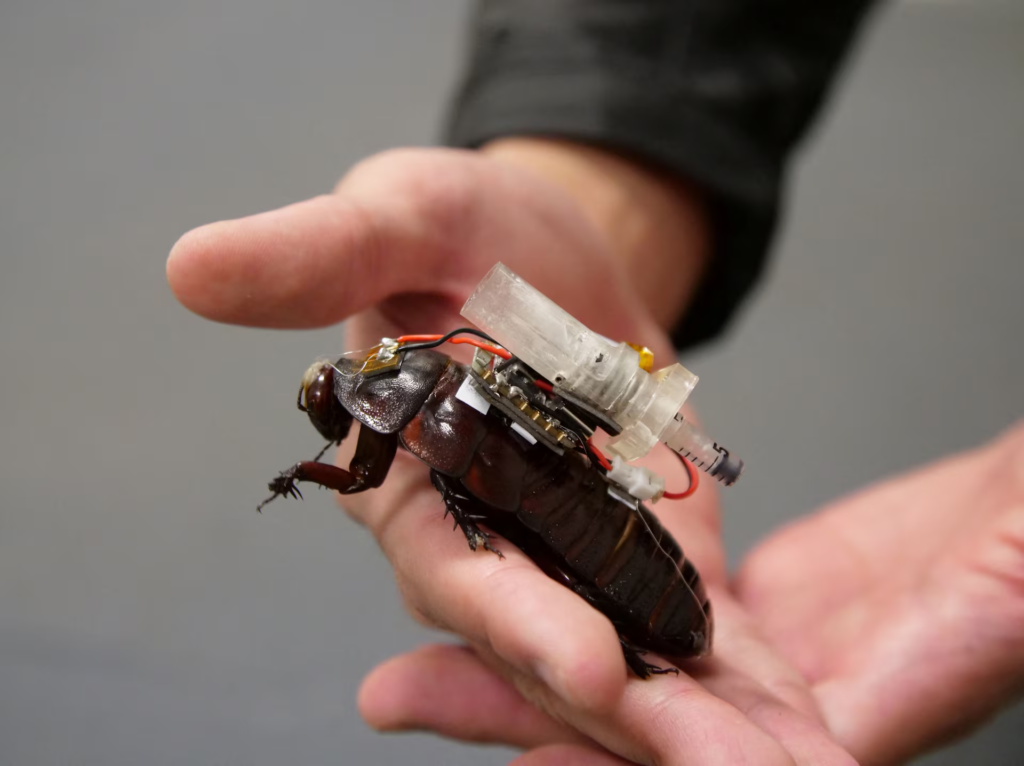
A new generation of cyborg cockroaches could one day crawl into places too dangerous or narrow for human rescuers, locate trapped survivors and deliver emergency medication under remote human supervision.
Researchers at the University of Queensland (UQ), working with biomedical engineers at the University of New South Wales (UNSW), have developed insect-based rescue systems called “Paraborgs.” The six-legged machines combine a living cockroach’s ability to navigate difficult terrain with miniature electronics, cameras and an automated injection mechanism.
The concept is aimed at situations such as collapsed buildings after earthquakes, cave emergencies and other disaster zones where rubble, confined spaces or unstable structures can prevent conventional rescue equipment from reaching victims.
The technology remains at the proof-of-concept stage. The insects have not been deployed to treat people in real disasters, and significant engineering and safety challenges remain before such systems could become part of an emergency response team.
What are the Paraborg cyborg cockroaches?
The Paraborg is based on the giant burrowing cockroach (Macropanesthia rhinoceros), a species native to northern Queensland.
Unlike conventional small robots, the insect already has a highly capable biological locomotion system. Researchers add lightweight electronics that allow them to influence its movement and equip individual insects for specific tasks.
The research team describes the approach as moving cyborg insects beyond their traditional role as mobile sensors.
Instead of simply finding a survivor, a Paraborg could potentially provide limited assistance while a human operator remains responsible for the medical decision.
The research paper describes three central capabilities:
- Remote locomotion control using electrical stimulation.
- Onboard imaging through a miniature camera.
- Targeted drug delivery using a remotely triggered auto-injection mechanism.
How do the cyborg cockroaches work?
The system does not turn the cockroach into an autonomous robot.
Instead, researchers use electrical stimulation to influence the insect’s movements. The electronics are attached through a compact harness, allowing operators to steer the cockroach and direct it toward a target.
For rescue applications, cameras can provide visual information from areas where conventional equipment may struggle to operate.
The medical version adds a miniature auto-injection mechanism (AIM). Once the cockroach reaches the required position, the system can be remotely triggered to launch the injector into a target.
That distinction matters. The insect is effectively providing the mobility platform, while the human operator retains control over the critical intervention.
As UQ biorobotics engineer Thang Vo-Doan put it, cyborg insects have been developed for “search and explore” missions for years. The team’s question was what could happen after a survivor was found: “Once they find someone, can they actually help?”
How successful were the cyborg cockroaches?
The early results suggest the concept is technically feasible, although the numbers also show why the technology is not yet ready for emergency deployment.
In proof-of-concept experiments, the Paraborg system achieved:
- 95% success for close-range injection when positioned within 15 centimeters of the target.
- 72% success for the complete navigation-and-injection sequence.
- 90% success for the auto-injection mechanism itself, according to the research paper.
- 100% success in reaching designated navigation checkpoints during the reported manual-control testing.
The gap between the close-range injection rate and the overall 72% result highlights one of the hardest problems: getting the insect into precisely the right position and keeping it stable long enough to inject.
The researchers found that injection performance was stronger at shorter distances. Some failures occurred when the injector was launched from roughly 15 to 25 centimeters away, with the injector rebounding rather than penetrating the target.
Why use cockroaches instead of tiny robots?
The idea may sound unusual, but the biological platform offers several advantages.
Building a miniature robot capable of independently moving through rubble is difficult. Researchers would need to solve problems involving motors, batteries, traction, navigation and obstacle avoidance while keeping the robot small enough to enter confined spaces.
A cockroach already comes with much of that biological machinery.
The giant burrowing cockroach is also relatively large compared with many other insects. The research paper reports body lengths of about 84–87 millimeters and weights of roughly 34–40 grams, giving the researchers more room to mount electronics and medical equipment.
Its natural ability to move over uneven surfaces could also be useful in environments where wheels or conventional robotic mechanisms become trapped.
The researchers therefore aren’t trying to build a better cockroach-shaped robot. They are using the insect’s existing biomechanics and adding technology where it is needed.
What could Paraborgs do during a disaster?
The potential applications extend beyond earthquake rescue.
A future swarm could contain insects equipped for different jobs, rather than asking every Paraborg to perform every task.
For example:
- Camera-equipped insects could search for survivors.
- Sensor-equipped insects could collect environmental information.
- Medical Paraborgs could carry emergency injectors.
- Multiple insects could potentially work together to perform more complex tasks.
This division of labor is part of the researchers’ longer-term vision for cyborg insect rescue teams. (UQ News)
The medical application could be particularly useful when a victim is located but cannot immediately be extracted.
A person trapped beneath debris might need urgent medication before rescuers can safely reach them. A small insect could potentially move through a narrow opening and bring treatment closer to the victim.
The important limitation is that this would not make the cockroach a paramedic in the conventional sense. The system is designed around human-supervised intervention, not independent medical diagnosis or decision-making.
Precise positioning is still the biggest challenge
Finding a survivor is only the first problem.
The insect must then approach the correct location, orient itself appropriately and remain sufficiently stable for the injection mechanism to work.
PhD candidate Hai Nhan Le identified positioning as one of the team’s major engineering challenges. The insect’s natural movement, while useful for navigating difficult terrain, also makes precise positioning harder than it would be with a conventional robotic arm.
That is particularly important when an injector has to hit a small target from a controlled distance.
The current experiments therefore demonstrate feasibility rather than field readiness. The reported tests were conducted under controlled experimental conditions, including work with artificial targets; real rubble, dust, unstable surfaces, poor visibility and communications problems could introduce additional failure modes.
Could cyborg cockroaches actually save lives?
Potentially—but that remains a future application, not an established capability.
The strongest argument for the technology is its ability to exploit spaces that conventional rescue robots may find difficult to access. A small biological platform that can carry a camera or medical payload could provide rescuers with information or assistance before a human can safely enter.
Fire and Rescue NSW Superintendent Tim Hassiotis said the technology could potentially extend the reach of urban search-and-rescue teams if the insects can safely enter inaccessible spaces, locate casualties and assist with emergency care.
But several hurdles remain before that vision becomes practical.
Researchers would need to demonstrate reliable operation across complex real-world terrain, maintain communications in collapsed structures, improve positioning accuracy and establish robust medical safeguards. They would also need to determine how the system behaves when conditions differ dramatically from laboratory testing.
There are ethical considerations, too. The researchers anesthetize the cockroaches while fitting the electrodes and electronics, and report that the insects can live for as long as other cockroaches after their harnesses are removed. The study also describes controlled housing and care conditions for the insects.
When could cyborg insect rescue teams become reality?
The researchers envision swarms of specialized cyborg insects working together rather than a single insect performing every rescue task.
That could make the system more resilient. If one insect fails, another could potentially continue the search or perform a different function.
Vo-Doan has suggested that cyborg insect rescue teams could potentially appear in real emergencies within five to 10 years, although that is a research vision rather than a confirmed deployment timetable.
For now, the Paraborg project represents an intriguing shift in biohybrid robotics: instead of asking robots to imitate every capability of an animal, researchers are using the animal itself and augmenting it with technology.
That could prove useful in one of the hardest problems in disaster response—bringing help to people when bringing the rescuers themselves is too dangerous.
TL;DR
Australian researchers have developed Paraborgs, cyborg cockroaches equipped with cameras and miniature auto-injection systems. The insects can be remotely guided through difficult terrain and, in laboratory tests, achieved up to 95% success in close-range injection and 72% success across the complete navigation-and-injection sequence.
The technology could eventually help search-and-rescue teams reach people trapped inside collapsed buildings, caves, and other confined spaces. However, it remains an experimental platform and has not yet demonstrated real-world medical rescue operations.