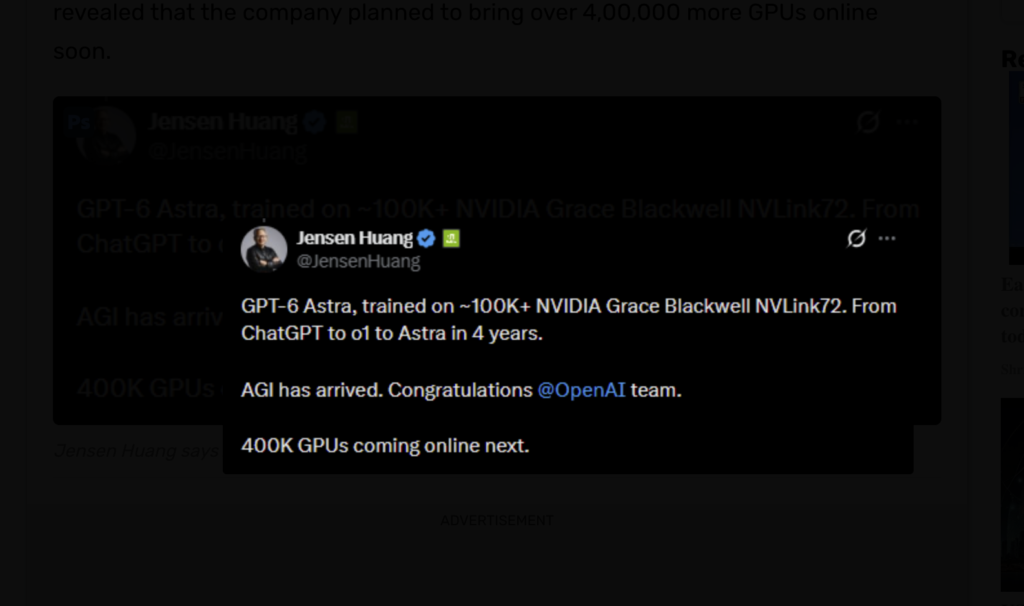

Nvidia CEO Jensen Huang has declared that artificial general intelligence has arrived, pointing to OpenAI’s newly released GPT-6 Astra as the model that marks the breakthrough.
“AGI has arrived,” Huang wrote on X while congratulating OpenAI’s team. He also highlighted Nvidia’s role in powering the model, saying Astra was trained on more than 100,000 Nvidia Grace Blackwell NVLink72 systems. Huang added that another 400,000 GPUs are expected to come online next.
The claim is striking, but it is not universally accepted. OpenAI has described Astra as a major step into the “AGI era,” while AI critic Gary Marcus has argued that there is not enough evidence or a sufficiently clear definition of AGI to declare victory.
That leaves a deceptively simple question: has AGI actually arrived, or are technology companies using a term that still has no universally accepted finish line?
What is GPT-6 Astra?
OpenAI unveiled GPT-6 Astra on September 3, describing it as its most capable and aligned model to date.
The company says Astra is designed to handle a broad range of demanding tasks rather than operating as a specialist tool. Its reported capabilities include computer use, software engineering, scientific work, mathematics, cybersecurity and complex professional tasks.
OpenAI President Greg Brockman said the launch marked the beginning of the “AGI era” and suggested that people could eventually look back on Astra as the moment AGI was created.
What does Jensen Huang mean by ‘AGI has arrived’?
Huang’s statement is essentially a judgment that Astra has crossed the threshold from highly capable AI into artificial general intelligence.
AGI is generally used to describe an AI system that can perform a broad range of intellectual tasks at or above human levels, rather than excelling in only a narrow set of capabilities.
The problem is that there is no universally accepted test that determines when a system becomes AGI.
Different researchers emphasize different characteristics, including reasoning, learning new tasks, adaptability, autonomy, general knowledge and the ability to perform economically valuable work.
That ambiguity gives technology companies considerable room to define the milestone differently.
Does OpenAI itself say AGI has been achieved?
Not quite.
OpenAI has strongly suggested that Astra represents a transition toward AGI, but the company’s public language is more cautious than Huang’s declaration.
Brockman said OpenAI is “now moving into the AGI era,” while OpenAI has described Astra as a major capability breakthrough rather than issuing a universally recognized scientific certification that AGI has been achieved.
That distinction matters because Huang is effectively making an industry-level proclamation, while the underlying scientific question remains unsettled.
Why do some AI researchers disagree?
One of the most prominent critics is Gary Marcus, a longtime AI researcher and skeptic of claims that current generative AI systems have achieved human-level general intelligence.
Marcus argued that Huang’s declaration lacked both evidence and a sufficiently precise definition of AGI. He has proposed his own criteria for evaluating whether an AI system genuinely possesses general intelligence and said Astra falls short on most of them.
His criticism gets at the central problem with the announcement: demonstrating extraordinary performance on selected tasks is not necessarily the same as demonstrating general intelligence across unfamiliar situations.
An AI can be spectacularly good at many things while still failing in unexpected ways.
Why is AGI such a difficult concept to define?
Human intelligence is not one skill.
A person can reason mathematically, learn a new language, understand social situations, navigate an unfamiliar city, repair a broken object and adapt when circumstances change.
An AI model may perform extremely well on many of those tasks while still struggling with others.
That makes a single AGI benchmark difficult to construct.
Even Sam Altman has previously described AGI as a poorly defined term. The lack of an agreed scientific threshold means two experts can look at exactly the same model and reach completely different conclusions about whether it qualifies.
What can Astra reportedly do?
The new model is designed to operate across a much wider range of tasks than conventional software.
It can reportedly use computers, browse information, work through multi-step problems and perform specialized professional tasks. OpenAI has also highlighted advances in software engineering, science, mathematics and cybersecurity.
One reason the launch has generated so much excitement is the possibility of delegating entire workflows rather than simply asking an AI to produce a paragraph, answer a question or write a short piece of code.
That shift is important because AGI is typically defined around the ability to perform broad categories of work, not merely generate impressive individual outputs.
Why does Nvidia matter so much to Astra?
There is another story hiding inside Huang’s announcement: the enormous amount of computing power required to build frontier AI systems.
Huang said Astra was trained using more than 100,000 Nvidia Grace Blackwell NVLink72 systems. The figure illustrates the extraordinary infrastructure now required to train and operate cutting-edge AI.
Nvidia has become the dominant supplier of the high-performance GPUs used by many leading AI companies.
For Nvidia, the growth of models such as Astra represents a massive commercial opportunity because increasingly capable AI requires increasingly large amounts of computing power.
Huang’s post therefore celebrated both an AI milestone and the hardware ecosystem that helped make it possible.
How much AI hardware is coming next?
Huang said roughly 400,000 additional Nvidia GPUs are expected to come online.
That suggests the race toward more capable AI is not slowing down after Astra. Companies are continuing to build enormous computing clusters as they pursue increasingly sophisticated models.
The hardware race has become almost inseparable from the AI race itself.
Better models require more computing in many cases, and companies with access to the biggest pools of advanced processors can train, test and deploy increasingly complex systems.
Does Astra actually think like a human?
That remains an open question.
A model can produce remarkably sophisticated answers and complete complicated tasks without necessarily possessing human-like understanding.
AI systems process patterns in data and use learned representations to generate outputs. Whether that amounts to “understanding” in the same sense humans do is a philosophical and scientific question that remains unresolved.
More importantly, general intelligence involves reliable performance in unfamiliar circumstances. A system that performs brilliantly on known evaluations can still encounter unexpected weaknesses outside those tests.
That is why demonstrations alone cannot settle the AGI debate.
Could Astra already outperform humans at some jobs?
Almost certainly in certain narrowly defined tasks.
Modern AI systems can already outperform many humans in areas such as large-scale information retrieval, certain forms of coding, data analysis and pattern recognition.
The AGI question is broader.
It asks whether one system can reliably handle almost any economically meaningful intellectual task that a skilled human could perform, including tasks it has not specifically been optimized for.
That distinction is why reaching exceptional performance across hundreds of benchmarks still does not automatically settle the question.
Why would AGI be such a major milestone?
A genuinely general AI system could change the economics of knowledge work.
Instead of using AI as a tool for isolated activities, businesses could potentially delegate entire projects to autonomous systems. Research, software development, analysis, customer support, design and other forms of intellectual work could become increasingly automated.
That could boost productivity dramatically.
It could also disrupt labor markets, reshape the value of expertise and create new questions about ownership, accountability and economic inequality.
The distinction between today’s AI and true AGI therefore matters enormously.
What are the risks if AGI really has arrived?
The potential benefits come with equally serious risks.
A highly capable system that can autonomously operate computers, write software and discover vulnerabilities could be substantially more powerful than a chatbot that only produces text.
OpenAI has already described Astra as its first model to reach what it calls a critical cybersecurity capability threshold, highlighting the dual-use nature of increasingly capable AI.
That means the same capabilities that could accelerate scientific discoveries or improve software could potentially be exploited for cyberattacks, fraud or other harmful activities.
The question of alignment therefore becomes more important as systems become more autonomous.
Has AGI finally arrived?
There is no consensus yet.
Jensen Huang says yes. OpenAI executives are signaling that the company has entered the AGI era. But other researchers argue that Astra has not demonstrated the breadth, reliability or autonomy required to meet conventional definitions of artificial general intelligence.
The disagreement is not merely semantic.
Declaring AGI achieved requires a meaningful standard that can be tested independently. Without one, the announcement risks becoming a contest over who gets to define the finish line.
Astra may ultimately prove to be a landmark in AI development. It may even become the model that future historians identify as an early form of AGI.
But for now, the most defensible conclusion is more restrained: artificial intelligence has taken another substantial step toward general-purpose capability, while the scientific community is still arguing about whether the finish line has been crossed.