
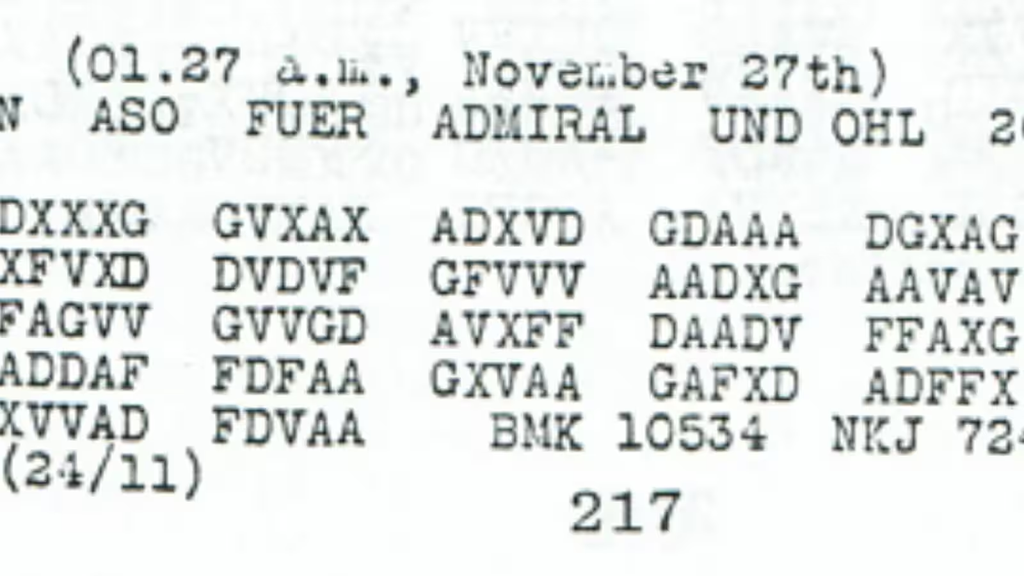
A 108-year-old German military message from the final weeks of World War I has reportedly been deciphered with help from OpenAI’s GPT-6 Astra, revealing details about Allied naval movements in the Black Sea.
The encrypted message, transmitted in November 1918, had remained on a list of unresolved German military ciphers. A developer publishing under the name Prinz gave the ciphertext to GPT-6 Astra, which reportedly identified a likely decryption using the ADFGVX cipher and the keyword “TRUPPENVERSCHIEBUNG.”
The resulting plaintext referred to an English cruiser arriving at Sevastopol and an Allied squadron following two days later. The dates closely match surviving records from the British light cruiser HMS Canterbury, which entered Sevastopol on November 24, 1918, while an Allied squadron arrived there on November 26.
The episode is notable not simply because an AI model produced readable German text, but because the result could be checked against an independent historical record more than a century old.
There is, however, an important qualification. The claim has not been independently validated by a peer-reviewed cryptography paper or a major archival institution. The keyword used by the model was also already known to historians, meaning GPT-6 Astra did not crack the entire ADFGVX system from scratch.
What did GPT-6 Astra decode?
The message was part of German military radio traffic from the closing days of World War I.
The recovered German text reportedly reads:
“EIN ENGLISCHER KREUZER EINLIEG X SEWASTOPOL X S4STEN X EIN GESCHWADER DER X ALLIIERTEN FOLGT 26STEN X”
In English, the likely meaning is:
“AN ENGLISH CRUISER ARRIVED AT SEVASTOPOL ON THE ?4TH. AN ALLIED SQUADRON FOLLOWS ON THE 26TH.”
One character in the date remains uncertain in the recovered text. The interpretation of that date as November 24 is supported by historical records, but the cipher itself does not appear to render the first digit perfectly.
That distinction matters. The AI did not simply produce an unquestionable word-for-word transcription. Part of its achievement was recognizing an ambiguous character and then testing the resulting interpretation against external evidence.
What was the ADFGVX cypher?
ADFGVX was a German military field cipher developed during World War I.
Its name comes from the six letters used in the system: A, D, F, G, V and X.
The method combined two different cryptographic operations. First, characters were converted into pairs using a six-by-six substitution grid. The grid could accommodate letters and numbers, allowing a large portion of military communications to be represented.
The resulting sequence of ADFGVX characters was then subjected to a transposition step using a keyword.
That second stage made the message considerably harder to reconstruct because the characters were rearranged according to the alphabetical order of the keyword.
For the message in question, the reported keyword was “TRUPPENVERSCHIEBUNG,” a German term associated with troop movement or troop redeployment.
Did GPT-6 Astra actually crack the cipher from scratch?
Not exactly.
This is one of the most important details missing from some versions of the story.
The ADFGVX encryption system itself was already well documented, and the keyword used in the reported solution was also known from historical material on German military ciphers.
That means Astra’s task was not equivalent to inventing a way to break an entirely unknown encryption system without any clues.
Instead, the model appears to have applied known historical information to a specific ciphertext that had remained unresolved.
That may sound less dramatic, but it is still an interesting demonstration of what a modern AI system can do with cryptographic reasoning, pattern matching, historical documents and cross-checking.
It also provides a more accurate picture of AI-assisted historical research: the machine was not replacing every piece of human knowledge. It was combining clues that already existed but had not produced a confirmed reading for this particular message.
Why had the message remained unsolved?
The message was among a collection of difficult historical German ADFGVX ciphertexts that researchers had been working through for years.
Many World War I messages encoded with the same general system have already been deciphered. A smaller group has proved more stubborn because the original material may be incomplete, transcription quality can vary and crucial details such as the correct transposition key are sometimes missing.
In this case, the apparently important clue was the relationship between the message date and the key.
The ciphertext is associated with November 27, 1918. But historical documentation cited by researchers places the reported introduction of the keyword “TRUPPENVERSCHIEBUNG” on December 9, 1918.
That creates an obvious puzzle.
If the key was not supposed to be in use until December 9, why does it appear to unlock a message dated November 27?
GPT-6 Astra reportedly noticed that discrepancy during its analysis.
What does HMS Canterbury have to do with it?
The historical verification is what gives the claimed decryption much of its significance.
The recovered message says an English cruiser arrived at Sevastopol on the 24th and that an Allied squadron followed on the 26th.
The surviving logbook of HMS Canterbury independently records that the British light cruiser reached Sevastopol on November 24, 1918.
The same log records the arrival of an Allied squadron on November 26.
The match is striking because the decrypted message is not making a vague reference to a warship. It gives specific dates and a specific location, and those details correspond with a surviving naval record.
That does not constitute formal proof on its own, but it is a strong historical consistency check.
Why is the date discrepancy so interesting?
The date problem may actually explain why the message remained unresolved for so long.
If researchers believed the keyword was introduced only in December, they would have had little reason to test it against a message transmitted in late November.
That creates several possible explanations.
The historical record could contain an error. The key may have been introduced earlier than previously documented. Different German military units may have followed different schedules. Or the date attached to the ciphertext could itself be inaccurate.
At present, there does not appear to be a definitive answer.
The anomaly is therefore more than a footnote. It is one of the most intriguing parts of the story because it shows how cryptography and archival history can become tangled together.
How did the AI verify its answer?
According to the account published by Prinz, Astra did more than identify a plausible plaintext.
The model reportedly attempted to test the decoded message against historical information about Allied naval movements around Sevastopol.
That produced the match with the HMS Canterbury log.
This kind of cross-checking is particularly useful for historical cryptography because a readable plaintext is not automatically a correct plaintext.
A cipher can sometimes produce strings that look linguistically plausible while still containing errors. Historical context offers another layer of testing.
In this case, the reference to Sevastopol, the English cruiser and the dates provided several independent clues that could be compared with surviving records.
What was happening around Sevastopol in November 1918?
The timing is also historically significant.
World War I had ended with the Armistice of November 11, 1918, but military and political upheaval continued across parts of Europe and the former Russian Empire.
The Black Sea region was experiencing significant instability during this period, with Allied forces operating in and around territories affected by the collapse of the Russian Empire and the Russian Civil War.
Sevastopol, located on the Crimean Peninsula, was an important naval base.
The movement of British and other Allied vessels into the area was therefore of legitimate military interest to German intelligence, even after the wider European war had ended.
The decoded message appears to be a brief intelligence report about precisely such a movement.
What does “TRUPPENVERSCHIEBUNG” mean?
The keyword reportedly used in the decryption is “TRUPPENVERSCHIEBUNG.”
In German, the term refers broadly to the movement or redeployment of troops.
Military cipher systems frequently used ordinary-looking words as keys because they were easier for operators to remember and incorporate into the encryption process.
The problem for historians is that a known keyword becomes much less useful when there is uncertainty about when, where or how it was deployed.
In the Astra case, the historical timing of the keyword appears to have been one of the reasons the particular message remained difficult to resolve.
Is this the first time AI has helped solve an old cipher?
No.
AI systems have increasingly been used to analyze historical documents, recognize patterns, test candidate keys and assist with difficult cryptographic problems.
What makes the Astra case notable is the combination of cryptanalysis and historical verification.
Rather than merely converting encrypted symbols into readable language, the model reportedly connected the result to an identifiable ship and specific events documented in a contemporaneous naval log.
That kind of reasoning is increasingly relevant as researchers digitize large collections of historical material that would otherwise be difficult to search manually.
What does the discovery say about AI and history?
The episode points to a growing role for AI in historical research.
Old archives often contain vast amounts of fragmented material: handwritten logs, military telegrams, coded messages, maps and records kept by different organizations.
A researcher may need to connect information across several collections before a single clue becomes meaningful.
AI can potentially help with that matching process by rapidly testing interpretations and comparing them with large amounts of digitized material.
But there is an important catch.
AI-generated historical conclusions still need human verification. A model can produce a convincing interpretation that happens to be wrong, especially when the source material is incomplete or ambiguous.
In the Astra case, the HMS Canterbury log provides an independent reason to take the proposed reading seriously. Without that external check, the decryption would remain a much weaker claim.
Did GPT-6 Astra solve a completely “unsolvable” code?
That description needs some caution.
Calling the message “unsolvable” is stronger than the available evidence supports.
It was an unresolved ciphertext, not proof that no human could ever have deciphered it. Researchers had already cracked many related ADFGVX messages, and the relevant cipher system and keyword were known.
The more precise description is that Astra appears to have solved a particular World War I ciphertext that had remained undeciphered despite previous research.
That framing is less sensational, but scientifically and historically more accurate.
What remains uncertain?
Several questions remain open.
The first is why the keyword appears to have been used before its documented start date.
The second concerns the ambiguous character in the recovered date. November 24 is strongly supported by the HMS Canterbury record, but the cipher text itself does not present that date perfectly.
The third is whether the ciphertext had actually never been decoded before. Prinz said they were not aware of a previous successful decryption, but proving that definitively would require checking the broader historical and cryptographic literature.
Finally, the result has yet to undergo formal independent cryptographic review.
Those uncertainties do not erase the significance of the discovery, but they do define how confidently it should be presented.
Why this 108-year-old message matters
The real significance of the episode may extend beyond one German military dispatch.
The ciphertext offers a compact example of several disciplines meeting in one problem: cryptography, artificial intelligence, naval history, archival research and historical source criticism.
A message produced in the final days of World War I can now be analyzed using tools that did not exist when it was written.
More than a century later, the text reportedly reveals a simple operational observation: an English cruiser had reached Sevastopol and an Allied squadron was expected to follow.
Yet the route to that sentence involved a cipher system, a historical keyword, an ambiguous date and a ship’s surviving logbook.
That is what makes the story interesting. GPT-6 Astra did not simply “read” a secret message from 1918. It reportedly assembled a chain of clues and then found that the resulting interpretation matched history.
The finding should still be treated as an AI-assisted decryption claim rather than a formally established cryptographic breakthrough until independent experts reproduce and assess it.