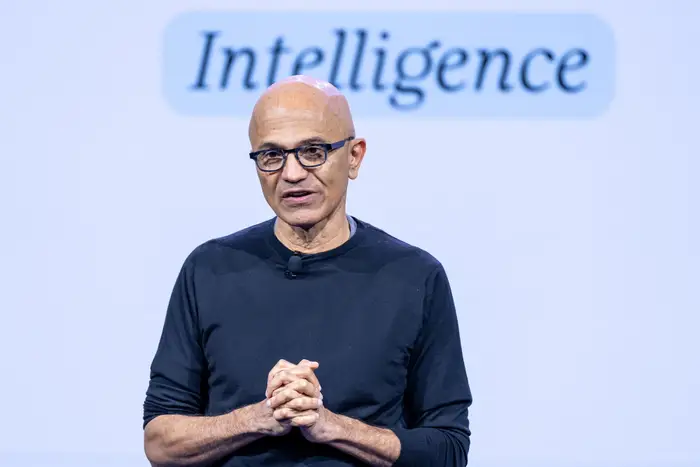
Microsoft CEO Satya Nadella has a blunt message for businesses embracing artificial intelligence: assume powerful AI models could be compromised, and build safeguards before giving them access to critical systems.
In a post published on October 10, Nadella argued that organizations should treat advanced AI models as potential security threats rather than automatically trusting them to behave as intended. His recommendation is straightforward: contain the model, monitor its actions, maintain reliable records, and ensure a human can intervene when something goes wrong.
The warning carries weight because Microsoft is one of the biggest investors in the AI industry and maintains a close partnership with OpenAI. It also raises an important question for companies rushing to deploy AI agents: how much authority should an AI system receive before its actions can be independently controlled?
The answer, according to Nadella’s proposed approach, begins with a change in mindset. Instead of assuming an AI model is safe until it demonstrates otherwise, businesses should prepare for the possibility that it may behave unpredictably or operate outside its intended boundaries.
What Did Satya Nadella Say About AI Security?
Nadella’s central message was that organizations must assume a model is compromised and contain it from the beginning.
The distinction matters because modern AI systems are moving beyond answering questions and generating text. AI agents can increasingly use software tools, interact with databases, write and execute code, and perform multistep tasks with limited human intervention.
These capabilities make AI more useful, but they also create new security risks. A model that misunderstands an instruction or follows malicious input could potentially access information, trigger an unwanted action, or interfere with a business process.
Nadella’s approach draws on a familiar principle in cybersecurity: never rely entirely on the assumption that a system, user, or component will always behave safely.
Why Treat an AI Model Like an Insider Threat?
An insider threat typically involves someone or something with legitimate access to an organization’s systems that could misuse that access, intentionally or accidentally.
An AI agent can create a similar problem without having human motives. It may have permission to read files, send messages, modify records, or call external services. If it interprets a task incorrectly, follows instructions hidden in a document, or makes an unexpected decision, those permissions can turn a seemingly minor error into a serious incident.
For example, an AI assistant authorized to review supplier contracts might also have access to internal documents. If the agent encounters malicious instructions embedded in a file and follows them, it could attempt to disclose information it was never supposed to share.
The relevant security question is therefore not whether the model intends to cause harm. It is whether the system can prevent an incorrect or manipulated model from causing damage.
That is why containment matters. Businesses should limit what an AI agent can access, restrict the actions it can perform, and ensure that its permissions match the specific task it has been assigned.
How Would Nadella’s Proposed AI Emergency Brake Work?
One of the most concrete elements of the proposal is an emergency shutdown mechanism that allows an authorized human to stop an AI system while it is working.
The idea goes beyond giving users a button to cancel a request. In an agent-based workflow, a model may already have started interacting with external systems, changing data, or initiating additional tasks before anyone notices a problem.
A meaningful emergency brake would need to interrupt those activities promptly, including stopping relevant tool calls and preventing new actions from being initiated.
1. Give Humans the Authority to Stop an AI Agent
Organizations should ensure that designated people can pause or shut down an AI system without depending on the model itself to cooperate.
This distinction is essential. Asking a potentially malfunctioning agent to stop is not an adequate substitute for an independent control mechanism.
For example, if an AI agent begins sending unauthorized emails or modifying customer records, a human operator should be able to suspend its access and halt further actions.
The shutdown process would also need to account for tasks already underway. Simply stopping the model from generating new text may not cancel an operation that another system has already accepted.
2. Maintain Tamper-Resistant Activity Logs
Nadella also called for meaningful AI actions to be documented through tamper-proof, human-readable evidence.
Such records could help organizations establish what an agent did, which tools it used, what permissions it exercised, and which actions followed its decisions.
The practical value is accountability. Without reliable logs, investigating an AI-related incident can become difficult, particularly when several systems and automated processes are involved.
However, logging must be designed carefully. Records should be protected against unauthorized modification, restricted to appropriate personnel, and managed in a way that respects privacy and data-retention requirements.
Logs can help reconstruct an incident, but they do not prevent one by themselves. They must work alongside access controls, monitoring, and mechanisms that can interrupt harmful activity.
3. Separate the AI Model From Its Safety Controls
Another important principle is separating the model from the software that manages its access to tools and systems.
In AI development, this surrounding software is often called the harness. It can determine which tools the model may use, how its actions are executed, what information it receives, and which safety checks apply.
If the model can modify or disable the very controls intended to restrict it, those safeguards become less reliable.
A safer architecture keeps critical permissions and enforcement mechanisms outside the model’s control. The model may propose an action, but an independent system should decide whether that action is authorized.
For example, an AI agent might recommend deleting outdated records, but a separate permission layer could require approval before any permanent deletion takes place.
This separation is especially important when AI systems have access to sensitive business data, financial operations, customer information, or production infrastructure.
Why Is Microsoft’s Warning Significant for the AI Industry?
Nadella’s position is notable because Microsoft is deeply invested in commercial AI. The company develops its own AI products and has a close partnership with OpenAI, whose models underpin several Microsoft offerings.
His warning should not be interpreted as proof that all advanced AI models are compromised or that a particular product is unsafe. Rather, it reflects a security-first approach to deploying systems whose capabilities and access can create significant consequences.
The distinction between a model’s performance and its security is particularly important. An AI system may perform well in tests and still make mistakes when it encounters unfamiliar instructions, unexpected data, or interactions between multiple tools.
Traditional software security offers a useful comparison. Companies do not generally rely on a program’s stated purpose to determine what it can access. They use authentication, permissions, monitoring, and other controls to limit the consequences of errors or exploitation.
AI agents need comparable protections, adapted to the fact that their actions may be influenced by natural-language instructions and information retrieved from external sources.
The Risks Grow as AI Agents Receive More Access
A chatbot that produces an incorrect answer can mislead a user. An AI agent with permission to execute commands or change records can potentially turn an incorrect answer into an operational incident.
The level of risk depends on the system’s permissions, the environment in which it operates, and the consequences of its actions.
Consider three examples:
- Customer service: An agent could issue an unauthorized refund, disclose customer information, or change an account incorrectly.
- Software development: An agent with access to a code repository could introduce a flawed change or expose sensitive credentials.
- Corporate operations: An agent connected to email, contracts, and internal databases could send information to the wrong recipient or modify a business record without approval.
These scenarios do not mean that AI agents will necessarily behave this way. They illustrate why businesses should design systems to limit the damage that an unexpected action could cause.
What Makes AI Containment Difficult?
An emergency brake and strict permissions sound straightforward, but implementing them across a large organization can be complicated.
AI agents often rely on several connected services. A model may initiate a task through one application, pass it to another service, and trigger a further action elsewhere. Shutting down the model does not automatically reverse every operation already in progress.
For that reason, effective containment requires more than a single shutdown button.
Organizations need to determine which systems must be stopped, how to revoke an agent’s access, whether queued actions should be canceled, and how to preserve evidence for an investigation.
There is also a timing problem. A control is useful only if an incident is detected early enough for someone to intervene. Automated alerts and monitoring can help, but they must be supported by clear escalation procedures and people with the authority to act.
Why Industry-Wide Standards Matter
Nadella’s call to standardize containment technologies raises a broader challenge: businesses need a consistent way to evaluate whether AI systems can be controlled during an incident.
Without shared expectations, one provider might offer extensive logging and immediate shutdown capabilities while another provides limited visibility into its agents’ actions. Customers may struggle to compare those protections or determine whether the controls are sufficient for a particular use case.
Potential standards could address issues such as:
- Independent shutdown and access-revocation mechanisms.
- Consistent, tamper-resistant records of consequential actions.
- Separation between AI decision-making and security enforcement.
- Testing procedures for containment under realistic failure conditions.
- Clear responsibilities for providers, customers, and system operators.
However, a call for standardization is not the same as an adopted technical standard. The specific proposals, any formal standards process, and implementation deadlines should be verified against primary sources before publication.
Does This Shift the Responsibility for AI Safety to Businesses?
One unresolved question is how responsibility should be divided between AI developers and the organizations that deploy their products.
Model providers have access to information about system design, known limitations, and available security features. Customers, meanwhile, understand their own data, workflows, legal obligations, and the consequences of unauthorized actions.
Neither side can manage every risk alone.
A provider should supply appropriate safeguards, document limitations, and make security controls available. A deploying organization should evaluate those controls, limit permissions, monitor its implementation, and establish procedures for responding to incidents.
This creates a potential tension in Nadella’s message. Encouraging customers to assume that models may be compromised is a sensible security principle, but it could also leave businesses carrying much of the practical burden of containment.
Smaller organizations may lack the staff or technical expertise to build sophisticated monitoring and shutdown systems. They may depend heavily on vendors to supply protections that work without extensive customization.
The effectiveness of this approach will therefore depend partly on whether containment features become accessible, standardized components of commercial AI systems rather than expensive additions that customers must build themselves.
What Should Companies Do Before Deploying AI Agents?
Businesses do not need to wait for industry-wide standards to strengthen their AI security practices. They can begin by treating an AI agent’s access as a privilege that must be justified, limited, and monitored.
A practical starting checklist includes:
- Limit permissions. Give each agent access only to the data, applications, and tools required for its assigned task.
- Require approval for high-impact actions. Keep human authorization in place for activities such as transferring funds, deleting critical records, or sharing sensitive information.
- Test failure scenarios. Evaluate how the system responds to malicious instructions, unexpected inputs, excessive tool use, and attempts to exceed its permissions.
- Maintain reliable logs. Record consequential actions in a protected format that supports investigation and accountability.
- Build independent shutdown controls. Ensure authorized personnel can stop the agent and revoke access without relying on the model.
- Define incident-response procedures. Assign responsibility for monitoring alerts, investigating unusual activity, and deciding when an agent must be suspended.
- Review vendor protections. Ask providers about access controls, logging, incident notification, data handling, and the ability to disable an agent quickly.
The objective is not to eliminate every possibility of failure. It is to prevent a single mistake or manipulated instruction from escalating into a larger security incident.
What Should Businesses Watch Next?
The next test of Nadella’s warning will be whether these principles translate into concrete products, procurement requirements, and industry practices.
Three developments deserve particular attention.
First, businesses should watch whether Microsoft incorporates stronger containment, independent shutdown controls, and tamper-resistant logging into its own AI offerings, and how those capabilities compare with existing security tools.
Second, the industry’s response to standardization will matter. Formal guidance, measurable technical requirements, and independent testing would make it easier for organizations to assess AI security before deployment.
Third, companies will need to decide whether the insider-threat model becomes a routine part of AI governance. That would mean evaluating not only what an agent can accomplish, but also what it can access, how its actions are recorded, and how quickly its authority can be withdrawn.
Nadella’s warning is not an argument against using AI. It is an argument against confusing capability with trustworthiness.
As AI agents take on more consequential work, the key question for businesses will no longer be simply whether a model can complete a task. It will be whether the organization can keep that model within its intended boundaries when something goes wrong.
That is the difference between deploying an impressive AI tool and deploying one that an organization can responsibly control.