For decades, the future of computing has largely been defined by shrinking transistors and packing more processing power onto silicon chips. But a breakthrough from researchers at Monash University suggests the next major leap may not come from moving electrons faster. It may come from replacing them altogether.
Scientists have developed a tiny chip that processes information using light rather than electricity. This milestone could pave the way for faster computers, more energy-efficient AI systems, and next-generation quantum technologies.
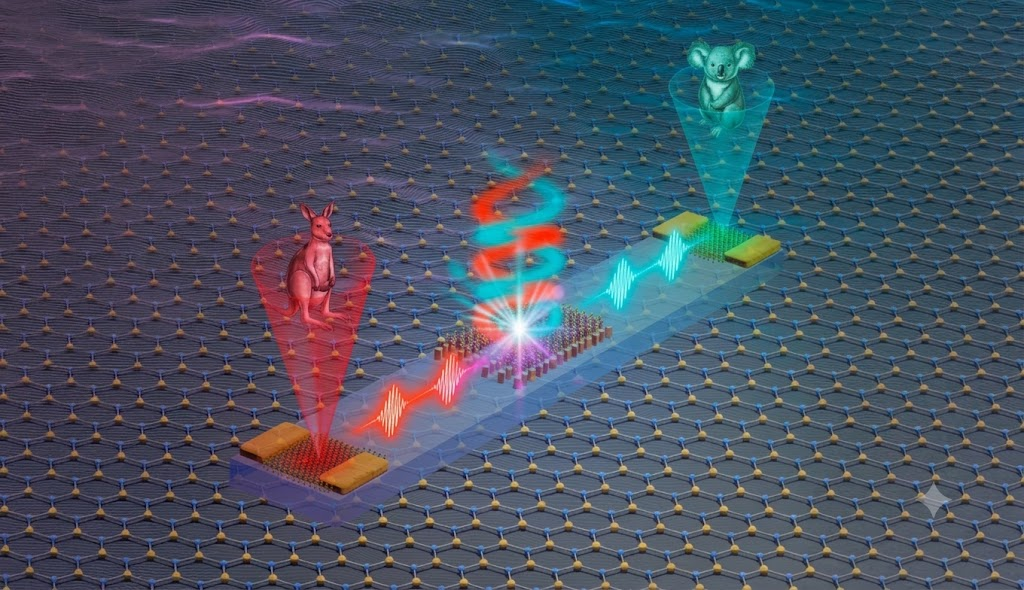
The research, published in Nature Photonics, demonstrates a compact device capable of generating, controlling, and reading specialized light-based information signals on a single chip. While the technology remains in the research stage, experts say it addresses one of the biggest obstacles in a promising field known as valleytronics.
The achievement could bring researchers closer to a future where photonic computers handle massive amounts of data at speeds and efficiencies beyond the reach of today’s electronic systems.
What is the new light-based chip developed by Monash University?
The newly developed chip is a nanoscale photonic circuit that manipulates information carried by light rather than electrons.
Traditional computer processors rely on electrical currents moving through billions of transistors. While this approach has powered decades of technological progress, it faces growing challenges related to energy consumption, heat generation, and physical scaling limits.
The Monash device takes a different route.
Instead of moving electrons through wires, it uses carefully engineered light signals to carry and process information. The chip can generate these signals, direct them through microscopic pathways, and convert them into electrical outputs, all within a single integrated platform.
Researchers say this marks the first time all of these capabilities have been successfully combined into one compact valleytronic device.
What is valleytronics, and why does it matter?
Valleytronics is an emerging branch of quantum technology that seeks to use a property known as the “valley degree of freedom” to store and process information.
In certain advanced materials, electrons can occupy different energy states called valleys. These states can function similarly to binary information in conventional computing, but with additional capabilities that could unlock new forms of data processing.
Scientists have viewed valleytronics as a potentially transformative technology because it offers several theoretical advantages:
- Faster information processing
- Reduced energy consumption
- Greater data density
- Enhanced quantum computing capabilities
- Improved optical communication systems
The challenge has been the practical implementation.
Until now, researchers could either create valley-based signals or detect them, but integrating the full process into one scalable system remained difficult.
Lead author Dr. Chi Li said the new device closes that gap.
“Until now, we could generate or detect these signals, but not do everything in one integrated device,” Li explained.
How does the chip work?
The breakthrough relies on a combination of advanced materials and nanotechnology.
Researchers integrated ultra-thin quantum materials, just a few atoms thick, with specially engineered metasurfaces. These nanostructures can manipulate light with extraordinary precision at scales far smaller than a human hair.
The role of metasurfaces
Metasurfaces are engineered materials designed to control how light behaves.
Unlike conventional optical components such as lenses or mirrors, metasurfaces can:
- Bend light
- Focus light
- Redirect light
- Filter specific wavelengths
- Encode information
All within structures measured in billionths of a meter.
By combining metasurfaces with quantum materials, researchers created a platform capable of manipulating valley-based information directly on a chip.
A simpler manufacturing approach
One of the notable aspects of the research is the manufacturing method.
Previous attempts to integrate delicate quantum materials with photonic devices often risked damaging the materials during fabrication.
The Monash team instead used a stacking technique that layers ultra-thin materials onto photonic structures.
According to co-first author Dr. Kaijian Xing, the method avoids many of the challenges associated with direct material growth and opens the door for future advances in valleytronic device design.
Why room-temperature operation is a breakthrough
Many experimental quantum technologies require extreme cooling systems to function properly.
Some quantum devices operate near absolute zero, demanding expensive and complex infrastructure that limits practical deployment.
The Monash chip works at room temperature.
That may sound like a small detail, but it is one of the most commercially important aspects of the breakthrough.
Room-temperature operation means future versions of the technology could potentially be integrated into real-world devices without requiring specialized cooling systems.
This dramatically improves the prospects for scalability and commercialization.
Why photonic computing could change the future of technology
Photonic computing has attracted growing interest because light offers several advantages over electricity for moving information.
Higher speeds
Light travels significantly faster than electrical signals and can carry vast amounts of information simultaneously.
This could enable:
- Faster processors
- Higher-performance AI systems
- More efficient cloud computing infrastructure
Lower energy consumption
Modern data centers consume enormous amounts of electricity.
As artificial intelligence workloads continue to grow, reducing power consumption has become a major industry priority.
Photonic systems generate less heat and require less energy for data transmission, potentially lowering operational costs and environmental impact.
Greater bandwidth
Unlike electrical signals, multiple light wavelengths can travel through the same channel simultaneously.
This allows photonic systems to process multiple streams of information at once, increasing overall data capacity.
Researchers demonstrated the chip by processing multiple images simultaneously
To showcase the platform’s capabilities, the research team conducted a practical demonstration.
The chip successfully encoded and processed two separate images at the same time.
While relatively simple compared to commercial computing tasks, the demonstration highlights the technology’s ability to handle multiple information streams simultaneously, an important capability for future computing and communication systems.
The result provides an early glimpse into how valleytronic photonic circuits could eventually support advanced data processing applications.
What are the potential applications?
Although commercial products are likely years away, researchers see several promising use cases.
Potential applications include:
Quantum computing
Valleytronic systems may provide new methods for storing and manipulating quantum information.
Artificial intelligence
Photonic processors could help accelerate machine learning workloads while reducing energy consumption.
Advanced imaging
Researchers believe the technology could improve high-resolution imaging systems used in medicine, science, and defense.
Optical communications
Future communication networks may use valley-based photonic technologies to transmit larger amounts of data more efficiently.
Data centers
Energy-efficient photonic processors could reduce power demands in large-scale computing facilities.
Why this research matters
The significance of the Monash breakthrough is not that it immediately replaces today’s processors.
Instead, it solves a fundamental engineering challenge that has limited progress in valleytronics for years.
By integrating signal generation, routing, and detection onto a single chip, researchers have demonstrated a complete valleytronic system that operates under practical conditions.
According to senior researcher Dr. Haoran Ren, the achievement represents a major step toward scalable technologies that process information using light rather than electricity.
While substantial development remains before such devices reach consumers, the work offers a glimpse of a future where computers may rely less on electrons and more on photons.
As demand for AI computing power, high-speed communications, and quantum technologies continues to rise, breakthroughs like this could help shape the next era of information processing.
TL;DR
Researchers at Monash University have created a tiny chip that processes information using light instead of electricity. The device integrates generation, control, and detection of valley-based quantum signals on a single platform, overcoming a major hurdle in valleytronics. Operating at room temperature and capable of handling multiple information streams simultaneously, the breakthrough could accelerate future advances in quantum computing, AI, and ultra-fast communication systems.