A Chinese automaker is rethinking one of the most basic limitations of life on the road: access to a bathroom. Seres has secured a patent for an in-car toilet integrated directly into a passenger seat, a design that could reshape long-distance driving, camping, and even urban commuting in edge cases.
The idea may sound unconventional at first glance, but it taps into a real, often overlooked friction point in mobility. As electric vehicles push for longer range and autonomous driving edges closer to reality, the car cabin is steadily transforming from a transport shell into a living space. Seres’ patent suggests the bathroom might be next.
What is the Seres in-car toilet patent?
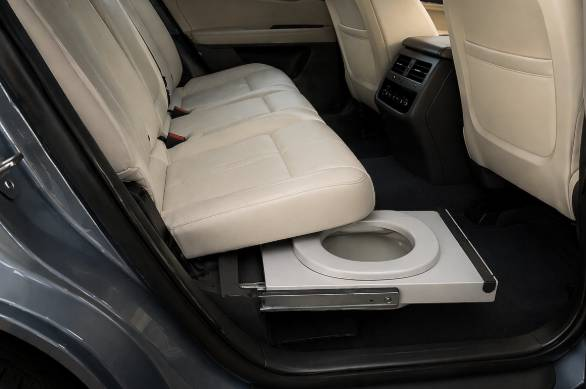
The Seres in-car toilet patent describes a compact lavatory system that deploys from beneath a passenger seat. Unlike recreational vehicles that dedicate an entire compartment to sanitation, this design is embedded within the standard seating layout of a conventional car.
The patent, filed on April 10, outlines a system that can be activated either by a button or a voice command. Once engaged, the seat effectively becomes the interface for the toilet, eliminating the need for a separate enclosed space.
This is not a product announcement. It is a protected concept. But patents often act as early signals of where companies believe the market could go.
How does the in-car toilet system work?
At its core, the system combines mechanical design with environmental controls to address hygiene, odor, and space constraints.
Deployment mechanism
The toilet unit remains hidden beneath the passenger seat during normal use. When activated, it rises into position, allowing the occupant to use it without leaving the seat.
Waste management system
The patent describes a heating element that evaporates liquid waste and dries solid waste. This approach reduces storage needs and minimizes the frequency of disposal.
Ventilation and odor control
A dedicated fan and exhaust system channels odors out of the vehicle. This is critical in a sealed cabin environment where air quality directly affects comfort.
Voice integration
Voice commands allow hands-free operation, aligning with broader in-car AI trends already seen in vehicles developed with partners like Huawei under the Aito brand.
Why would a car need an in-car toilet?
At first, the feature feels like a novelty. But zoom out, and it begins to look more like a response to changing mobility patterns.
Long-distance travel
Highway driving often means limited access to clean restrooms, especially in remote areas. An integrated solution could reduce unnecessary stops.
Camping and outdoor use
For road trips that double as overnight stays, particularly in EVs with “camp mode,” a built-in toilet removes dependence on external facilities.
Urban gridlock scenarios
In dense cities where traffic can stall for hours, the convenience factor becomes less theoretical.
Accessibility use cases
For elderly passengers or individuals with mobility challenges, leaving the vehicle frequently can be difficult. This feature could offer a practical alternative.
How is this different from RV bathrooms?
Recreational vehicles have long offered onboard bathrooms, but the approach is fundamentally different.
Space allocation
RVs dedicate a separate room for sanitation. Seres compresses the function into existing seating space.
Vehicle category
RVs are niche, large, and expensive. The Seres concept targets standard passenger vehicles, potentially expanding the feature to a wider market.
Design philosophy
RVs treat the bathroom as a necessity. This patent treats it as a modular feature that can be hidden when not in use.
The distinction matters because it signals a shift toward multi-functional interiors in everyday vehicles.
What are the biggest challenges?
Even with clever engineering, the idea faces significant hurdles before it can reach production.
Hygiene concerns
Consumers may hesitate to accept a toilet integrated into a seat they use daily. Cleaning systems would need to be exceptionally reliable.
Odor management
While the patent includes ventilation, real-world performance will determine user acceptance.
Cultural perception
Bathroom use is deeply personal and culturally sensitive. Adoption rates could vary widely across regions.
Regulatory approval
Vehicle safety and sanitation regulations differ globally. Integrating a toilet into a passenger car would likely require new compliance frameworks.
What does this say about the future of car interiors?
The Seres in-car toilet patent is less about sanitation and more about how automakers are reimagining the cabin.
Cars are increasingly becoming the following:
• Workspaces with screens and connectivity
• Entertainment hubs with immersive audio and video
• Rest zones with reclining seats and sleep modes
Adding a toilet, even as a concept, pushes the idea of the car as a self-contained environment closer to reality.
Companies like SF Motors, based in California, already operate in markets where long commutes and road trips are common. If such a feature ever moves beyond the patent stage, those markets could become testing grounds.
Is Seres likely to launch this feature soon?
There is no confirmation that Seres plans to commercialize the in-car toilet. Many patents never translate into products. They serve as intellectual property protection or exploratory design work.
However, the company’s track record in electric SUVs and its collaboration with Huawei suggest it is actively experimenting with next-generation vehicle experiences.
That makes this patent worth watching, even if it never appears in a showroom.
How should readers interpret this development?
Think of this less as “cars will have toilets soon” and more as “automakers are rethinking every inch of the cabin.”
The real takeaway is the direction of innovation:
• Maximizing utility within limited space
• Integrating features traditionally kept separate
• Designing for longer, more autonomous journeys
TL;DR
• Seres has patented an in-car toilet integrated into a passenger seat
• The system uses heating and ventilation to manage waste and odor
• It targets long trips, camping, and accessibility use cases
• Major challenges include hygiene, perception, and regulation
• The concept reflects a broader shift toward multi-functional car interiors