
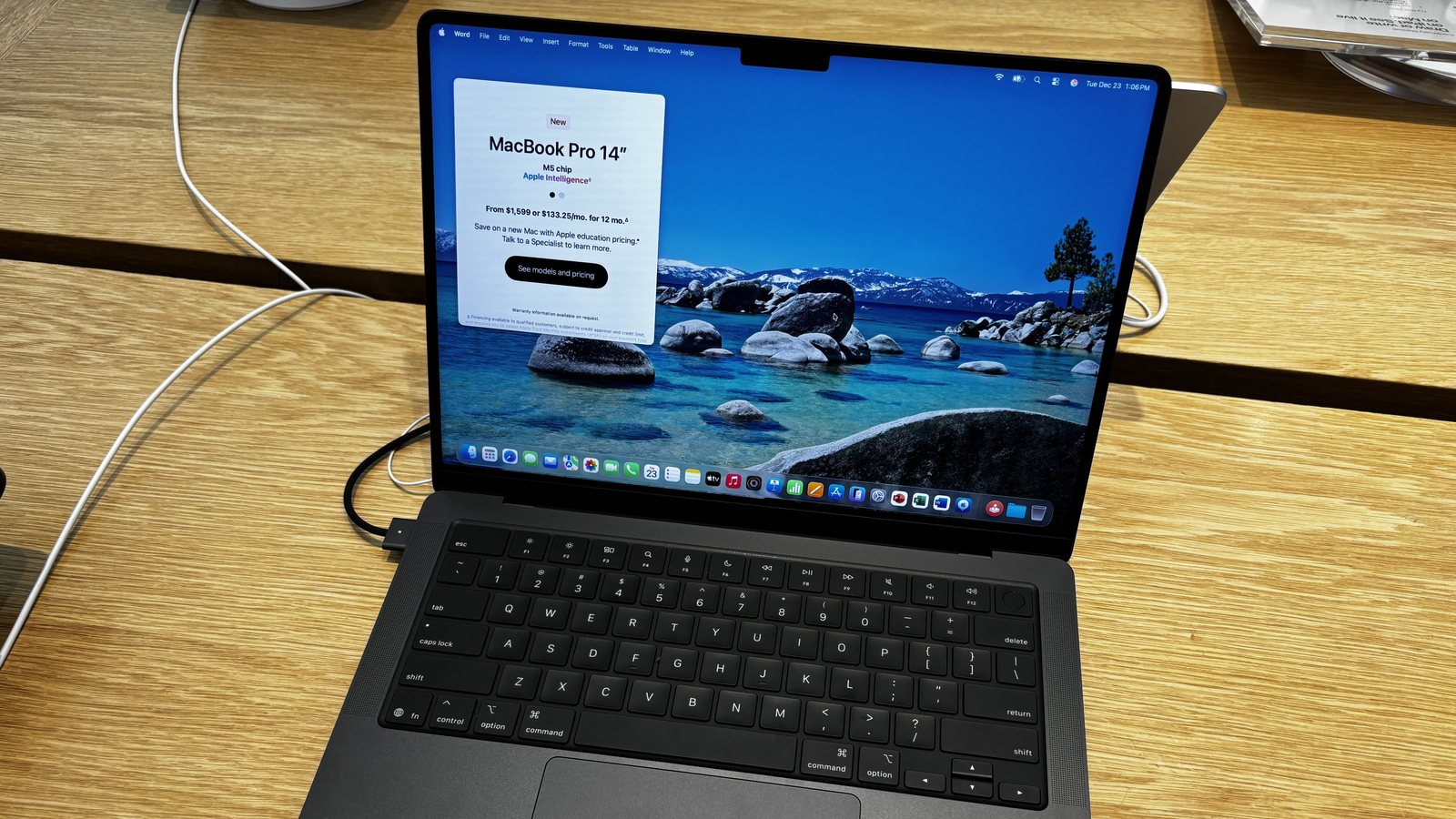

Apple will hold a “Pro and Tell” event in Los Angeles at 10 a.m. Pacific on Wednesday, October 28. Bloomberg’s Mark Gurman reports that Apple will unveil its first touchscreen MacBook Pro there. He says it comes in 14-inch and 16-inch sizes with OLED displays.
Apple itself has not said what it will announce. But if Gurman is right, MacBook Pro shoppers are two days away from a new top tier. He says it will cost “significantly” more than today’s $2,499 starting price. For most buyers, the sensible move is to wait until Wednesday afternoon, for reasons that depend on which Mac you had in mind.
What Apple has confirmed so far
Apple announced the event on Monday, October 19, Reuters reported. Invitations went to selected press, among them YouTuber Marques Brownlee, according to Macworld. Apple vice president Greg Joswiak posted a teaser on X: “Can’t wait to pro and tell next week.”
That is the full list of confirmed facts: the name, the date, the 10 a.m. Pacific start (1 p.m. Eastern) and the city. Macworld thinks it will be an “Apple Experience” of press releases and videos, not a full keynote. 9to5Mac says it “likely won’t be a streamed event.”
What Bloomberg reports about the touchscreen MacBook Pro
Almost everything known about the laptop comes from Gurman. MacRumors summarized his Power On newsletter of October 25. It says the new 14-inch and 16-inch models will have touch-enabled OLED displays.
They will look similar to today’s MacBook Pro but weigh less. A Dynamic Island, the pill-shaped cutout from the iPhone, takes the place of the camera notch at the top of the screen.
The chips are reportedly not new. Gurman has said the touch models will use the M5 Pro and M5 Max, the chips in today’s MacBook Pro. 9to5Mac reports the same.
Touch will sit alongside the keyboard and trackpad, not replace them. Gurman says Apple will pitch it as an extra input method that people can use when it makes sense.
The next version of macOS, code-named Golden Gate, adapts to how you work, according to MacRumors’ summary. It shows different controls depending on whether you last touched the screen or used the trackpad. Tapping a button can open a menu around your finger. Apple has also reworked the Dock and menu bar for touch.
A pricier tier, and a split inside Apple
The decision was “not unanimous” inside Apple, Gurman reports, according to the Free Press Journal’s summary. Company leaders felt buyers increasingly expected touch on a Mac, while the industrial design team opposed it.
The compromise is a new, pricier tier. Gurman says the touch models will carry a “significantly higher price” than current high-end MacBook Pros. He adds that the existing mini-LED models stay on sale “for now” and will eventually go.
Two other reported details matter for timing. Gulf News and 9to5Mac expect a cheaper 14-inch MacBook Pro with Apple’s newer M6 chip. Gulf News says it keeps the current design.
On his podcast, Gurman said Apple stores have a floor reset planned overnight from November 5 into November 6. Gizbot and others read that as a likely on-sale date.
Steve Jobs said vertical touch screens don’t work
Apple held this position for 16 years, and it started with Steve Jobs. At Apple’s “Back to the Mac” event on October 20, 2010, he explained why Macs would not get touch screens. “Touch surfaces don’t want to be vertical,” he said, as recorded in Gizmodo’s live blog of the event.
His argument was ergonomic. Reaching up to a screen tires the arm quickly, according to iClarified’s live notes. So touch belonged on horizontal surfaces such as trackpads.
That is the route Apple took. Its laptops got ever-larger multi-touch trackpads, and the iPad became its touch computer. The nearest a Mac came to a touch screen was the Touch Bar, a thin strip above the keyboard that arrived on the MacBook Pro in October 2016.
Gurman’s account suggests Apple has worked around Jobs’s logic rather than abandoned it. The keyboard and trackpad stay central, and touch is there for the moments when reaching for the screen is quicker.
What a MacBook Pro costs today
Apple’s online store sets the baseline for the new tier. These are the starting prices on Apple’s US store as of October 26:
- 14-inch with M5: $1,999
- 14-inch with M5 Pro: $2,499
- 16-inch with M5 Pro: $2,999
- 14-inch with M5 Max: $4,099
- 16-inch with M5 Max: $4,399
Today’s 14-inch weighs 3.4 to 3.6 pounds depending on the chip, according to Apple’s spec sheet. Its mini-LED screen reaches 1,000 nits sustained and 1,600 nits peak for HDR. Compare those numbers with the new models’ specs on Wednesday.
Apple has not given a price for the touch models. MacRumors puts the increase at up to $500, but that is its own estimate, not Gurman’s.
Who should wait, and who doesn’t need to
- Want touch or OLED? Wait. Apple should give prices on Wednesday, and the reported on-sale date is November 6.
- About to buy an M5 Pro or M5 Max MacBook Pro? Waiting two days costs nothing. The touch models reportedly use the same chips, so speed won’t justify the higher price. Gurman also says the current models stay on sale. If you bought one this week, Apple’s return policy gives you 14 calendar days from delivery.
- Looking at the $1,999 base 14-inch? Wait as well. The reported M6 model would bring a newer chip in the same design. Apple has not said what it will cost.
- Need a laptop for work this week? Buy what you need. Nothing reported changes the keyboard, trackpad or chips of the models in stores now.
There is also the usual case for patience with any first-generation Apple design. The iPhone Duo, Apple’s first foldable, went on sale on October 23 at $1,999. Within a day, a handful of owners posted photos of inner screens cracked along the hinge.
Nobody has shown how common that is, but early buyers carry the risk of problems nobody has found yet. A touch-friendly macOS is also brand new, and most Mac apps today assume a pointer.
Apple’s news should land at 10 a.m. Pacific on Wednesday, October 28. We will update this article with the confirmed prices, specs and on-sale date once Apple publishes them.