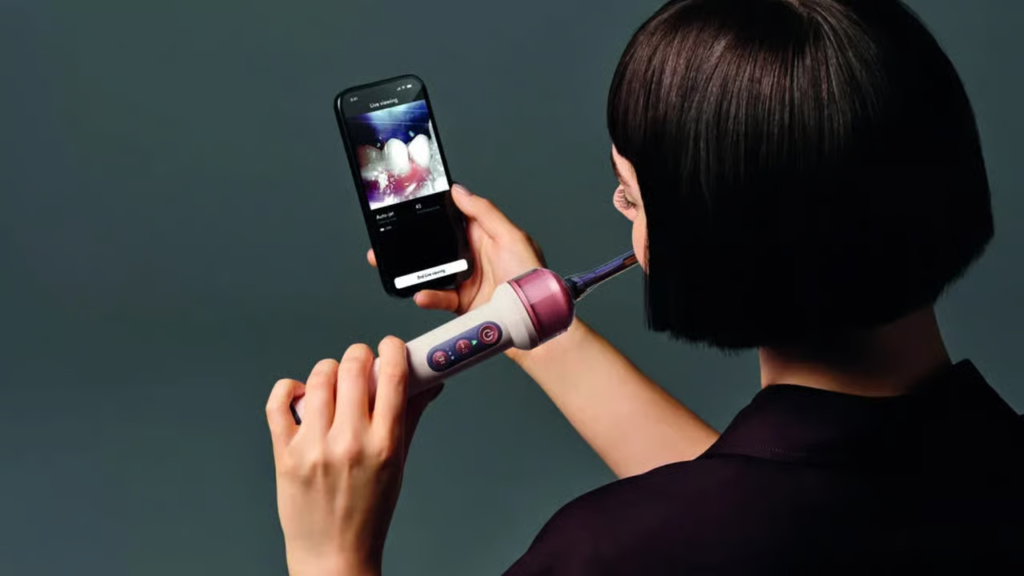
Dyson has brought its engineering-heavy approach to an unexpected part of the bathroom: the toothbrush.
The company has launched the Dyson CameraJet, a $499.99 electric toothbrush with a built-in intraoral camera, artificial intelligence and a precision mouth-rinse jet designed to clean between teeth while you brush. Founder James Dyson unveiled the device in Paris on September 1, marking the company’s entry into the oral-care market.
Rather than simply monitoring how someone brushes, CameraJet uses a tiny camera to look inside the mouth, identify gaps between teeth and direct a jet of liquid toward those spaces.
The result is a toothbrush that attempts to combine brushing, flossing, rinsing and real-time visual feedback in one device.
What is the Dyson CameraJet toothbrush?
The CameraJet is built around a system Dyson calls Gap Optical Targeting.
At its center is a 100,000-pixel macro-lens camera integrated into the brush head. The camera captures 28 images per second, while an AI-powered machine-learning system analyzes those images to identify, track and predict spaces between the user’s teeth.
When the system identifies a gap, it can trigger a targeted burst of mouth rinse.
Dyson says the process can happen within 100 milliseconds, allowing the toothbrush to direct the jet at the gap while the user continues brushing.
In other words, the camera isn’t there simply to make the toothbrush look futuristic. It is being used as the device’s targeting system.
How does the CameraJet’s AI flossing system work?
The technology follows a relatively simple sequence:
- The camera scans the teeth as the user brushes.
- Machine learning analyzes the images to identify interdental gaps.
- The system tracks the gap as the brush moves.
- A precision jet fires mouth rinse toward the targeted space.
- The brush continues cleaning the teeth and gumline simultaneously.
Dyson says its machine-learning system runs on 16 million lines of code and was trained using more than 470,000 dental images collected during development.
The system is also designed to compensate for one of the practical problems with liquid flossing: the toothbrush can be held at different angles.
A diaphragm pump and what Dyson calls an anti-gravity tank are designed to maintain consistent liquid delivery regardless of the brush’s orientation. The system can deliver up to 0.15 milliliters of liquid in a targeted burst.
The camera also streams what is happening inside the mouth
The camera doubles as an intraoral camera.
When connected to the MyDyson app, users can view a live image of their teeth while brushing—essentially giving them a miniature version of the view a dentist might get with an intraoral camera.
The app can also provide:
- Guided cleaning sessions
- Coverage mapping
- Brushing and flossing insights
- Personalized feedback
- Live viewing of the mouth
- Technique guidance
The CameraJet connects through 2.4GHz Wi-Fi and Bluetooth.
How much plaque does the Dyson CameraJet remove?
Dyson claims the CameraJet can remove up to 69% more plaque than market-leading electric toothbrushes in certain laboratory testing. (Dyson)
That number needs some context.
The company’s own product documentation says the comparison was based on laboratory testing, including testing in hard-to-reach areas, rather than a blanket claim that every user will remove 69% more plaque in everyday brushing.
Dyson also says the CameraJet has been clinically tested. Its website cites a six-week clinical study involving 204 participants, comparing the device in Brush and Auto-jet mode with a manual toothbrush.
That distinction matters when evaluating the product. Laboratory plaque-removal figures and clinical outcomes are not interchangeable.
What makes the brush head different?
The CameraJet uses a dual-bristle brush head designed for two different cleaning jobs.
The inner bristles are firmer and intended to help lift surface stains, while the softer outer bristles are designed to clean along the gumline more gently.
The brush also uses variable sonic oscillation designed to keep the bristles moving rather than stalling under pressure.
Dyson says the motor oscillates at 245 times per second, while the brush head is engineered to maintain constant motion.
The brush heads also contain RFID technology. This allows the toothbrush to recognize the attached head and alert the user when it needs replacing. Dyson says each brush head is designed for approximately three months of use.
Why does Dyson include special toothpaste and mouth rinse?
The camera creates an unusual requirement for an oral-care product: the device needs to see through the toothpaste and rinse while it is working.
Traditional toothpaste produces foam that could obstruct the camera’s view.
Dyson has therefore developed a non-foaming toothpaste intended to provide clearer visibility for the camera system. The company says its proprietary oral-care formulations are engineered to work with CameraJet, although the toothbrush can be used with other dental products. (Dyson)
The company has also introduced its own mouth rinse for the system.
That creates a broader Dyson ecosystem around the toothbrush: the hardware, brush heads, toothpaste, mouth rinse and MyDyson app are designed to work together.
What about privacy?
Putting a camera inside a toothbrush naturally raises privacy questions.
Dyson says the CameraJet’s images are not recorded or stored on the toothbrush or in the cloud. The company also says it cannot access the images and that third parties cannot access them.
The camera is active during live viewing or when the automatic jetting function is operating, according to Dyson.
That makes the privacy architecture an important part of the product, especially because the device is effectively filming inside a person’s mouth.
Users can also view the live footage through the MyDyson app, giving the camera a purpose beyond automated flossing.
Why is Dyson entering the toothbrush market?
Dyson has spent decades taking ordinary household products and redesigning them around engineering challenges.
Its vacuum cleaners, fans, hair dryers and styling tools have all followed that approach. CameraJet applies the same philosophy to oral care: identify a problem—difficulty cleaning between teeth—and build technology around it.
The company says nine out of 10 people do not floss as regularly as they should, making interdental cleaning a potentially significant problem for a toothbrush that aims to combine brushing and flossing.
The underlying idea is straightforward: instead of relying on users to remember to floss separately, CameraJet attempts to make interdental cleaning part of the brushing process itself.
That could be the product’s biggest selling point.
The $499 price could be the biggest hurdle
At $499.99, CameraJet is entering the oral-care market at a premium price point.
For comparison, consumers can already buy electric toothbrushes and water flossers separately for substantially less.
Dyson is therefore betting that consumers will pay for a combination of:
- A high-end electric toothbrush
- Automated liquid flossing
- An intraoral camera
- AI-powered targeting
- A connected smartphone experience
- Personalized brushing feedback
Whether that combination provides enough additional value to justify the price will likely determine how broadly the technology is adopted.
The proposition is particularly interesting for people who struggle with conventional flossing. For others, a $500 toothbrush may look more like an engineering showcase than an essential bathroom upgrade.
Is the Dyson CameraJet actually replacing floss?
Not necessarily.
Dyson describes the system as precision-flossing with mouth rinse, but that should not automatically be interpreted as meaning it replaces every form of interdental cleaning recommended by dental professionals.
The device is designed to direct liquid into gaps between teeth, while conventional floss physically contacts the tooth surfaces.
Consumers should therefore distinguish between Dyson’s product claims and independent dental guidance about the most appropriate interdental-cleaning method for an individual.
The strongest claim that can currently be made is that CameraJet is designed to integrate interdental cleaning into the brushing process, rather than requiring users to perform it as a separate step.
When is the Dyson CameraJet available?
Dyson says the CameraJet launched on September 1, 2026, through Dyson’s website, Dyson Demo Stores and selected retailers. It is available in Ceramic Ultra Blue and Ceramic Pink.
The CameraJet itself is priced at $499.99 on Dyson’s US website.
The package includes the toothbrush and associated components of Dyson’s dental system, including the charging dock and travel case, with Dyson’s toothpaste and mouth rinse designed to complement the device.
The bigger idea behind Dyson’s camera toothbrush
The most interesting part of CameraJet may not be the toothbrush itself.
Dyson is experimenting with a different model of personal-care technology—one in which a device can see what the user is doing, interpret it and respond immediately.
A conventional electric toothbrush tells a user how long they have brushed. A smart toothbrush might tell them where they missed.
CameraJet takes that concept further by attempting to identify a specific physical target—the gap between two teeth—and automatically direct a cleaning action toward it.
Whether that represents the future of oral care or an exceptionally elaborate solution to brushing remains to be seen.
But Dyson has certainly made the toothbrush a lot more complicated than it used to be.
TL;DR
Dyson’s $499.99 CameraJet is an electric toothbrush with a 100,000-pixel camera, AI-powered Gap Optical Targeting and a precision mouth-rinse jet. The camera scans 28 images per second, identifies gaps between teeth and can trigger a targeted liquid burst within 100 milliseconds.
Dyson claims up to 69% greater plaque removal than market-leading electric toothbrushes under specified laboratory conditions and says its system was trained using more than 470,000 dental images.
The camera can also provide live intraoral footage through the MyDyson app, while Dyson says the images are not stored on the device or in the cloud.
At $499.99, however, CameraJet is betting that consumers will pay a substantial premium for combining brushing, liquid flossing, imaging, and AI in a single device.