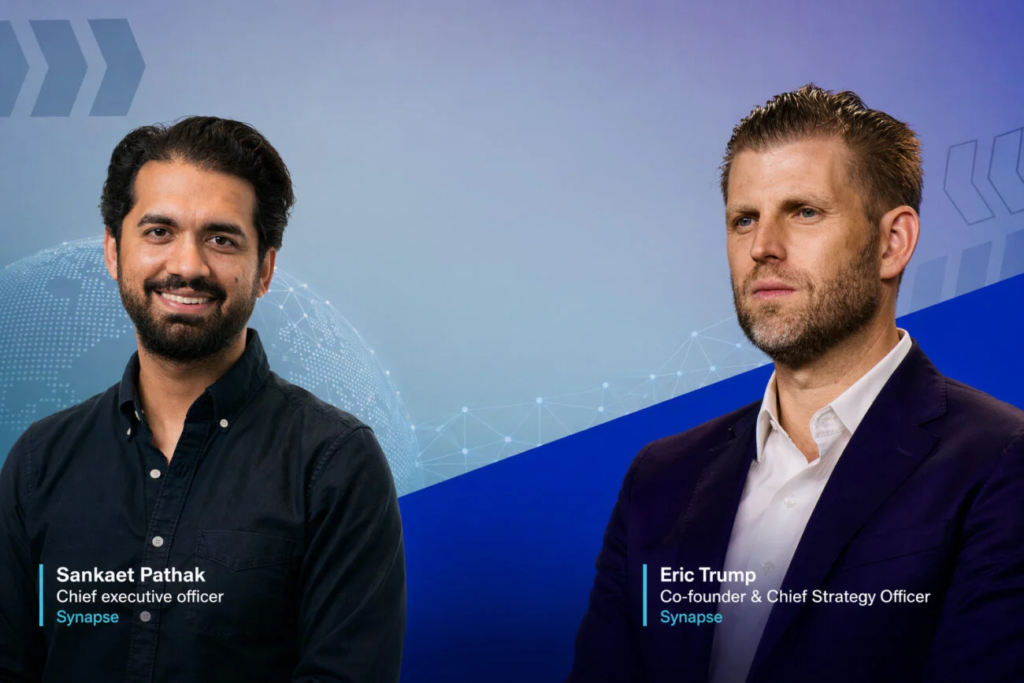
Sankaet Pathak is an Indian-American robotics entrepreneur whose company, Foundation Future Industries, is developing humanoid robots for industrial and military use. Unlike many humanoid robotics startups focused primarily on factories, warehouses or household tasks, Pathak has made defense a central part of the company’s strategy.
That ambition has already taken the technology into one of the world’s most active war zones. In early 2026, Foundation sent two Phantom MK-1 humanoid robots to Ukraine for testing in hazardous areas, including frontline reconnaissance and logistics missions. The deployment has been described by multiple reports as one of the first known tests of humanoid robots in an active combat theater.
Sankaet Pathak is now pushing the idea further. His company is talking with U.S. national-security agencies about potential applications for its robots, including surveillance and reconnaissance along the U.S.-Mexico border. At the same time, Pathak has openly discussed eventually giving the machines military capabilities.
The result is a robotics company operating at the intersection of artificial intelligence, defense and geopolitics — and a founder whose vision is considerably more ambitious than simply building a robot that can walk like a person.
Who is Sankaet Pathak?
Sankaet Pathak is the founder and CEO of Foundation Future Industries, a San Francisco-based robotics company established in 2024.
Pathak’s background is rooted in robotics and artificial intelligence, and he has positioned Foundation around a straightforward proposition: humanoid robots should be capable of performing tasks that are dangerous, difficult or expensive for people.
That philosophy applies to industrial environments as well as military operations.
In an interview with Reuters, Pathak described the company’s long-term objective as building fully autonomous robots capable of both industrial and defense work. The robot’s movement and walking systems are already designed to operate autonomously, while other aspects of the system remain on a path toward greater autonomy.
Pathak’s argument is that humanoids have an unusual advantage because the world around them has largely been designed for humans.
A human-shaped machine can potentially:
- Walk through buildings and uneven terrain
- Use stairs and doors
- Pick up and carry objects
- Handle tools designed for people
- Move supplies
- Enter dangerous areas without immediately putting a human operator at risk
That makes the technology potentially useful in factories, warehouses and disaster zones. But the same characteristics also make humanoids interesting to militaries.
What is Foundation Future Industries building?
Foundation’s flagship platform is the Phantom humanoid robot.
The first-generation Phantom MK-1 was designed as a general-purpose humanoid capable of working in industrial and defense environments. The company has increasingly emphasized military applications, describing its broader mission in unusually direct terms.
Foundation’s own defense-focused materials now market humanoids for war-related applications and highlight government work involving the Navy, Air Force and Army.
The company’s strategy differs from the approach taken by many better-known humanoid robotics companies.
Instead of asking only whether a robot can perform repetitive factory work, Foundation is asking whether the same basic platform can eventually perform dangerous jobs that currently require soldiers or other personnel.
That includes:
- Reconnaissance
- Logistics and resupply
- Handling equipment
- Inspection
- Operating in hazardous environments
- Potentially, combat-related missions
The distinction is important. Foundation’s current public reporting does not establish that Phantom robots are independently selecting and killing human targets. Much of the testing reported in Ukraine has involved logistics and reconnaissance, while the company has described human involvement in its systems.
Were humanoid robots actually sent to the Russia-Ukraine front?
Yes, but the details matter.
Foundation sent two Phantom MK-1 robots to Ukraine in February 2026 for testing. Reports said the initial objective was to determine whether humanoids could perform useful tasks in dangerous areas, including frontline reconnaissance and logistics.
Some reports have characterized this as the first known deployment of humanoid robots in an active combat theater. That description should be treated carefully: it refers to the reported deployment and testing of humanoids, not to a large-scale deployment of autonomous robot soldiers.
The Ukrainian testing was essentially a real-world stress test.
A battlefield presents problems that laboratories and factories cannot easily reproduce:
- Unpredictable terrain
- Dust and water
- Extreme weather
- Damaged buildings
- Limited communications
- Explosions and shock
- Unstable surfaces
- The need to operate around humans and military equipment
Testing a humanoid under these conditions can reveal weaknesses that would remain invisible in a controlled demonstration.
Reports from the Ukrainian trials indicate that the Phantom robots were used for logistics tasks, including moving supplies in dangerous areas.
Consider adding an infographic here showing the Phantom MK-1’s reported Ukraine testing timeline, from delivery to frontline reconnaissance and logistics trials.
Why does Sankaet Pathak want humanoid robots in war?
Pathak’s central argument is not that humanoids are better weapons than missiles, artillery or drones.
It is that they could eventually perform specific missions where sending a human soldier would be unnecessarily dangerous.
In comments reported by Euronews, Sankaet Pathak argued that humanoids make the most sense for precision missions where the objective is to avoid unnecessary destruction and civilian casualties rather than simply maximize destructive power.
That is a different proposition from the Hollywood image of an army of robots storming a battlefield.
A humanoid could theoretically be sent into a damaged building to inspect rooms, retrieve equipment or investigate a suspected threat before a human enters.
It could also move supplies through an area exposed to enemy fire, potentially reducing the number of soldiers required for dangerous logistical missions.
Pathak has argued that increasingly dangerous ground combat creates a potential role for robotic systems that can operate where human soldiers cannot safely go.
Is Foundation building armed robot soldiers?
The company has made clear that it is exploring military capabilities, although the current Phantom deployment should not be confused with an autonomous robot army.
Pathak told WIRED that Foundation was exploring what he described as “kinetic” capabilities, a reference to weapons systems, and said the company expected to reveal more.
The company has also discussed the possibility of humanoids eventually taking on combat functions.
That does not necessarily mean the machines would independently decide whom to attack.
The distinction between an autonomous platform and an autonomous weapon is critical. A robot can autonomously walk, recognize objects or carry a package while still requiring a human to authorize the use of lethal force.
That distinction is likely to remain central to any future deployment of humanoid military systems.
The debate also sits within a much larger international discussion about lethal autonomous weapons. The United Nations has been discussing autonomous weapons systems under the framework of international humanitarian law, including questions surrounding human control and the distinction between combatants and civilians.
Could Sankaet Pathak’s robots patrol the U.S.-Mexico border?
Potentially, but there is currently no confirmed DHS contract for such a deployment.
Pathak has said Foundation is in discussions with U.S. national-security agencies, including the Department of Homeland Security, Army, Navy and Air Force. He has also discussed using humanoids for border surveillance in places where drones, cameras and fixed observation posts may have limitations.
The concept is straightforward.
A robot could potentially patrol terrain, identify people or unusual activity and transmit information to human officers. It could also investigate areas that are difficult or dangerous for personnel to reach.
But reports indicate that DHS has said it currently has no non-contractual agreements, pilots or active prime contracts with Foundation. That means talk of a potential border deal should not be presented as an awarded government contract.
Consider linking here to a separate article explaining how AI surveillance and autonomous systems are being used at the U.S.-Mexico border.
What role does Eric Trump play?
Foundation has attracted attention partly because of its connection to Eric Trump, the son of U.S. President Donald Trump.
Eric Trump became an investor in Foundation and serves as its chief strategy adviser. Reuters reported in July that Foundation and AMD had also entered a partnership to develop next-generation humanoid robots for military and industrial applications.
The political connection has inevitably increased scrutiny around the company’s ambitions in the defense sector.
However, a relationship with a politically connected investor should not itself be treated as evidence that Foundation has secured a particular government contract.
That distinction is especially important because the company is actively seeking military business while government agencies have publicly indicated that some proposed relationships remain under discussion.
How capable is the Phantom robot?
The technology is advancing quickly, but it remains far from the fully autonomous robot soldier imagined in science fiction.
Foundation’s second-generation Phantom 2 is being developed with significantly greater capabilities than the MK-1.
According to Euronews, the company has been working toward a robot with:
- A payload capacity of roughly 80 kilograms, compared with about 25–30 kilograms for the earlier generation
- A 3-kilowatt-hour battery
- Greater tolerance for falls and physical impacts
- Waterproof and dustproof construction
- Improved suitability for outdoor environments
The company has also announced plans to use AMD’s Ryzen AI Embedded X100 processors in the Phantom MK-2 platform. Reuters reported that Foundation plans to scale manufacturing substantially, with a new facility expected to support production of thousands of robots annually.
These improvements matter because a military robot needs to survive conditions that are much harsher than a factory floor.
A robot that performs well indoors but cannot tolerate rain, dust, falls or prolonged outdoor operation has limited battlefield value.
What are the biggest problems with humanoid war robots?
The biggest challenge may not be whether a robot can walk. It may be whether it can reliably keep working.
Battery life remains a major limitation.
Humanoid robots need substantial energy to move their limbs, balance themselves and carry heavy loads. A military robot operating far from a charging station creates an immediate logistical problem.
Other challenges include:
Reliability
A battlefield is an unforgiving environment. A robot that falls, loses communications or suffers sensor damage at the wrong moment could become useless.
Mobility
Humanoid legs allow a machine to navigate environments designed for humans, but legs are also mechanically complicated. Wheeled vehicles are generally more efficient on suitable terrain.
Weather resistance
Outdoor military systems must handle rain, mud, dust and extreme temperatures. Foundation has been working on more rugged versions of Phantom, but that remains an important engineering challenge.
Communications
A sophisticated robot may depend on communication with operators or remote infrastructure. Jamming, damaged networks and battlefield interference could compromise that connection.
Autonomy and decision-making
The closer these machines move toward weapons use, the more difficult the ethical and legal questions become.
A system that can identify objects is one thing. A system that can independently decide that a person is a legitimate target is an entirely different category of technology.
Why does this matter beyond the battlefield?
The significance of Foundation’s work extends beyond whether humanoid robots become soldiers.
Military environments often accelerate technologies that later find civilian applications.
Robots developed to carry supplies under fire could eventually be useful for disaster response. Machines designed to enter dangerous buildings could be deployed after earthquakes or industrial accidents. Robots capable of navigating damaged infrastructure could assist emergency crews.
The reverse is also possible.
Advances made for industrial robots — better batteries, motors, sensors, computer vision and AI — can make military robots cheaper and more capable.
That is why the Foundation story is not simply about one startup building a futuristic soldier.
It is about the convergence of three rapidly developing technologies: humanoid robotics, physical AI and autonomous military systems.
What happens next for Sankaet Pathak and Foundation?
Foundation is pursuing two tracks simultaneously.
The first is commercial robotics. The company has positioned Phantom as a machine capable of working in industrial environments, where businesses can potentially use humanoids for tasks that are repetitive or hazardous.
The second is defense.
Foundation has tested its robots in Ukraine, is discussing potential applications with U.S. national-security agencies and is developing more capable versions of Phantom. Reuters also reported that the company has government contracts and is expanding its manufacturing ambitions.
The next major test will be whether the technology can move from demonstrations and pilots to dependable, repeatable operations.
That is a much higher bar.
For now, Sankaet Pathak is not commanding an army of robot soldiers. But he is helping turn an idea once associated almost entirely with science fiction into an engineering and procurement question.
The more important question may no longer be whether humanoid robots can enter war zones.
They already have.
The question is how much responsibility humans are eventually willing to give them once they get there.
TL;DR
Sankaet Pathak is the Indian-American founder and CEO of Foundation Future Industries, a San Francisco robotics startup developing humanoid machines for industrial and military applications.
In early 2026, Foundation sent two Phantom MK-1 robots to Ukraine for testing in hazardous areas, including reconnaissance and logistics. The company has described this as an early step toward using humanoids in military environments.
Pathak has also discussed potential U.S. government applications, including border surveillance, while acknowledging that discussions with agencies such as DHS have not yet resulted in a confirmed DHS contract.
The company is developing Phantom 2 with greater payload capacity, improved durability and more advanced AI hardware. At the same time, Pathak has openly discussed exploring future weapons capabilities.
For now, the technology remains constrained by battery life, reliability, communications, mobility and the unresolved legal and ethical questions surrounding autonomous weapons.