

As the race to dominate artificial intelligence intensifies, Meta is embracing an unconventional solution to one of the industry’s biggest bottlenecks: construction time. The company is building parts of its next-generation AI infrastructure inside massive weatherproof tents, a strategy designed to get computing power online months faster than traditional data centers.
The approach may sound unusual, but it reflects a growing reality in the AI industry: access to computing capacity has become so valuable that speed often matters more than aesthetics.
Why is Meta using tents for data centers?
Meta refers to the structures as “rapid deployment structures,” but they are essentially industrial-scale weatherproof tents designed to house AI servers and networking equipment.
According to reports, several of these structures have already been completed outside New Albany, Ohio, as part of the company’s expanding AI infrastructure footprint.
The primary reason is simple: traditional data centers take too long to build.
A conventional hyperscale facility can require:
- Extensive permitting
- Concrete and steel construction
- Complex cooling systems
- Utility upgrades
- Months or years of engineering work
By contrast, tent-like structures can be assembled far more quickly, allowing Meta to deploy computing capacity while permanent infrastructure continues to be developed.
The company reportedly expects the strategy to cut completion timelines by roughly 50%.
Why speed matters in the AI race
The AI industry is facing an unprecedented infrastructure crunch.
Companies such as:
- Meta
- Microsoft
- Amazon
- OpenAI
- xAI
are competing for access to massive quantities of computing power needed to train and run increasingly sophisticated AI models.
Every month of delay can mean:
- Slower AI development
- Lost competitive advantage
- Reduced capacity for new products
- Higher operating costs
For Meta CEO Mark Zuckerberg, getting AI hardware online quickly has become a strategic priority.
The company is investing heavily in infrastructure as it seeks to compete with rivals in large language models, generative AI, and advanced reasoning systems.
What is inside these AI tents?
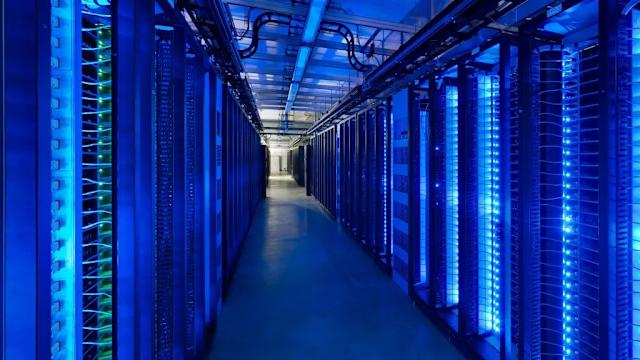
While the structures may resemble oversized warehouses or temporary event facilities from the outside, their contents are anything but temporary.
Inside are likely thousands of advanced AI accelerators and graphics processors.
These chips perform the enormous calculations required for:
- Training AI models
- Running chatbots
- Generating images and videos
- Powering recommendation systems
- Supporting future AI agents
Industry analysts estimate that the hardware inside a single AI facility can be worth hundreds of millions or even billions of dollars.
The tents essentially serve as protective shells that allow equipment deployment before permanent buildings are completed.
The Tesla connection
Meta’s strategy has drawn comparisons to Tesla’s famous manufacturing gamble in 2018.
When Tesla faced production delays while ramping up the Model 3, the company erected a giant assembly line inside a temporary sprung structure outside its California factory.
At the time, critics questioned the move.
Yet the solution helped Tesla increase production and overcome a major bottleneck.
Meta appears to be applying a similar philosophy: build quickly, deploy immediately, and optimize later.
In industries where time equals competitive advantage, unconventional infrastructure can become a strategic asset.
Powering the AI boom
Building the structures is only part of the challenge.
Supplying electricity has become an equally important concern.
Reports indicate that the Ohio site is supported by approximately 200 megawatts of modular gas-turbine generation.
To put that in perspective, 200 megawatts can supply electricity to tens of thousands of homes.
Modern AI systems consume enormous amounts of energy because advanced processors operate continuously during training and inference workloads.
Why does AI require so much electricity
Training a frontier AI model involves processing vast datasets across thousands of chips simultaneously.
These systems require power for:
- Computation
- Cooling
- Networking
- Storage
- Backup systems
As AI models grow larger, energy demand grows alongside them.
This has sparked a global race among technology companies to secure access to power generation, transmission capacity, and suitable land for future facilities.
Is this becoming an industry trend?
Meta is not alone in exploring unconventional approaches.
Across the technology sector, companies are increasingly experimenting with:
- Modular data centers
- Prefabricated facilities
- Containerized computing systems
- Temporary deployment structures
- On-site power generation
The goal is to compress development timelines while meeting surging AI demand.
What once took years is now expected in months.
The new bottleneck isn’t chips
Until recently, the biggest challenge in AI was obtaining advanced semiconductors.
Today, many experts argue that infrastructure has become the largest constraint.
Companies may secure thousands of GPUs, but they still need:
- Buildings
- Electricity
- Cooling systems
- Fiber connectivity
- Regulatory approvals
Rapid deployment structures help address one piece of that puzzle.
The irony: Fast infrastructure, slower software
While Meta is accelerating physical construction, reports suggest the company has faced delays in making some AI products available to developers.
According to recent reporting, Meta’s latest AI models may be ready internally, but software tools and application programming interfaces (APIs) needed for broader developer access have experienced repeated delays.
The contrast highlights a broader challenge facing the AI industry.
Building infrastructure is only one part of the equation.
Success also depends on:
- Reliable software
- Developer tools
- Model performance
- Product integration
- User adoption
Massive computing power alone does not guarantee success.
Why investors are paying attention
Meta’s infrastructure spending plans have attracted significant attention from Wall Street.
The company is expected to invest heavily in AI-related capital expenditures over the coming years, including data centers, networking systems, power infrastructure, and advanced computing hardware.
Investors view these expenditures as a signal that Meta intends to remain a major player in the AI race rather than cede ground to competitors.
The tent strategy reflects a broader mindset increasingly visible across the technology sector: move fast, deploy capacity quickly, and solve optimization challenges later.
What this means for the future of data centers
The image of billion-dollar AI hardware operating inside giant tents may seem surprising today.
However, it may represent the beginning of a broader transformation in how data centers are built.
Historically, data centers prioritized permanence, efficiency, and architectural planning.
The AI era has introduced a new priority: speed.
As demand for computing power continues to surge, temporary and modular infrastructure could become a common sight across the technology industry.
For Meta, the tents are not merely a construction shortcut. They are a symbol of how urgently tech companies are racing to secure the computing power needed for the next generation of artificial intelligence.
TL;DR
Meta is building parts of its AI infrastructure inside giant weatherproof tents to accelerate data center deployment by as much as 50%. The strategy allows the company to bring valuable computing capacity online faster as competition in artificial intelligence intensifies. While unconventional, the approach reflects a growing industry belief that speed has become one of the most important advantages in the AI race.




