
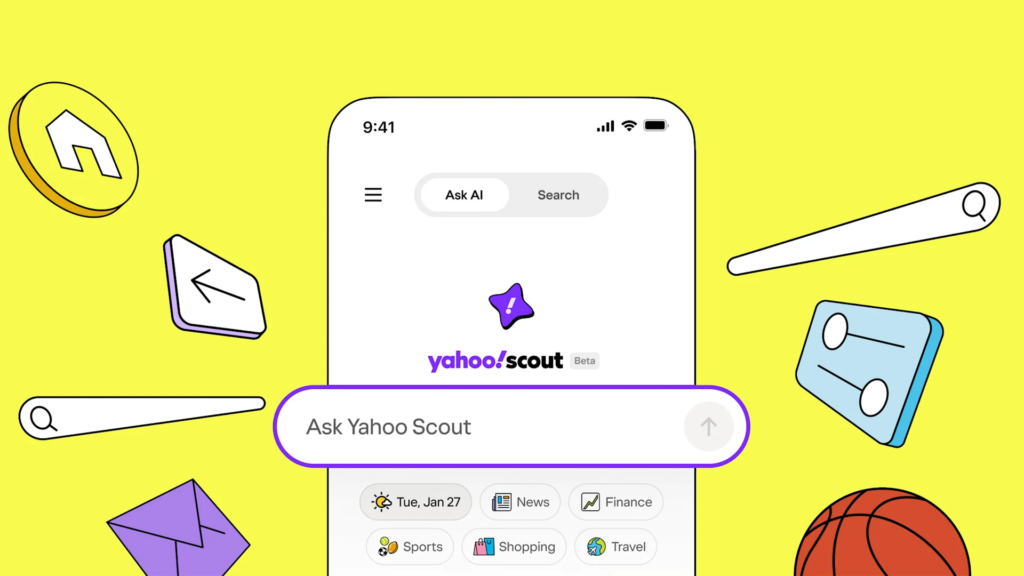
Yahoo is back in the search conversation—this time with artificial intelligence at the center.
The company has launched Yahoo Scout AI Search, a new AI-powered search experience designed to compete directly with Google’s AI Mode, Perplexity, and ChatGPT’s real-time search. Instead of serving a familiar list of blue links, Scout aims to answer questions outright, using natural language and context rather than keywords.
It’s a notable shift for a brand many associate with early internet portals. And it signals something bigger: Yahoo believes the future of search isn’t about finding pages—it’s about getting answers.
What Is Yahoo Scout AI Search?
Yahoo Scout AI search is an AI-driven search engine that synthesizes information from three main sources:
- The open web
- Yahoo’s own content ecosystem
- Aggregated user data and insights
The goal is to deliver clear, concise responses to user questions, written in natural language, without forcing people to click through multiple sites.
Instead of typing fragmented keywords like “best stocks Q4 earnings,” users can ask full questions such as:
“How did Tesla’s stock react after its last earnings call?”
Scout is built to understand that intent—and respond accordingly.
How Does Yahoo Scout Work Behind the Scenes?
A data-heavy foundation
Yahoo says Scout is informed by:
- 500 million user profiles
- A knowledge graph spanning more than one billion entities
That scale matters. It allows Scout to connect people, places, companies, events, and trends in ways that go beyond basic text matching.
For example, when users ask about an upcoming NFL game, Scout can pull from:
- Yahoo Sports coverage
- Historical performance data
- Recent news and injury reports
- Real-time stats
The result is a synthesized answer, not a collection of links.
Information synthesis, not summarization
Unlike basic AI summaries, Scout blends:
- Reporting from Yahoo’s owned-and-operated properties
- Authoritative web sources
- Contextual signals based on how users typically search and read
This position Scout closer to an “answer engine” than a search index.
Why Yahoo Thinks It Can Compete in AI Search
Yahoo isn’t entering AI search from scratch.
Three decades of search experience
Yahoo has been operating search products for over 30 years. While it hasn’t dominated in recent decades, that history gives it:
- Deep institutional knowledge of search behavior
- Massive archives of content across news, finance, sports, and lifestyle
- Long-standing infrastructure partnerships
According to CEO Jim Lanzone, Scout’s beta launch is “just the beginning.” His pitch is speed and usefulness: helping users accomplish tasks faster, across Yahoo’s verticals.
That’s a subtle but important distinction. Yahoo isn’t trying to replace everything Google does, it’s trying to win on intent-driven tasks.
What Can Yahoo Scout Do Right Now?
Scout’s early capabilities focus on high-frequency use cases where people want quick clarity.
Everyday tasks Scout is built for
Users can ask Scout to help with:
- Travel planning: Understanding weather patterns before a vacation
- Sports: Game previews, scores, and performance breakdowns
- Finance: Stock price movements after earnings
- Shopping: Comparing products without opening multiple tabs
- News: Fact-checking or contextualizing breaking stories
Each response is designed to be direct, readable, and grounded in sources.
How Yahoo Scout Handles Shopping Comparisons
A built-in product research assistant
Yahoo Scout includes a shopping feature that distills insights from:
- Expert reviews
- Editorial articles
- Brand comparisons
Instead of browsing five review sites, users get an instant comparison—plus shoppable links—inside the Scout interface.
This puts Scout squarely in competition with
- Google Shopping
- Amazon’s product search
- AI tools like Perplexity’s shopping answers
The difference is Yahoo’s emphasis on editorial context rather than just price and specs.
What Makes Yahoo Scout Different for Finance Users?
Yahoo Finance has long been one of the platform’s strongest assets—and Scout leans heavily into it.
One-click financial insights
Scout’s Yahoo Finance integration provides:
- Real-time company news
- Analyst ratings
- Financial statements
- Earnings call summaries
Headlines refresh every 10 minutes, making it useful for active investors and casual market watchers alike.
Rather than jumping between charts, articles, and filings, users can ask direct questions like:
“Why did Apple stock drop today?”
Scout handles the synthesis.
Why Yahoo Partnered With Anthropic and Microsoft
Yahoo didn’t build Scout alone—and that’s by design.
Claude powers the AI reasoning
Yahoo has partnered with Anthropic, using Claude as Scout’s primary foundational AI model. Claude is known for:
- Strong reasoning and summarization
- Lower hallucination rates compared to some models
- Safer handling of complex queries
Bing provides grounding and sources
Yahoo is also leveraging its long-standing relationship with Microsoft, using Bing’s grounding API. This ensures Scout’s answers are backed by authoritative web sources, not just generative text.
Together, these partnerships aim to solve one of AI search’s biggest problems: trust.
Why Yahoo Scout AI Search Matters
AI search is no longer a future concept—it’s happening now.
Google, OpenAI, and startups like Perplexity are racing to redefine how people find information. Yahoo Scout adds a new dynamic to that race by combining:
- AI-generated answers
- Editorial content
- Deep vertical expertise
If Scout succeeds, it could shift Yahoo from being a legacy portal to a task-oriented AI assistant—especially for finance, sports, and shopping.
More broadly, it reflects a growing trend: search engines are becoming decision engines.
Where Is Yahoo Scout Available?
For now, Yahoo Scout is limited to the US.
Current availability
- Accessible at Scout.Yahoo.com
- Available through the Yahoo Search app on iOS and Android
- Nearly 250 million US users already have access
Yahoo says expanded capabilities and deeper personalization features are coming in the months ahead.
TL;DR
- Yahoo Scout AI search replaces links with direct answers
- It uses Yahoo content, web sources, and user insights
- Powered by Anthropic’s Claude and Microsoft Bing grounding
- Strong focus on finance, shopping, sports, and news
- Available now in the US, with expansion planned
Yahoo isn’t trying to out-Google Google. It’s betting that clarity, context, and speed still matter—and that search doesn’t have to feel like work.