
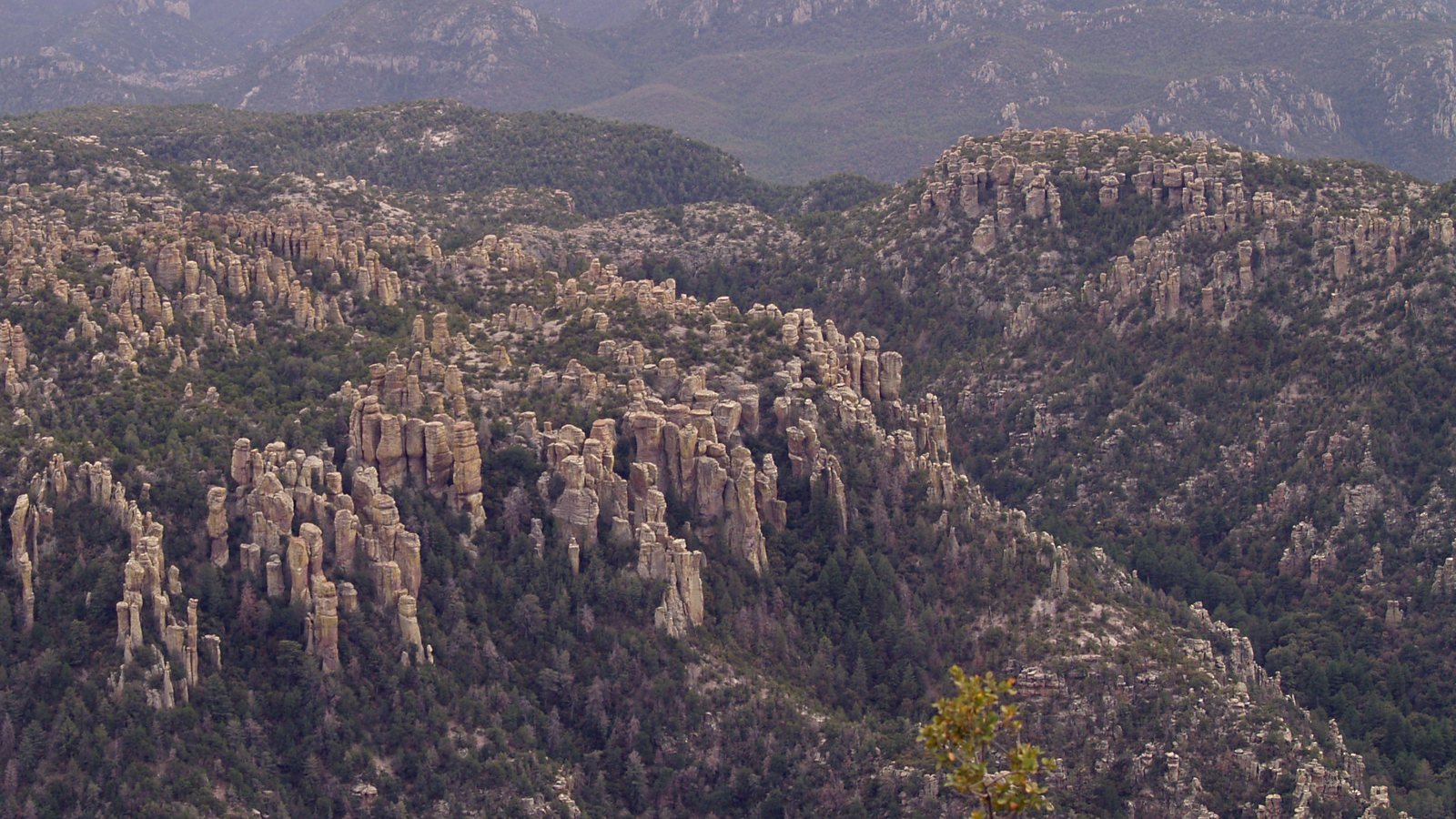

Chiricahua National Monument, about 12,000 acres of volcanic rock spires in southeastern Arizona, is now Chiricahua National Park. President Donald Trump signed the Chiricahua National Park Act on October 20, making it the country’s 64th national park and Arizona’s fourth.
For visitors, the new name changes almost nothing on the ground. Entry is still free, and the trails, campground and scenic drive work as before. The bigger change is likely to be the number of people on its narrow mountain road. The two most recent parks to get the same upgrade saw visits climb 29% and 41% above their pre-upgrade levels.
The law renames the park and leaves the rest alone
The Chiricahua National Park Act (H.R. 6380) is short. Arizona Republican Juan Ciscomani introduced it in the House in December 2025, with Democrat Greg Stanton as co-sponsor.
The House passed it by voice vote on March 16. The Senate approved it by unanimous consent on September 30, and Trump signed it on October 20, according to the congress.gov record. It is now Public Law 119-133.
We read the enrolled text in full. It keeps the monument’s boundaries exactly as they are, and any money set aside for the monument now goes to the park.
The only new rules concern tribes. The Interior Secretary must give tribal members access to traditional cultural and religious sites. At a tribe’s request, the secretary may also close specific areas to the public for a short time. Such closures must cover “the smallest practicable area for the minimum period necessary.”
The law carries no new money. “The legislation does not include dedicated funding,” the Park Service says in its redesignation FAQ. Its answer on fees and permits is just as plain: the change “does not by itself change fees.”
Interior Secretary Doug Burgum attended the designation ceremony on October 20 with Ciscomani and Willcox Mayor Greg Hancock, AZPM reported. Ciscomani called it “a defining moment for our state and the entire region.”
A ‘wonderland of rocks’ with a long Apache history
The spires are rhyolite, laid down by a volcanic eruption more than 27 million years ago, according to AZPM. Native Americans knew the area as the Land of Standing-Up Rocks, and early settlers called it the Wonderland of Rocks, the Associated Press reported. President Calvin Coolidge made it a national monument in 1924, and Franklin D. Roosevelt expanded it in 1938.
The land is the homeland of the Chiricahua Apache, who fought settlers until they surrendered to US troops in 1886 and were forcibly removed, the AP noted. Buffalo Soldiers were stationed there during the Army’s campaign against Geronimo and Cochise. Later, a guest ranch near the park’s entrance, Faraway Ranch, helped bring the rocks to public attention. Its forested mountains rise between the Sonoran and Chihuahuan deserts, an isolated range of the kind known as a “sky island.”
The new status will put more people on land some tribes still use. San Carlos Apache Deputy Attorney General Justine Jimmie told Congress in 2024, “National parks have become so packed with tourists,” the AP reported. The tribe took no formal position on the bill.
How to visit: free entry, small roads, no cell signal
Chiricahua is one of the few national parks with no entrance fee. “Chiricahua National Park does not have entrance or parking fees,” says its fees page, so you don’t need an America the Beautiful pass. The rest comes from the Park Service’s own pages:
- Getting there: From Interstate 10 at Willcox, take Highway 186 south for 32 miles, then Highway 181 for 4 miles, according to the park’s directions page. Tucson is roughly two hours away, AZPM says, and its airport is the nearest.
- Before you go: Gas, groceries and EV charging are 30 to 40 miles away. Rideshares don’t serve the area, and cell reception drops out, so download a map first.
- Vehicle limits: Vehicles over 29 feet must stop at Faraway Ranch. Nothing over 24 feet may go past the campground.
- The drive: Bonita Canyon Drive climbs 8 paved miles to Massai Point, where the road ends. It takes 60 to 90 minutes with stops.
- Hikes: The park has 17 miles of trail. Popular routes include the half-mile Massai Point Nature Trail, the 3.3-mile Echo Canyon Loop and the 7.3-mile Heart of Rocks Loop. The park’s hiker shuttle has not run since fall 2025.
- Camping: Bonita Canyon Campground has 23 sites at $25 a night, all booked through Recreation.gov.
Spring and fall are the best months to go
The park runs from 5,124 feet at the entrance to 7,310 feet on Sugarloaf Mountain. That keeps it cooler than the desert parks where heat has turned hikes deadly. Summer highs at the visitor center still reach the 80s and 90s, and the monsoon runs from June 15 to September 30. It brings thunderstorms and flash floods that can cut Highway 186.
Winter brings snow and ice between November and April, and trails can stay icy from January through March. October averages a high of 75°F, which makes late fall the easiest time to visit. March is the busiest month, along with the week between Christmas and New Year’s, the Park Service says. The campground often fills during spring break.
What New River Gorge and White Sands suggest about crowds
The Park Service won’t predict how many more people will come. Chiricahua had 70,406 visits in 2025, according to the FAQ. To estimate the effect, we pulled the agency’s visitor use statistics for the last two parks to be renamed.
White Sands in New Mexico became a national park on December 20, 2019. Its visits rose from 608,785 in 2019 to 782,469 in 2021, up 29%.
New River Gorge in West Virginia was redesignated at the end of 2020. It went from 1,195,721 visits in 2019 to 1,682,720 in 2021, up 41%. Over the same years, total visits across the whole park system fell about 9%.
The pandemic boom in outdoor travel overlapped with both, so the name can’t take all the credit. The bump also doesn’t always last.
White Sands fell back to 659,742 visits in 2025, only 8% above 2019. New River Gorge kept climbing, to 1,958,440, or 64% above its 2019 count. Its deputy superintendent, Eric Laprice, described an “initial 30% jump” in the first year in a 2024 Park Service release.
At Chiricahua, a 20% to 40% rise would mean roughly 84,000 to 99,000 visits a year.
That is modest for a system that runs from the Grand Canyon to the national park in American Samoa, but Chiricahua is built for small numbers. The Bonita Creek lot holds nine cars. March alone brought 13,317 visits in 2025, almost a fifth of the year.
The park is getting more visitors without more staff
The Park Service says it “will monitor use” at Massai Point, Echo Canyon, the campground and the parking areas. It plans no new construction. The AP reported that the agency had ranked maintenance work at Chiricahua as “low priority.” AZPM noted that the Park Service lost nearly 3,000 jobs last year.
Some changes are already under way. New signs will go up “on a phased basis as funding allows,” the FAQ says.
New passport stamps, brochures and merchandise are due “in the coming months,” and for now the stamp is print-at-home only. Burgum said Congress could pass a second Great American Outdoors Act, a park maintenance bill, when it returns in November or December, according to AZPM. Until then, the first real test of the new name comes with the spring-break crowds in March.