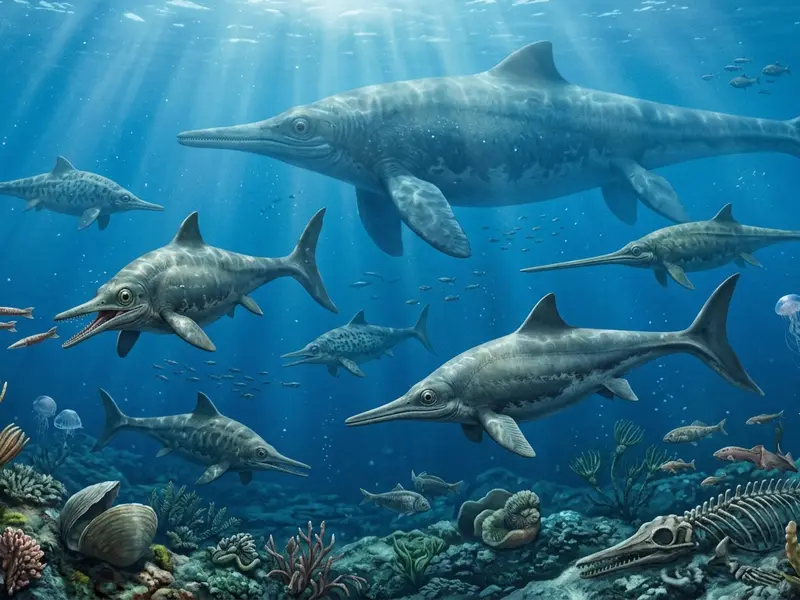
A newly analyzed fossil from Germany is giving scientists a rare look at how one of the Jurassic Ocean’s top predators adapted after suffering devastating injuries.
The creature, a giant marine reptile called Temnodontosaurus, lived roughly 180 million years ago and measured around 21 feet long. Armed with nearly 100 teeth and built for speed, it was one of the apex hunters of ancient seas.
But researchers say this predator’s real story is not about dominance. It is about survival. The study published in the Journal Zitteliana states that it is one of the largest ichthyosaurs to roam the ancient seas.
Inside the fossilized abdomen, scientists discovered gastroliths, or stomach stones, suggesting the injured sea reptile may have changed the way it hunted and digested food to stay alive after severe trauma.
The findings were published in the scientific journal Zitteliana.
What is Temnodontosaurus?
Temnodontosaurus belonged to a group of marine reptiles known as ichthyosaurs, often described as the dolphins of the dinosaur age, though they were reptiles rather than mammals.
These animals ruled prehistoric oceans during the Jurassic period and evolved streamlined bodies built for:
- Speed
- Deep diving
- Precision hunting
- Pursuing fast-moving prey
Temnodontosaurus stood out even among ichthyosaurs because of its enormous size and fearsome anatomy.
Scientists studying the German fossil found the following:
- A nearly complete skull
- Lower jaw structures
- Shoulder girdle remains
- Preserved spinal elements
- Eye and palate regions
- Roughly 100 heavily worn teeth
Its elongated snout and large eye sockets suggest it may have hunted in low-light conditions, possibly diving into darker waters to ambush prey.
Why were scientists stunned by the stomach stones
The biggest surprise was not the reptile itself. It was what researchers found inside it.
The fossil contained gastroliths, small stones swallowed by animals and retained in the digestive system.
Gastroliths are known from several ancient species, including some dinosaurs and marine reptiles, but they are rarely found in ichthyosaurs.
That discovery triggered a new theory about how this predator adapted after injury.
Researchers believe the stones may have functioned like internal grinding tools, helping the animal process food more efficiently after physical trauma made hunting difficult.
Think of them as nature’s prehistoric food processor, hidden inside the belly of a wounded sea dragon.
The fossil shows signs of serious injuries
The skeleton preserved evidence of major trauma, especially around:
- The shoulder region
- The jaw joint
Scientists believe those injuries would have dramatically affected the reptile’s ability to chase and capture agile prey.
That matters because ichthyosaurs depended heavily on speed and powerful jaw mechanics to survive.
The fossil suggests the animal endured long enough after the injuries for:
- Teeth to become heavily worn
- Healing processes to occur
- Behavioral adaptations to emerge
According to researchers, the reptile likely shifted from hunting fast prey toward easier-to-catch food sources.
Instead of relying purely on power and pursuit, it may have become more opportunistic, consuming softer or slower prey that required less force to capture.
What are gastroliths, and why do animals swallow stones?
Gastroliths appear in both extinct and living animals.
Today, some birds, crocodilians, and marine animals swallow stones for several possible reasons:
- Grinding food
- Improving digestion
- Assisting buoyancy control
- Helping process tough material
Because animals like birds lack teeth for chewing, swallowed stones can help mechanically break down food inside specialized digestive organs.
In the case of Temnodontosaurus, scientists suspect the stones compensated for its declining ability to properly process prey after injury.
The heavily worn teeth found in the fossil strengthen that idea.
Why this fossil matters to scientists
Beyond the dramatic visuals of a giant injured sea predator, researchers say the fossil could reshape understanding of Jurassic marine ecosystems.
It may extend the known timeline of the species
Researcher Ulrike Albert said the fossil is among the youngest known examples of the genus discovered so far.
That suggests Temnodontosaurus may have survived longer in the Southwest German basin than previously believed.
If confirmed, scientists may need to reconsider:
- Regional extinction timelines
- Marine ecosystem shifts
- Predator survival patterns in Jurassic seas
It reveals unexpected resilience in apex predators
The fossil also offers a rare glimpse into adaptation after injury.
Large predators are often portrayed as unstoppable killing machines in popular culture. But this specimen tells a more complicated story: even apex hunters sometimes survive by changing strategy rather than overpowering everything around them.
Researcher Stefan Eggmaier said the injuries likely limited the animal’s ability to catch prey, yet evidence suggests it continued surviving despite those limitations.
That resilience makes the fossil scientifically valuable far beyond its size or appearance.
Why ancient ocean predators still fascinate people today
Marine reptiles from the Jurassic period continue to captivate scientists and the public because they occupied a world that feels almost alien compared to modern oceans.
Imagine waters ruled not by whales or sharks, but by reptilian predators with:
- Massive eyes
- Torpedo-shaped bodies
- Long tooth-filled jaws
- Hunting adaptations unlike anything alive today
Each well-preserved fossil acts like a frozen dispatch from a vanished ecosystem.
And occasionally, as with this Temnodontosaurus specimen, those fossils reveal not just how ancient creatures died, but how they fought to keep living.
TL;DR
Scientists in Germany have studied a remarkably preserved 180-million-year-old Temnodontosaurus fossil that contained stomach stones known as gastroliths. Researchers believe the giant marine predator swallowed the stones after suffering severe injuries that affected its hunting ability. The discovery suggests the sea reptile adapted its feeding behavior and digestion strategy to survive despite major physical trauma.