
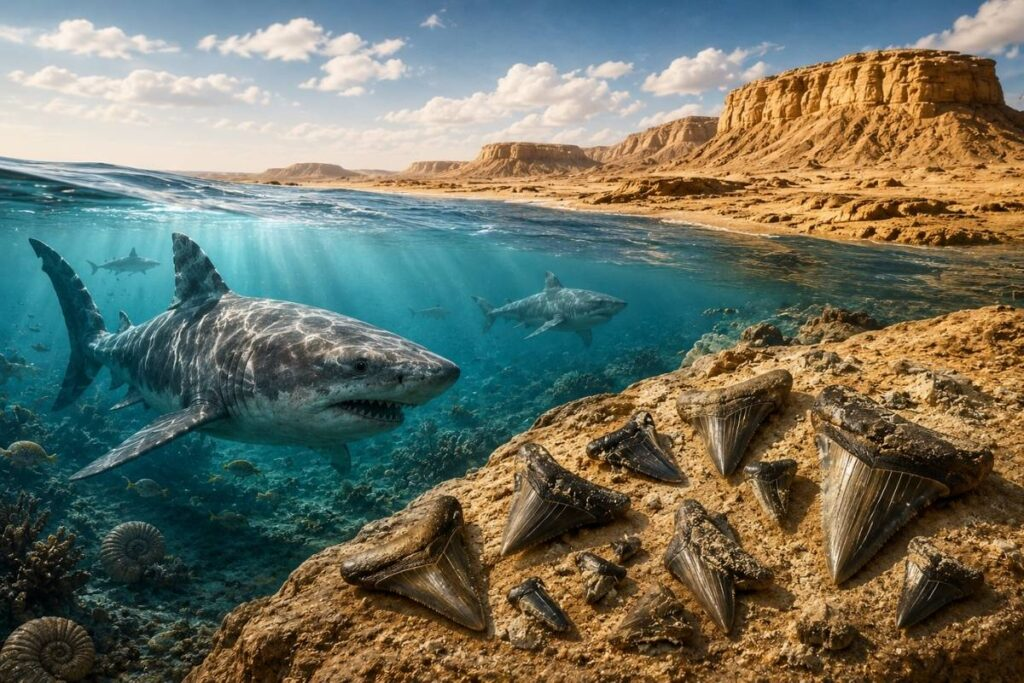
Egypt’s Western Desert, now dominated by vast stretches of sand and arid terrain, was once home to a thriving marine ecosystem filled with prehistoric sharks. Scientists have uncovered 14 fossilized shark teeth that are offering new clues about the region’s underwater past, dating back to the Late Cretaceous Period.
The fossils were recovered from phosphate deposits on the Abu-Tartur Plateau in southwestern Egypt. Researchers identified at least five extinct shark species among the teeth, expanding the known diversity of prehistoric sharks documented at the site.
The findings, published online in August 2026 in the journal Cretaceous Research, help reconstruct the marine environment that existed in this part of North Africa more than 70 million years ago.
The discovery also adds to evidence that the landscape now occupied by the Sahara was once submerged beneath warm, shallow seas where diverse marine animals flourished.
Where were the 14 shark teeth discovered?
The fossils came from the Duwi Formation, a geological unit containing extensive phosphate deposits in the Abu-Tartur Plateau, located between Egypt’s Kharga and Dakhla oases.
A research team led by paleontologist Tarek Yassin of Cairo University examined 14 isolated shark teeth collected from phosphate beds in the Maghrabi-Liffiya area.
The Duwi Formation dates to the Campanian stage of the Late Cretaceous, approximately 84 million to 72 million years ago. During this period, global temperatures were generally warmer, and sea levels were higher than today, allowing seawater to cover extensive areas of land that are now dry.
The phosphate-rich rocks preserve evidence of the ancient marine environment, including the remains of fish and other vertebrates.
The newly studied teeth were collected from black and yellow phosphate layers. Their differing colors are associated with the condition of the surrounding mineral deposits and chemical weathering processes.
Which shark species were identified?
The 14 teeth represent at least five extinct shark species belonging to the order Lamniformes, a group that includes several familiar modern sharks.
The identified species are Cretalamna cf. maroccana, Scapanorhynchus cf. raphiodon, Serratolamna cf. serrata, Squalicorax bassanii and Squalicorax pristodontus.
The abbreviation “cf.” indicates that the researchers consider a specimen comparable to a particular species but retain some uncertainty about its identification.
The findings are significant because the five species had not previously been documented together at Abu-Tartur. Some also represent new records for Egypt, while Scapanorhynchus cf. raphiodon may be the first known record of that species in Africa.
Earlier research at the same site had identified two other shark species, Scapanorhynchus rapax and Cretoxyrhina mantelli. Together, the earlier and newer findings indicate that at least seven shark species have now been documented from the area.
What do the different shapes of the teeth reveal?
Shark teeth are among the most useful fossils for studying prehistoric sharks because cartilage, which forms most of a shark’s skeleton, rarely fossilizes well.
Teeth, by contrast, are continually replaced throughout a shark’s life and are well suited to surviving in sedimentary deposits.
Their shapes can provide clues about feeding strategies.
Some of the newly identified teeth were narrow and pointed, while others were broader or serrated. Differences in tooth shape can indicate how sharks captured and processed prey, although teeth alone cannot reveal every detail of an animal’s diet.
The species identified at Abu-Tartur also have fossil records from other parts of the world. Comparing these fossils allows researchers to draw cautious inferences about the habitats and ecological roles of the sharks that inhabited the ancient sea.
Scapanorhynchus is associated with environments that may have included deeper water, while Cretalamna and Serratolamna have been linked to marine shelf settings. Squalicorax is generally associated with coastal and shelf environments.
Finding representatives of these different groups in the same geological formation suggests that the area supported a varied marine community.
How did a sea become part of the Sahara Desert?
The Sahara’s present-day landscape is very different from the environment in which these sharks lived.
During the Late Cretaceous, Earth’s climate was warmer, and higher sea levels allowed shallow marine waters to extend over regions of northern Africa.
Over millions of years, changes in global sea levels, tectonic activity and regional geology transformed the landscape. Marine waters gradually retreated, leaving sediments that eventually became part of the desert terrain visible today.
The phosphate deposits of the Duwi Formation preserve evidence of this former marine setting.
Such deposits are especially useful to palaeontologists because they can contain concentrated remains of organisms that lived in the ancient sea. These include shark teeth, fish fossils and remains of marine reptiles.
The fossils therefore provide a glimpse of an ecosystem that disappeared long before the modern Sahara developed into the arid environment known today.
Why is Abu-Tartur being called a prehistoric shark graveyard?
The area has acquired the nickname “shark graveyard” because researchers have identified multiple shark species within its phosphate deposits.
However, the term does not mean that all the sharks died in one catastrophic event or at the same time.
Fossils can accumulate gradually as teeth are shed, animal remains settle on the seabed, and sediments preserve material over long periods.
The deposits may therefore contain remains from animals that lived hundreds or thousands of years apart, rather than a single mass-death event.
The latest study builds on previous research at Abu-Tartur and expands the documented variety of sharks that once occupied the region.
The site’s value lies in its ability to preserve evidence of an ancient marine ecosystem, not simply in the number of fossil teeth recovered.
What does the discovery tell scientists about the ancient sea?
The range of shark species provides clues about the diversity of life supported by the Late Cretaceous marine environment.
Sharks occupied different ecological roles, and their presence suggests that the food web was capable of supporting several types of marine predators.
The researchers note that phosphate deposits in such settings can be associated with nutrient-rich, highly productive marine environments. Nutrients support microscopic organisms and other life forms near the base of the food web, which can sustain larger fish and predators.
Earlier discoveries in the Duwi Formation have included fish, sea turtles, and marine reptiles. The shark teeth add another layer to this picture of ancient marine biodiversity.
Nevertheless, the fossils do not provide a complete census of the ecosystem. They represent a small collection of isolated teeth, and additional discoveries will be needed to understand how the different species lived and interacted.
Why are these fossils important for understanding shark evolution?
The new findings expand the documented fossil record of several shark species in Egypt and North Africa.
Two species identified in the study, Serratolamna cf. serrata and Squalicorax bassanii, represent new records for Egypt. The material assigned to Scapanorhynchus cf. raphiodon may also represent the first known occurrence of the species in Africa and a particularly late occurrence in the fossil record.
These geographic and chronological records matter because palaeontologists use them to reconstruct how ancient shark groups were distributed and how their ranges changed over geological time.
However, the researchers caution that additional specimens and future taxonomic revisions may be needed to confirm some of the identifications.
The new discoveries consequently offer important clues, while also highlighting how much remains to be learned about prehistoric marine life in this part of Africa.
What happens next?
The researchers hope that continued exploration of the Abu-Tartur Plateau will reveal more fossils and help clarify the history of the region’s ancient marine ecosystems.
Additional teeth and other skeletal remains could improve species identification, strengthen estimates of when particular sharks lived and provide a fuller picture of the ecological conditions that supported them.
Further work may also help determine how the local shark community compared with those documented in other Late Cretaceous marine deposits around the world.
For now, the 14 teeth provide an important addition to the fossil record of Egypt’s Western Desert.
They show that a landscape now associated with extreme aridity once formed part of a marine environment supporting a diverse group of sharks.
The Sahara’s sands conceal many traces of that lost world, and each discovery helps scientists reconstruct a little more of its history.