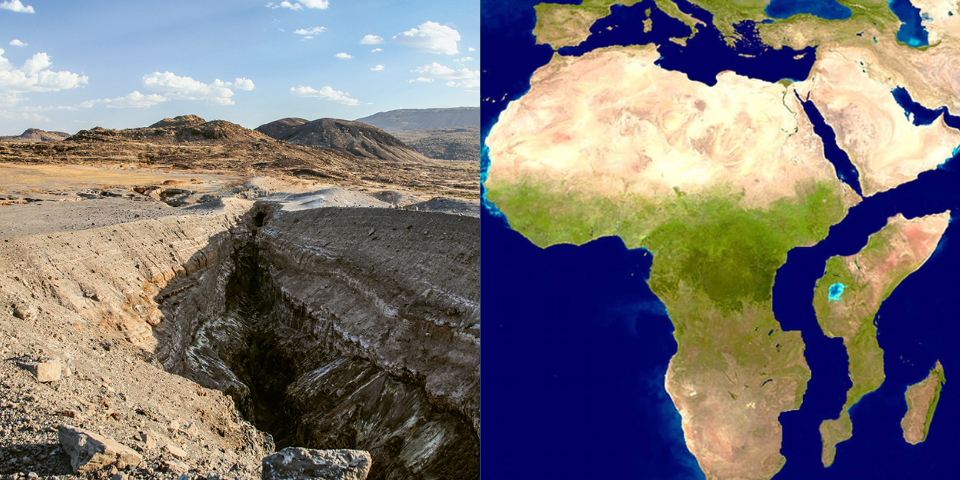
Africa is not breaking apart in a sudden geological catastrophe, but a huge rift in eastern Africa has reached a stage that scientists say brings the continent closer to an eventual breakup. Researchers studying the Turkana Rift Zone in Kenya and Ethiopia found that the continental crust beneath the rift has thinned to about 13 kilometers, compared with more than 35 kilometers beneath the surrounding regions. The finding indicates that the rift has entered a key stage known as “necking,” a phase that can precede the formation of a new ocean basin.
The study, published in Nature Communications, does not predict that Africa will split apart anytime soon by human standards. Researchers say it would still take a few million years for the process to progress from the current stage to ocean formation.
But on a geological clock, that represents a relatively advanced stage of continental breakup.
What is happening beneath eastern Africa?
The Turkana Rift is part of the enormous East African Rift System, a network of active faults and volcanic regions extending across eastern Africa.
The system is associated with the gradual separation of the Nubian and Somali plates. The Nubian Plate contains most of mainland Africa, while the Somali Plate includes parts of eastern Africa and continues toward Madagascar.
As the plates gradually pull apart, the continental crust stretches and becomes thinner along the rift.
That process is already visible at Earth’s surface through deep valleys, earthquakes, faults and volcanic activity. What the new research reveals is how far the process has progressed beneath the Turkana region.
The crust is only about 13 km thick
The researchers used high-resolution seismic reflection data together with borehole information to reconstruct the structure of the crust beneath the Turkana Rift.
Their analysis found that crystalline crust near the center of the rift is just 12.7 ± 2.8 kilometers thick. Outside the rift axis, the crust is more than 35 kilometers thick.
That difference is critical.
Continental crust generally becomes thinner as a rift develops. During the early stretching stage, deformation is spread over a relatively broad region. As rifting becomes more advanced, deformation becomes concentrated along a narrower zone and the crust begins to thin much more dramatically.
Scientists call this concentrated stage “necking.”
What does “necking” mean?
Imagine pulling a piece of soft material from opposite ends. The middle gradually becomes thinner until almost all the deformation is concentrated at one narrow section.
Continental rifting can follow a comparable pattern.
According to the study, the necking phase occurs as deformation localizes along the rift axis and reduces crystalline crust to roughly 15 to 10 kilometers in thickness. The Turkana Rift’s measured thickness therefore places it squarely within this critical phase.
The next major stage is known as “oceanization.”
At that point, continued stretching allows magma from the mantle to rise and form new oceanic crust. Eventually, the continental landmass can become separated by a new ocean basin.
So when will the new ocean appear?
Not for millions of years.
The researchers estimate that necking in the Turkana Rift began around 4 million years ago. They say it will take a few million more years before the region progresses into full oceanization, assuming the rifting continues.
That makes headlines describing Africa as “about to split” somewhat misleading.
There is no imminent continental rupture on a human timescale. The new evidence instead suggests that eastern Africa is farther along in the geological process than scientists previously recognized.
What would the new ocean look like?
If rifting continues long enough, the land between the separating plates could eventually subside and be replaced by newly formed oceanic crust.
Magma rising through fractures would cool and solidify, creating a new seafloor. Water from the surrounding seas could then flood the developing basin.
Researchers say this is broadly comparable to the process already underway farther north in the Afar region, where the East African Rift is at a more advanced stage of development. The Red Sea represents another nearby example of oceanic opening associated with continental rifting.
The eventual geography would be dramatically different from today’s Africa, but it would unfold too slowly for any person to witness from beginning to end.
Why Turkana is especially important
The Turkana Rift is not only a geological laboratory. It is also one of the world’s most important regions for understanding human evolution.
The area has produced more than 1,200 hominin fossils spanning roughly the last four million years. Researchers now argue that the same geological processes that created the rift may also have helped preserve those fossils by creating subsiding basins where sediments accumulated rapidly.
That offers a new way to look at Turkana’s importance.
The extraordinary fossil record may not necessarily mean that the region was uniquely important because human ancestors evolved there. Instead, its geological setting may have created unusually favorable conditions for preserving evidence of their lives.
Did the rift help preserve early human fossils?
The researchers point to an intriguing timing connection.
They estimate that the necking phase began around four million years ago, around the same broad period when thick, continuous fossil-bearing sediments began accumulating in the Turkana region.
As the crust thinned and the rift floor subsided, additional sediment could accumulate in the basin. Those sediments later became part of the geological record containing fossils of ancient hominins.
The study therefore suggests that tectonic change may have influenced not just the landscape, but also how well the history of human evolution was preserved.
Why is eastern Africa splitting in the first place?
The underlying driver is plate tectonics.
Earth’s outer shell is divided into large tectonic plates that move relative to one another. Where plates move apart, the crust can stretch, fracture and eventually break.
The East African Rift is one of the world’s clearest examples of continental rifting in progress.
But the new research suggests that plate motion is not the whole story. The Turkana Rift appears to have been influenced by older zones of weakness within the crust.
Earlier tectonic activity weakened the region, and later volcanic activity further contributed to the unusual way the rift developed.
Why scientists say the process is more advanced than expected
One of the study’s important conclusions is that the Turkana Rift does not behave exactly like a simple textbook model of continental breakup.
Other parts of the East African Rift remain in an earlier stretching phase, with considerably thicker crust.
The Turkana region, by contrast, has already developed a concentrated zone of extreme thinning. That makes it the first identified active continental rift clearly undergoing the necking stage, according to the researchers.
The discovery provides scientists with a rare opportunity to study a phase that is usually visible only in ancient rifted continental margins after oceans have already formed.
Africa’s map will eventually look different
The continent’s eventual breakup is not a prediction of a sudden disaster.
It is an exceptionally slow geological process already unfolding through small movements that are imperceptible from one day to the next.
But those tiny movements add up over millions of years.
The Turkana Rift now gives scientists unusually clear evidence that one part of eastern Africa has crossed a major threshold on that journey. Should rifting continue, magma will eventually help create new seafloor and surrounding seawater could flood the developing basin.
The map of Africa would then be permanently rewritten, but long after today’s human societies have disappeared.