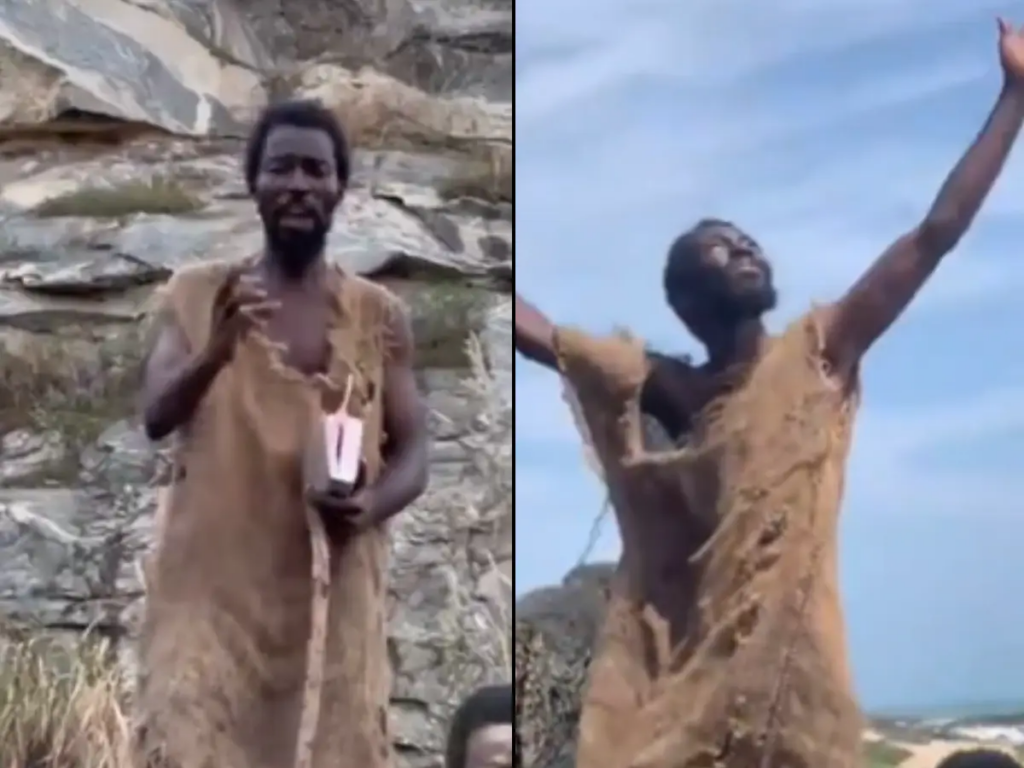
In the days leading up to Christmas 2025, social media feeds across Africa and beyond were filled with videos of people hauling bags, household items, and personal belongings toward wooden ships built inland in Ghana. They believed a global flood would arrive on December 25 and wash away the rest of the world.
It never did. When Christmas passed quietly, the man behind the prophecy, self-styled Ghanaian prophet Ebo Enoch, delivered a new message to his followers: the apocalypse had not failed; it had merely been postponed. God, he said, had granted him more time to prepare. Around the same time, reports surfaced that Enoch had bought a luxury Mercedes worth roughly $100,000 using donations collected for building the ark.
The episode has since gone viral, not only because of the failed prediction but also because it highlights how modern apocalyptic movements thrive at the intersection of faith, fear, and social media.
Who is Ebo Enoch, and what did he predict?
Ebo Enoch is a Ghana-based content creator who describes himself as a prophet. Over recent months, he built a substantial online following by sharing videos warning of an imminent divine catastrophe.
The flood prophecy explained
According to Enoch, God instructed him to prepare for a global flood beginning on December 25, 2025. The flood, he claimed, would last three years and wipe out most of humanity. Only those who believed and prepared in advance would be saved.
Drawing directly from the biblical story of Noah, Enoch said he was commanded to build an ark to shelter believers. Unlike Noah’s ark, these were not meant to carry animals, but people.
Key elements of the prophecy included:
- A fixed date for the catastrophe: December 25.
- A physical escape plan in the form of locally built arks.
- A call for followers to donate money to support construction.
- Public demonstrations showing the arks under construction.
Videos circulated online of followers preparing to board the vessels, some reportedly selling personal belongings to raise funds. The sense of urgency was central to the message. Christmas, he said, would not be a celebration but a reckoning.
What happened when December 25 arrived?
December 25 came and went without incident. There was no flood, no mass evacuation, and no divine intervention visible to the outside world.
Soon after, Enoch addressed his followers again. The explanation was simple: God had postponed the rapture. The delay, he said, was an answer to his prayers and proof that his mission remained valid.
According to Ghana Web, a local news outlet, Enoch claimed that around 10 arks had already been built and that the project would continue during this extended grace period.
How donations turned into controversy
The controversy escalated when reports emerged that Enoch had purchased a luxury Mercedes valued at about $100,000.
Why the Mercedes matters
The car itself is not illegal. What raised eyebrows was the source of the money. Donations were explicitly collected to fund ark construction and preparations for the supposed apocalypse. For critics, the purchase symbolized a betrayal of trust.
Online reactions ranged from disbelief to anger:
- Some accused Enoch of deliberately exploiting religious faith.
- Others questioned how followers could be convinced to part with life savings.
- A few supporters continued to defend him, arguing that prophets deserve material blessings.
Enoch had previously shared videos of himself inspecting the ships, reinforcing the idea that funds were being used as promised. The Mercedes, however, introduced doubt into a narrative built on urgency and sacrifice.
Why apocalyptic predictions keep resurfacing
This is not the first time a doomsday prophecy has failed, and it will not be the last. History is crowded with predicted end-of-the-world dates that came and went quietly.
The psychology behind end-times movements
Apocalyptic predictions tap into powerful human emotions:
- Fear of uncertainty, especially during economic or political instability.
- Desire for meaning in chaotic times.
- Hope of being among the chosen who will be spared.
Setting a specific date intensifies commitment. Followers are more likely to donate, prepare, and spread the message when the clock is ticking.
When the prophecy fails, leaders often reinterpret events rather than abandon the belief. Common explanations include divine mercy, human error in interpreting signs, or the need for more preparation.
This pattern is well documented in sociological research on millenarian movements.
The role of social media
Unlike past apocalyptic movements that relied on word of mouth or local congregations, modern prophets operate online. Platforms amplify messages quickly, reward sensational content, and create echo chambers where skepticism is filtered out.
In Enoch’s case:
- Short videos made the message accessible.
- Visuals of arks made the threat feel tangible.
- Algorithmic promotion helped spread the story far beyond Ghana.
This digital infrastructure makes it easier for fringe beliefs to gain mainstream attention, especially when tied to dramatic claims.
What is the rapture, and why does it resonate?
The term “rapture” refers to a belief held by some Christians that believers will be taken up to heaven before a period of great suffering on Earth. It is not universally accepted across Christian denominations, but it has a strong presence in certain evangelical traditions.
A global phenomenon, not a local one
Enoch’s prophecy echoes similar claims made elsewhere. In September, South African pastor Joshua Mhlakela reportedly predicted a rapture event on September 23, claiming both living and dead believers would rise.
These predictions often share common traits:
- Absolute certainty about timing.
- Charismatic leadership.
- Appeals to exclusive knowledge or divine communication.
Why this story matters beyond Ghana
At first glance, the story may seem like a viral curiosity. But it touches on deeper issues around misinformation, faith, and accountability.
Financial vulnerability and exploitation
When followers sell belongings or donate large sums based on prophetic claims, the consequences can be severe. Failed prophecies do not always come with refunds.
This raises questions worth examining:
- Should religious fundraising face stricter oversight?
- What protections exist for vulnerable believers?
- Where is the line between faith and fraud?
For readers interested in this angle, consider linking to previous reporting on religious scams or financial exploitation tied to spiritual movements.
Trust in the digital age
The Enoch episode also illustrates how trust is built and broken online. Visual storytelling can create credibility quickly, even without institutional backing. Once trust is established, reversing belief becomes difficult, even in the face of contradictory evidence.
What happens next for Ebo Enoch and his followers?
As of now, Enoch maintains that the mission continues. The arks remain, the prophecy lives on in modified form, and some followers appear willing to wait.
Historically, such movements tend to fracture after a failed prediction:
- Some followers leave quietly.
- Others double down, interpreting survival as proof of divine favor.
- Leaders may revise timelines or shift focus.
Whether Enoch’s following shrinks or stabilizes will likely depend on how convincingly he reframes the delay and whether further controversies emerge.
TL;DR
A self-proclaimed Ghanaian prophet predicted a Christmas Day apocalypse, collected donations to build arks, and later said the disaster was postponed after it failed to happen. Reports that he bought a $100,000 Mercedes with donated funds sparked backlash. The episode highlights how apocalyptic beliefs, amplified by social media, can inspire deep trust, financial sacrifice, and controversy when predictions collapse.