
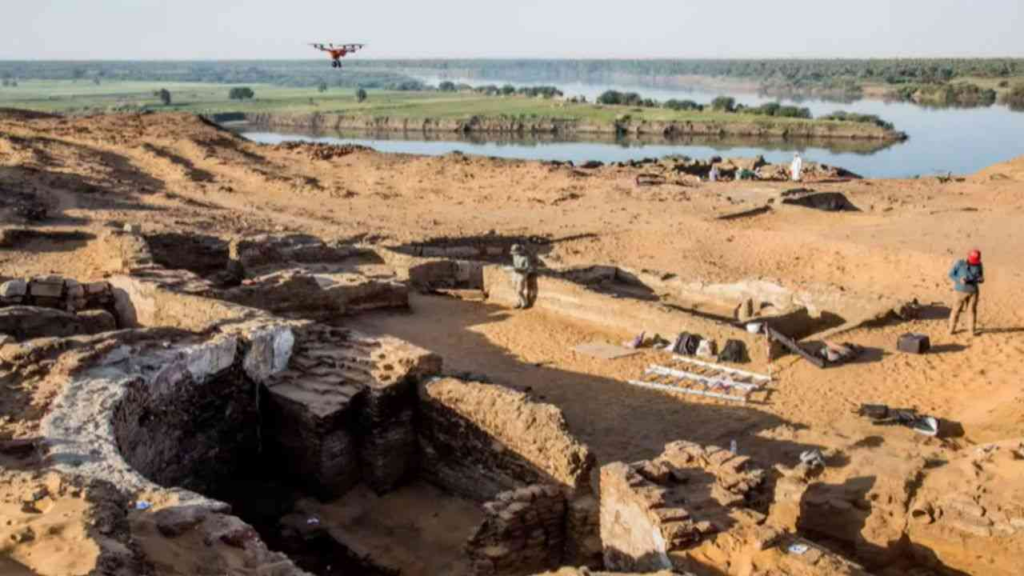
For decades, King Qashqash existed in the gray space between folklore and history—mentioned in oral traditions but dismissed by scholars as likely mythical. That has now changed. A recent archaeological discovery in northern Sudan provides the first concrete evidence that this elusive ruler of the Kingdom of Makuria was, in fact, real.
The finding doesn’t just validate a long-dismissed figure. It also fills a critical gap in the historical record of a region whose past has been partially erased over time.
What Was Discovered at Old Dongola?
Archaeologists working in the ruins of Old Dongola uncovered fragments of a 500-year-old document—an administrative order issued in the name of King Qashqash.
The discovery was made inside a structure known as the “House of the Mekk” (Building A.1), believed to have been the residence of a high-ranking elite figure. Located near the eastern bank of the Nile, the site has long been considered central to understanding Makurian political life.
Key details of the find:
- A 4 x 3.5-inch paper fragment
- Written in Arabic
- Authored by a court scribe named Hamad
- Addressed to an official named Khidr
- Contains a directive involving livestock and textiles exchange
The document is simple in content but monumental in implication: it bears the name of King Qashqash, anchoring him in verifiable history.
The research was published in Azania: Archaeological Research in Africa, a respected journal focused on African archaeology.
Why Was King Qashqash Considered a Myth?
For years, historians lacked hard evidence linking Qashqash to any confirmed timeline or administrative record. His name appeared primarily in:
- Oral traditions
- Religious or hagiographic texts
- Fragmented historical references
Without physical artifacts or written documentation, scholars categorised him as fictional.
The bigger issue: lost history
The Kingdom of Makuria thrived between the 6th and 14th centuries. But after its decline, especially during the rise of the Funj Sultanate, historical documentation became scarce.
This led to:
- Gaps in the historical timeline (especially 16th–17th centuries)
- Limited archaeological evidence
- Heavy reliance on oral narratives
As a result, figures like Qashqash slipped into the realm of legend.
How Did Researchers Verify the Document?
The newly discovered document was not dated, which posed an immediate challenge. To determine its age and authenticity, researchers relied on multiple scientific and historical methods.
Verification techniques included:
- Radiocarbon dating of nearby organic materials
- Numismatic analysis (study of coins found at the site)
- Comparative textual analysis with other known records
Based on these methods, researchers concluded the document likely dates to the late 16th or early 17th century.
This places King Qashqash in a previously under-documented period of Makurian history.
What Does the Edict Actually Say?
At first glance, the content of the document seems mundane. It outlines a transactional order:
- Retrieve an ewe (female sheep) from an individual
- Transfer it to another person
- Receive three textile units in exchange
But this seemingly routine instruction is exactly what makes the discovery so valuable.
Why it matters:
- It confirms administrative governance under King Qashqash
- It demonstrates economic activity and trade systems
- It shows the use of Arabic in official communication, signalling cultural shifts
In short, this is not mythology—it’s bureaucracy. And bureaucracy leaves paper trails.
What Else Was Found at the Site?
The document was not an isolated find. Excavations at the House of the Mekk uncovered a broader collection of artifacts that paint a vivid picture of life during that era.
Notable discoveries include:
- Over 20 letters and legal documents
- Textiles and jewelry
- Leather shoes
- A dagger handle made of ivory or rhino horn
These items suggest the residence belonged to someone of significant status, possibly a regional authority operating under the king.
Why This Discovery Matters for African History
This finding goes beyond confirming one ruler’s existence. It reshapes how historians understand a critical period in African history.
1. It bridges a historical gap
The late Makurian period has long been poorly documented. This discovery provides rare, tangible evidence from that era.
2. It validates oral traditions
Historians often treat oral accounts cautiously. This case shows that such traditions can preserve accurate historical memory.
3. It highlights early globalisation
The use of Arabic and references to trade indicate:
- Cultural exchange
- Economic integration
- Influence from neighbouring Islamic regions
4. It challenges colonial-era narratives
Much of Africa’s documented history was filtered through colonial perspectives. Discoveries like this help reconstruct indigenous histories on their own terms.
The Role of Arabization in Makuria
One of the most significant insights from the discovery is the increasing influence of the Arabic language and culture in Makuria during this period.
Indicators of Arabization:
- The document is written entirely in Arabic
- Names in the text reflect Islamic influence
- Trade systems align with broader regional practices
This suggests a gradual transformation rather than abrupt cultural replacement.
What Questions Still Remain?
While the discovery answers one major question—whether King Qashqash existed—it raises several others:
- What was the extent of his rule?
- Was he a central monarch or a regional authority?
- How did his reign fit into the broader political structure of the time?
- Are there more documents waiting to be uncovered?
Archaeologists believe further excavations at Old Dongola could reveal additional records
TL;DR
- Archaeologists found a 500-year-old document in Old Dongola
- The document confirms the existence of King Qashqash, once thought fictional
- It provides rare insight into late Makurian history
- The discovery validates oral traditions and reveals cultural shifts toward Arabization
- It opens new avenues for research into Africa’s under-documented past