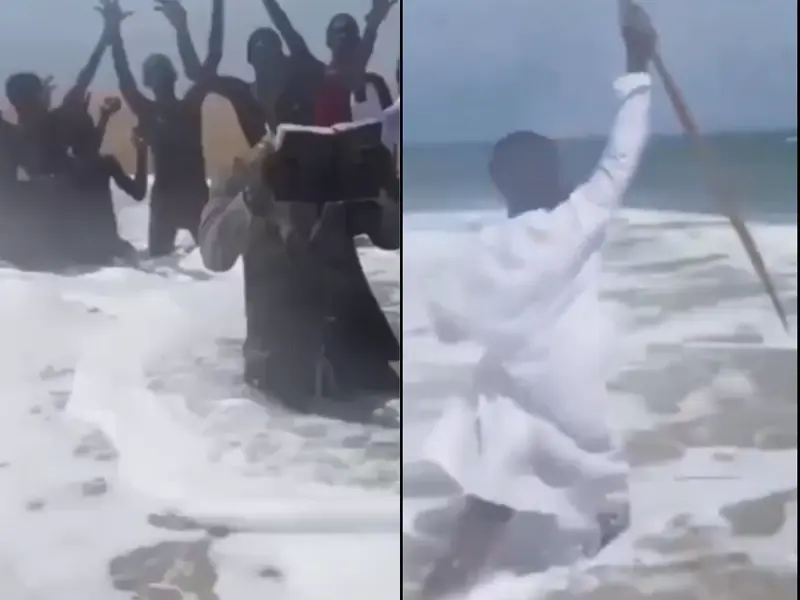
A viral video showing a Nigerian pastor attempting to recreate one of the Bible’s most famous miracles has sparked a flood of reactions online — most of them mocking, some deeply concerned about the growing trend of performative prophecy and miracle culture across parts of Africa.
The clip, which spread widely on social media this week, shows the pastor dressed in a white robe and holding a stick as followers gather around him near the ocean. Appearing to imitate the biblical story of Moses parting the Red Sea, the man raises his hands and walks toward the water as supporters watch closely.
Moments later, a powerful wave crashes toward him.
The pastor immediately tries to retreat but loses his footing and gets swept up in the surge before others nearby appear to help him regain balance.
The internet, unsurprisingly, had thoughts.
What Happened in the Viral “Parting the Sea” Video?
The short video does not reveal the pastor’s identity or exact location, but the symbolism is unmistakable.
In the Bible’s Book of Exodus, Moses parts the Red Sea — also referred to in some translations as the Yam Suph — allowing the Israelites to escape from Pharaoh’s army. The miracle is among the most recognised stories in Christianity and Judaism.
In the viral clip, the pastor appears to reenact that moment:
- He approaches the shoreline with a staff-like stick
- Raises his arms dramatically toward the water
- Speaks to the crowd, though the audio is unclear
- Waits for a reaction from the sea
Instead of the waters splitting, a large wave barrels toward him and sends him scrambling backwards.
The moment instantly became meme material.
Social Media Reactions Turned the Pastor Into a Meme
Online users wasted little time turning the failed miracle attempt into a viral joke.
One widely shared comment read:
“Bro wanted to be Moses, ended up being Pharaoh.”
Another user joked:
“Sea be like — User ID authorization failed.”
Others pointed out that the stunt could have turned dangerous very quickly, especially given the size and force of the incoming wave.
One commenter wrote that the pastor’s followers “could have forcefully drowned him” if the situation escalated further, highlighting how emotionally charged religious gatherings can become when public prophecies fail.
Why the Video Went Viral
The clip hit several internet pressure points at once:
- Religious spectacle
- Public failure caught on camera
- Biblical references familiar to global audiences
- Meme-ready visuals
- Ongoing debates about “miracle pastors”
That combination helped the video travel far beyond Nigeria and into broader international conversations about faith, influence, and social media performance.
Why Performative Religion Is Growing on Social Media
The video is not an isolated incident.
Across several African countries — particularly Nigeria, South Africa, Kenya, and Ghana — self-proclaimed prophets and pastors have built massive followings through dramatic demonstrations, apocalyptic predictions, and miracle-centred ministries.
Social media has accelerated that trend.
Platforms like TikTok, Facebook, YouTube, and Instagram reward spectacle. The more shocking or emotionally charged the content, the more likely it is to spread.
That creates incentives for increasingly theatrical displays, including:
- Fake healings
- End-times predictions
- Deliverance rituals
- “Prophetic” financial promises
- Public miracle demonstrations
Religious scholars and media analysts have long warned that viral attention can blur the line between spiritual leadership and entertainment.
The Economics Behind Viral Prophecy
In many cases, pastors who go viral gain:
- Larger congregations
- YouTube monetization
- Donations and offerings
- Paid speaking invitations
- Influence beyond their local communities
Critics argue that this ecosystem rewards sensationalism over accountability.
Supporters, however, often see these pastors as charismatic leaders offering hope in places facing economic hardship, unemployment, or political instability.
That tension helps explain why controversial religious figures continue to attract loyal audiences despite repeated failed predictions or public embarrassment.
The Moses Comparison Matters More Than It Seems
The reason this particular video resonated globally is that the Moses story is deeply recognisable.
Even people with limited religious knowledge understand the image of a figure standing before the sea with a staff raised.
That instantly gave viewers a narrative framework:
the pastor was attempting something symbolic and grand — and the ocean responded in the exact opposite way.
The humor came from the reversal.
Instead of commanding nature, he appeared overwhelmed by it.
Africa’s Recent Wave of Rapture Predictions
The viral sea video also arrives amid renewed attention on apocalyptic preaching in parts of Africa.
In September 2025, South African pastor Joshua Mhlakela drew headlines after publicly predicting that the Rapture would occur on September 23.
According to evangelical Christian belief, the Rapture refers to a future event in which believers are taken to heaven before a period of tribulation on Earth.
Mhlakela reportedly claimed on YouTube that the Earth would “shake” and that the event was imminent.
The prophecy triggered widespread social media discussion, with videos showing some believers allegedly preparing for the end times by:
- Selling possessions
- Leaving jobs
- Sharing emotional farewell messages
- Encouraging others to “prepare spiritually”
When the predicted date passed without incident, online criticism intensified.
A Pattern of Failed Predictions
Failed doomsday predictions are hardly new.
Religious historians have documented centuries of end-times prophecies across multiple faith traditions. Yet social media has changed the scale and speed of their spread.
A local prophecy can now become a global trend within hours.
That visibility creates two parallel reactions:
- Devout followers who become more committed
- Online audiences who respond with skepticism and humor
The Nigerian pastor’s wave incident sits squarely at that intersection.
What the Viral Video Says About Internet Culture
The internet treats public failure differently today than it did a decade ago.
Moments that once might have stayed local now become global entertainment within hours. Religious leaders, politicians, celebrities, and influencers all face the same reality: if a stunt fails on camera, the internet will likely turn it into a meme.
But beneath the jokes is a more serious conversation about influence and responsibility.
When spiritual authority becomes tied to spectacle, failed demonstrations can do more than damage reputations — they can erode trust, manipulate vulnerable followers, and sometimes create physical danger.
That’s why clips like this resonate beyond simple comedy.
They raise broader questions:
- Where is the line between faith and performance?
- How should religious leaders be held accountable?
- What role does social media play in amplifying extreme behavior?
The Bigger Picture Behind the Viral Pastor Video
For many viewers, the clip was simply funny: a man tried to command the ocean and got hit by a wave instead.
But the story also reflects a larger digital-era phenomenon where religion, performance, and virality increasingly overlap.
The modern internet rewards dramatic moments. Religious influencers know it. Audiences know it. Platforms know it.
And sometimes, the ocean reminds everyone that nature is not part of production.