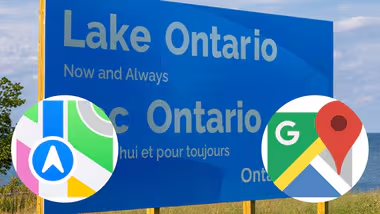
Apple and Google have renamed Lake Ontario as “Lake America” on their mapping platforms for users in the United States, escalating a growing naming dispute between Washington and Ottawa.
The change follows an executive order from US President Donald Trump directing the United States to adopt the new name amid heightened tensions with Canada over trade.
The update is location-specific: users in the US see “Lake America,” while users in Canada continue to see the body of water identified as “Lake Ontario.”
Why did Apple rename Lake Ontario?
Apple’s Maps app has adopted the name Lake America for users accessing the service from the United States following the Trump administration’s executive order.
The decision places Apple among major technology companies that have adjusted digital maps to reflect changes directed by the US government.
For Canadian users, however, Apple’s Maps continues to display the lake’s longstanding name, Lake Ontario.
That difference is significant because the lake is shared by the United States and Canada. Rather than establishing a single name across the platform, the mapping services are effectively displaying different names depending on where the user is located.
Google has also changed the name
Apple is not alone.
Google Maps follows Apple’s move
Google has also changed the name displayed for Lake Ontario to Lake America for users in the United States.
The move has generated criticism online, particularly because the lake’s traditional name remains unchanged in Canada.
The situation mirrors a similar naming dispute from 2025, when both Apple and Google updated their US-facing maps to display “Gulf of America” instead of “Gulf of Mexico” following another Trump administration order.
The companies’ approach demonstrates how digital mapping platforms can maintain different geographic labels for the same feature depending on the user’s location.
What does Trump’s executive order say?
The renaming is tied to a Trump executive order directing the US government to recognize the new name.
Under the order, the US Department of the Interior has 30 days to update the name in the Geographic Names Information System, or GNIS.
The GNIS is the US government’s official repository for standardized geographic names.
That distinction is important: changing the name in US government databases does not automatically compel Canada or international organizations to adopt the same terminology.
In practice, geographic names can remain politically and internationally contested even after one country officially changes its own usage.
Why is Canada rejecting the new name?
Canada has rejected the US renaming effort and continues to call the body of water Lake Ontario.
The dispute comes against the backdrop of deteriorating US-Canada relations, particularly over trade.
Canada has vowed to impose “dollar-for-dollar” counter-tariffs in response to new US tariffs, while negotiations between the two countries have become increasingly contentious.
Canadian officials have also pushed back against the proposed geographic name change, underscoring that Washington’s decision does not determine how Canada identifies the lake.
Ontario sends a message
Ontario authorities have responded symbolically by putting up a sign at the lake reading:
“Lake Ontario. Now and Always.”
Ontario Premier Doug Ford said the sign was installed “just in case President Trump or anyone else forgets.”
The response turns what might ordinarily be a technical geographic naming issue into another visible symbol of the political friction between the two neighboring countries.
Can a US president rename a lake shared with Canada?
Not unilaterally for the entire lake.
The US government can establish and standardize geographic names for US federal use, including through the Geographic Names Information System.
But Lake Ontario is a shared international geographic feature. Canada’s government is not bound by a US executive order and can continue using Lake Ontario in its own official documents, maps and public communications.
That means both names can coexist in different jurisdictions.
This is also why the Apple and Google changes are geographically targeted rather than universal. A person in New York may see Lake America, while someone in Toronto may see Lake Ontario.
Why does the map display matter?
For most users, the change may seem like a simple label replacement. But digital maps have become important reference points for how people understand geography.
Companies such as Apple and Google provide maps used by millions of people for:
- Navigation and travel
- Business listings
- Emergency planning
- Education
- News reporting
- Geographic research
- Location-based services
A change in a widely used mapping application can therefore make a government-preferred name much more visible, even when the underlying geographic dispute remains unresolved.
It also raises a broader question about how technology companies handle politically disputed geographic names.
Should a mapping platform follow the terminology officially recognized by the government where the user is located? Should it use internationally recognized names? Or should it display multiple names when countries disagree?
There is no universally applicable answer, and the Lake Ontario dispute illustrates the challenge.
What happens next?
The immediate next step is the US government’s update of its geographic-name database.
The executive order provides a 30-day timeframe for the Department of the Interior to make the change through the Geographic Names Information System.
Canada, meanwhile, has given no indication that it intends to adopt the new US terminology.
As a result, the dispute is likely to remain visible in digital maps, official communications and political rhetoric.
For travelers and residents around the Great Lakes, the practical reality may simply be that the same lake has two different names depending on which side of the border they are standing on—or which country’s map they are viewing.
Lake Ontario or Lake America? The dispute in brief
| Issue | United States | Canada |
|---|---|---|
| Name displayed on Apple Maps | Lake America | Lake Ontario |
| Name displayed on Google Maps | Lake America | Lake Ontario |
| Government position | Supports the new US designation | Rejects the change |
| Official database | US government moving toward Lake America | Continues to recognize Lake Ontario |
| Political backdrop | Trump executive order and trade tensions | Opposition to US tariffs and naming decision |
The controversy ultimately goes beyond a name on a map. It highlights how geography, national identity, diplomacy, and technology increasingly intersect—and how a decision made by one government can produce entirely different digital realities on opposite sides of an international border.