
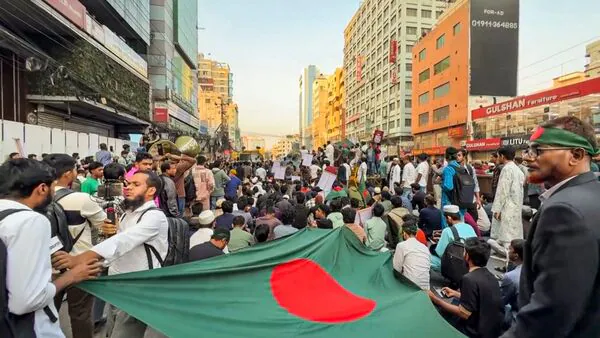
Anti-India protests spread across Bangladesh this week, prompting India to temporarily shut visa application centres in key cities and raising fresh concerns about diplomatic security and regional stability. The closures, confirmed by India’s High Commission in Dhaka, come amid demonstrations near Indian diplomatic missions and sharp exchanges between New Delhi and Bangladesh’s interim authorities.
This article explains what triggered the protests, why visa centres were closed, how both governments are responding, and what the developments could mean for India-Bangladesh relations as we advance.
Why did India close its visa centres in Bangladesh?
India closed its visa application centers in Khulna and Rajshahi after protests escalated and the local security situation deteriorated, according to officials at the Indian High Commission in Dhaka.
What officials have said
An official from the High Commission told ANI that the decision was driven purely by security considerations.
- Protests erupted in Khulna and Rajshahi.
- Local conditions were assessed as unsafe for normal operations.
- Visa services were suspended as a precautionary measure.
The same official confirmed that visa services in Dhaka have since resumed, indicating that the shutdowns are targeted and temporary rather than a blanket suspension across Bangladesh.
Why visa centres are sensitive targets
Visa application centres are civilian-facing extensions of diplomatic missions. During periods of unrest, they can become flashpoints because:
- They attract large crowds daily.
- They are symbolically linked to bilateral ties.
- Any incident can quickly escalate into a diplomatic crisis.
What sparked the anti-India protests in Bangladesh?
The current wave of protests appears to be driven by a mix of domestic political tensions in Bangladesh and grievances directed at India’s perceived role in recent events.
Marches toward Indian diplomatic offices
In Rajshahi, a platform calling itself “July 36 Mancha” organised a march toward the Indian Assistant High Commission.
- The march began around midday from Bhadra Mor.
- Police erected barricades roughly 100 meters before the mission.
- Protesters staged a sit-in when they were prevented from proceeding.
Similar demonstrations were announced in Khulna, reinforcing concerns that the protests were coordinated across multiple cities.
Protests in Dhaka’s Gulshan area
Earlier in the week, Bangladeshi police stopped protesters marching toward the Indian High Commission in Dhaka’s Gulshan neighbourhood. According to reporting by The Daily Star, demonstrators demanded the return of deposed prime minister Sheikh Hasina and others who fled during and after last year’s July uprising.
These protests reportedly followed threats made against Indian diplomats, a key factor that escalated the issue from public unrest to a diplomatic flashpoint.
How has India responded to the security concerns?
India’s response has combined immediate operational steps with formal diplomatic messaging.
Summoning Bangladesh’s envoy
The Ministry of External Affairs summoned Bangladesh’s High Commissioner to India, Riaz Hamidullah, to convey New Delhi’s concerns.
Key points raised by India included:
- Threats to the safety of Indian diplomats and missions.
- Activities of extremist elements planning to create a security situation around the Indian Mission in Dhaka.
- Dissatisfaction with how recent incidents have been handled.
India’s official position
In a strongly worded statement, the MEA rejected what it described as a “false narrative” being promoted by extremist groups regarding recent developments in Bangladesh.
India also noted that:
- The interim government has not conducted a thorough investigation into the incidents.
- No meaningful evidence has been shared with India so far.
- Diplomatic obligations require host countries to protect foreign missions and personnel.
What is Bangladesh’s interim government expected to do?
Under international diplomatic norms, host governments are responsible for the safety and security of foreign missions.
Expectations under diplomatic law
India has publicly stated that it expects Bangladesh’s interim government to:
- Ensure the safety of Indian missions and posts.
- Prevent marches or actions that threaten diplomatic premises.
- Act against extremist groups planning violence or intimidation.
Political pressure at home
The interim government is operating in a politically charged environment, with:
- Ongoing fallout from last year’s uprising.
- Polarized public opinion around Sheikh Hasina’s removal.
- Competing pressures from protest groups and international partners.
Why do these protests matter for India-Bangladesh relations?
Anti-India protests spread across Bangladesh are not just a security issue. They touch on deeper strategic and emotional aspects of the bilateral relationship.
A historically close relationship
India and Bangladesh share ties rooted in:
- The 1971 liberation struggle.
- Extensive trade and connectivity projects.
- Deep people-to-people links, including tourism, education, and medical travel.
India reiterated this in its statement, emphasizing its support for peace, stability, and credible elections in Bangladesh.
Risks if tensions escalate
If protests continue or intensify, potential consequences include:
- Prolonged disruption of visa services.
- Reduced cross-border travel and exchanges.
- Diplomatic friction affecting trade and regional cooperation.
How could this situation evolve in the coming weeks?
Several scenarios are possible, depending on political and security developments on the ground.
Short-term outcomes
- Visa centres in Khulna and Rajshahi may reopen once local conditions stabilise.
- Increased police presence around Indian missions.
- Behind-the-scenes diplomatic engagement to lower tensions.
Medium-term risks
- Renewed protests are tied to Bangladesh’s internal political roadmap.
- Continued targeting of India in domestic political rhetoric.
- Stricter security protocols are affecting normal diplomatic and consular operations.
What should readers watch next?
To stay informed, watch for:
- Statements from Bangladesh’s interim government on mission security.
- Updates from India’s MEA on visa operations.
- Reporting from credible regional outlets such as The Daily Star, Reuters, or the Associated Press.
Fact-checking reminder: All quotes attributed to officials and agencies should be cross-verified with official MEA releases, ANI dispatches, and reputable Bangladeshi media reports before publication.
TL;DR
- Anti-India protests spread across Bangladesh, including in Dhaka, Khulna, and Rajshahi.
- India shut visa application centres in Khulna and Rajshahi citing security concerns.
- Protests targeted areas near Indian diplomatic missions.
- India summoned Bangladesh’s envoy and demanded stronger protection.
- The situation tests an otherwise close bilateral relationship and could affect travel and diplomacy if tensions persist.