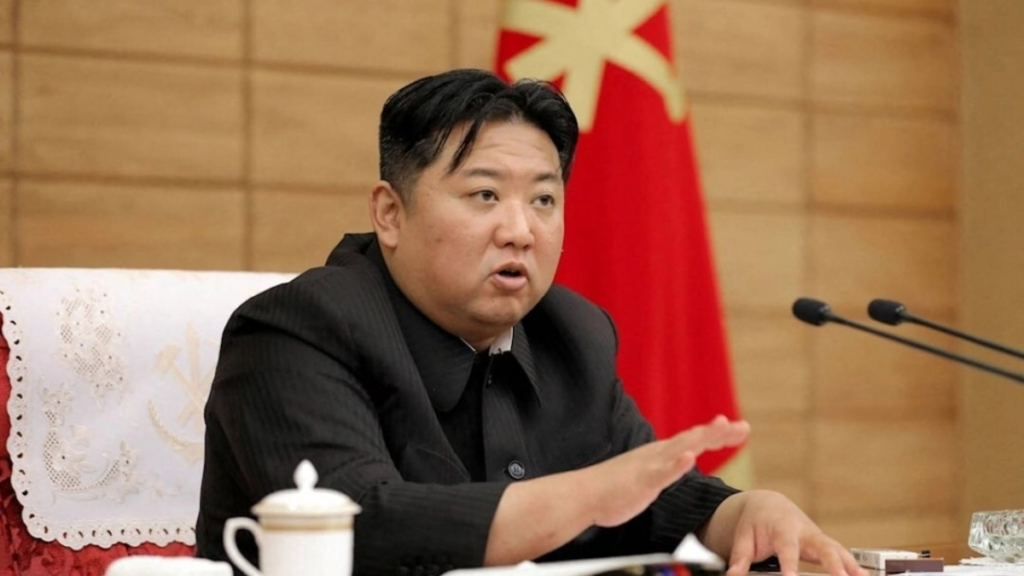
In a political system known for near-total unanimity, even the smallest crack can echo loudly. That’s exactly what happened after Kim Jong Un secured 99.93% of the vote in North Korea’s latest parliamentary election. The result itself was expected. What wasn’t? The acknowledgment that 0.07% of voters said “no.” That sliver of dissent has become the internet’s favorite statistic, turning a tightly controlled election into an unlikely viral moment.
The latest vote was held to elect representatives to the Supreme People’s Assembly, North Korea’s rubber-stamp parliament. According to state media, turnout reached 99.99%, with only a minuscule fraction of citizens unable to participate.
Of those who voted:
- 99.93% approved the candidates
- 0.07% voted against
- An almost negligible number abstained
On paper, these figures reinforce the image of overwhelming national unity. But the inclusion of any dissent at all is what sets this election apart.
Why the 0.07% matters more than the 99.93%
In most democracies, 0.07% would barely register. In North Korea, it’s historic.
According to the Korean Central News Agency, this is the first time since 1957 that official results have acknowledged “no” votes in such an election.
That raises two key questions:
- Why admit dissent now?
- What does it signal, if anything, about internal dynamics?
For analysts, the answer isn’t straightforward. Some see it as a controlled display of transparency. Others interpret it as a statistical adjustment meant to appear more credible internationally.
How controlled elections work in North Korea
To understand the reaction, it helps to understand the structure of North Korean elections.
Single-candidate system
Each district typically features only one approved candidate, selected by the ruling party. Voters are presented with a simple choice:
- Approve the candidate
- Reject the candidate
Rejecting is technically possible but widely believed to carry serious risks.
Social and political pressure
Voting is not just a civic act, it’s a monitored one. Participation rates are near total, and deviation from expected behavior can attract scrutiny.
Why is turnout always near 100%
Official turnout figures regularly exceed 99%, attributed to:
- Mandatory participation norms
- Organized voting systems
- Reporting practices controlled by the state
Why the internet is obsessed with the 0.07%
If the election result was predictable, the online reaction was anything but.
Social media platforms, especially X, turned the 0.07% into a symbol of dark humor.
Viral reactions and meme culture
Some of the most widely shared jokes included:
- “A moment of silence for the 0.07%”
- “That 0.07% just became the most wanted group in the country”
- “Somewhere, history’s bravest voters are updating their resumes”
The humor leans heavily on irony. In a system where dissent is rare, even a fraction becomes mythologized.
Why this moment resonated globally
This story hit a sweet spot for online virality:
- A striking statistic (99.93% vs 0.07%)
- A geopolitical backdrop
- A hint of the unexpected
It also reflects how audiences engage with authoritarian systems, often through satire when direct insight is limited.
Is this a sign of change in North Korea?
Short answer: probably not, but it’s worth watching.
Possible interpretations
Experts tend to fall into a few camps:
Controlled transparency
The regime may be signaling a slightly more “realistic” image to the outside world without changing the underlying system.
Statistical calibration
Reporting a perfect 100% can appear less credible internationally. Introducing minimal dissent may make results seem more believable.
Internal messaging
Even a tiny acknowledgment of opposition could serve as a controlled release valve, allowing the state to define and contain dissent.
What it likely does not mean
- It does not indicate competitive elections
- It does not suggest political pluralism
- It does not point to imminent reform
What comes next after the 15th Supreme People’s Assembly?
Beyond the numbers, the newly elected assembly could shape policy directions on several fronts.
Key issue to watch: South Korea relations
One major question is whether North Korea will formally redefine its stance toward South Korea as a “hostile state” in its constitutional framework.
Such a move would:
- Codify years of escalating rhetoric
- Influence military and diplomatic strategies
- Signal long-term intentions to the international community
Why this story matters beyond the memes
It’s easy to dismiss the 0.07% as just a punchline. But it highlights something deeper about how information works in closed systems.
Small details can carry big signals
In highly controlled environments:
- Minor deviations become significant
- Official narratives are carefully curated
- Even tiny data points can trigger global scrutiny
The power of global audiences
The internet’s reaction shows how quickly local events can gain international traction. A statistic released by state media became a global conversation within hours.
A reminder about data and context
Numbers alone don’t tell the full story. Understanding how they are produced and why they are shared is just as important.
TL;DR
- Kim Jong Un won 99.93% of the vote in North Korea’s latest election
- State media acknowledged 0.07% dissent for the first time since 1957
- The tiny figure sparked widespread memes and global attention
- Analysts see it as controlled transparency, not political change
- The moment highlights how even small data points can carry outsized meaning in closed systems