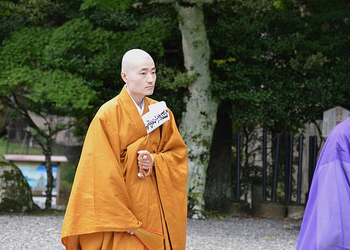
A Buddhist monk in flowing gray robes bows respectfully at a Seoul temple, answers questions about devotion, and prepares to join one of South Korea’s biggest religious festivals. The twist? The monk is a humanoid robot powered by artificial intelligence.
South Korea has officially introduced “Gabi,” the country’s first AI-powered Buddhist monk, in a move that blends centuries-old spiritual traditions with modern robotics. The debut took place at Seoul’s historic Jogye Temple ahead of celebrations marking the birth of Gautama Buddha, instantly sparking global fascination about where faith and technology intersect.
The moment feels almost cinematic: incense smoke curling through the temple halls while a robot monk folds its hands in prayer. But behind the spectacle lies a serious conversation about how religions worldwide are adapting to the AI era.
What is Gabi, South Korea’s robot monk?
Gabi is a humanoid robot developed to participate in Buddhist cultural and ceremonial activities under South Korea’s largest Buddhist sect, the Jogye Order.
Standing 130 centimeters tall and dressed in traditional robes, the robot underwent a formal ordination ceremony typically reserved for Buddhist monks. During the event, senior monks asked whether Gabi would dedicate itself to Buddhism and its teachings. The robot responded affirmatively in a calm, measured voice.
Video footage shared by Reuters showed Gabi bowing respectfully and performing gestures associated with Buddhist rituals.
Key features of Gabi
- AI-powered conversational system
- Humanoid body designed for ceremonial interaction
- Traditional Buddhist monk attire
- Programmed to engage with visitors and answer questions
- Built to participate in religious and cultural events
The name “Gabi” reportedly translates to “Buddha’s mercy,” reflecting themes of compassion and kindness central to Buddhist teachings.
Consider adding a photo carousel here showing:
- Gabi during the ordination ceremony
- The robot bowing at Jogye Temple
- Monks placing the 108-bead rosary around its neck
Why did South Korea create an AI monk?
The project is not simply a publicity stunt. Officials from the Jogye Order say the initiative is meant to explore how technology and spirituality can coexist in an increasingly AI-driven society.
A changing religious landscape
Religious institutions across the world are facing:
- Declining participation among younger generations
- Digital transformation in education and communication
- Questions about relevance in highly technological societies
South Korea, one of the world’s most technologically advanced nations, has become an especially interesting testing ground for experiments like Gabi.
According to Ven. Seong Won, who oversees cultural affairs for the Jogye Order, the project represents an early attempt to understand future human-robot coexistence.
Buddhism and technology have crossed paths before
Buddhist organizations in Asia have previously embraced technology in unexpected ways, including:
- Robot priests in Japan
- AI-assisted scripture translation
- Meditation apps powered by machine learning
- Virtual temple tours and digital prayer services
Gabi pushes that relationship further by giving technology a symbolic religious identity.
Consider linking internally to an article about AI in religion or robotics in East Asia.
How does Gabi fit into Buddhist tradition?
This is where the debate becomes more layered.
Symbolism over spirituality
Religious scholars note that Gabi is not being presented as a spiritually enlightened being. Instead, it functions as:
- A cultural ambassador
- A teaching tool
- A symbol of technological coexistence
The ordination ceremony itself carried strong symbolic value. Monks placed a 108-bead rosary around Gabi’s neck, referencing the 108 earthly desires recognized in Buddhist philosophy.
At the same time, some rituals were modified. Reports noted that during the incense-burning ceremony, Gabi reportedly received a symbolic sticker instead of participating fully in the traditional rite.
That detail subtly highlights the boundary between ritual participation and spiritual authenticity.
Why is the Lotus Lantern Festival significant?
Later this month, Gabi is expected to participate in South Korea’s famous Lotus Lantern Festival, one of the country’s largest Buddhist celebrations.
What is the Lotus Lantern Festival?
The festival celebrates the birth of Gautama Buddha and is known for:
- Massive lantern parades
- Temple ceremonies
- Cultural performances
- Public displays of Buddhist art and tradition
The event attracts both religious followers and tourists from around the world.
Adding Gabi to the festival lineup signals that the Jogye Order wants AI to be seen not as a threat to tradition, but as something that can exist alongside it.
A useful infographic here could explain:
- The history of the Lotus Lantern Festival
- The symbolism of lotus lanterns in Buddhism
- How Gabi fits into this year’s celebration
Could AI become part of religion globally?
The appearance of a robot monk naturally raises deeper philosophical questions.
The big questions people are asking
- Can machines participate meaningfully in spiritual practice?
- Should AI be used in sacred spaces?
- Does religious guidance require human experience and emotion?
- Could robots eventually serve educational or ceremonial roles in other faiths?
For now, most religious institutions view AI as a support tool rather than a replacement for human spiritual leaders.
Still, projects like Gabi suggest the conversation is moving faster than many expected.
Why Gabi matters beyond South Korea
Gabi’s debut arrives at a time when artificial intelligence is entering nearly every part of public life, from schools and hospitals to government offices and creative industries.
Religion may be one of the last places people expected AI to appear so visibly. Yet South Korea’s experiment suggests faith communities are also preparing for a future shaped by robotics and machine intelligence.
The image of a robot monk bowing before temple elders may feel unusual today. A decade from now, it could look like the beginning of a broader shift in how humans blend tradition with technology.
TL;DR
- South Korea introduced “Gabi,” the country’s first AI-powered Buddhist monk
- The humanoid robot was formally ordained at Seoul’s Jogye Temple
- Gabi will participate in the Lotus Lantern Festival celebrating Buddha’s birth
- The Jogye Order says the project explores coexistence between humans and technology
- The initiative has sparked global discussion about AI’s role in religion and spirituality