
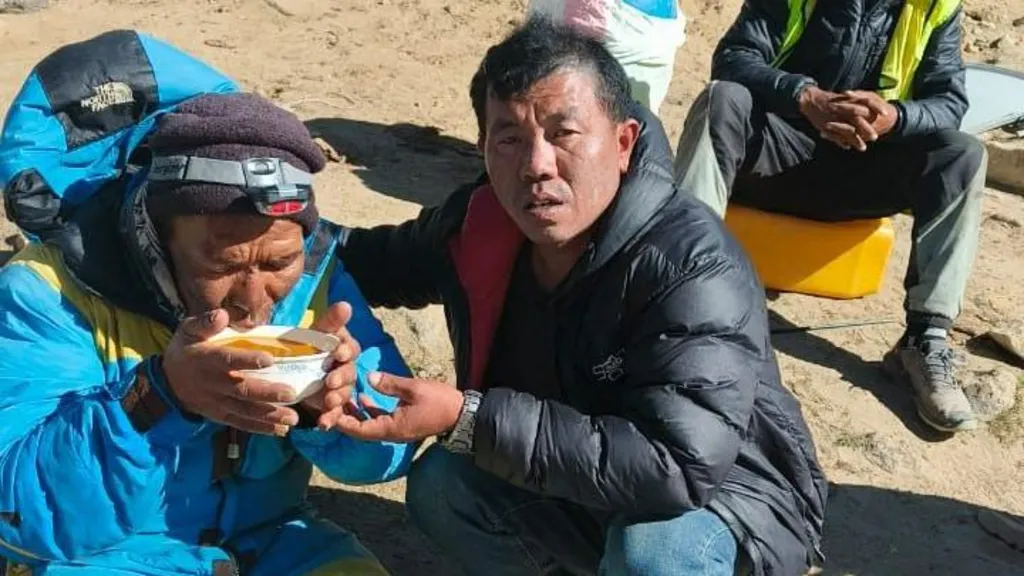
A veteran Nepali mountain guide who was feared dead on Mount Everest has been found alive after surviving nearly a week alone in one of the world’s harshest environments.
Dawa Sherpa, an experienced climbing guide known as “Hillary Dawa Sherpa,” disappeared while descending from the summit of Everest and was presumed lost after search efforts failed to locate him. Six days later, rescuers and cleanup workers spotted him slowly making his way down the mountain toward Base Camp.
Climbers and expedition leaders are describing his survival as nothing short of extraordinary.
The 52-year-old was later airlifted to a hospital in Kathmandu, where doctors say he is awake, responsive, and undergoing treatment.
What happened to Dawa Sherpa on Mount Everest?
Dawa Sherpa was last seen above Camp 3 at an altitude of roughly 7,500 meters (24,600 feet) while descending from Everest’s summit.
The area lies deep within what mountaineers often call the “death zone,” where oxygen levels are dramatically lower than at sea level, and survival becomes increasingly difficult.
As members of his expedition continued their descent, Dawa Sherpa failed to rejoin the group.
Days passed without contact.
With no confirmed sightings and severe weather conditions complicating search efforts, many feared the veteran guide had died on the mountain.
Even his family began preparing for the worst.
According to reports, his wife had performed the last rites traditionally offered for someone believed to have passed away.
How was he found?
The breakthrough came when a cleanup crew working near the Khumbu Icefall spotted a lone climber slowly moving downhill.
The man turned out to be Dawa Sherpa.
Witnesses described him as weak but conscious, gradually making his way toward safety despite days spent alone at extreme altitude.
Expedition organizers quickly coordinated a rescue operation and arranged for a helicopter evacuation.
A remarkable self-rescue
Pemba Sherpa, executive director of the expedition company involved in the search, called the survival story unprecedented.
According to the rescue team, Dawa Sherpa managed to descend largely on his own despite suffering frostbite and enduring some of the harshest conditions found anywhere on Earth.
“This is a true self-rescue,” expedition officials said.
Why surviving six days alone on Everest is so extraordinary
Mount Everest presents dangers that extend far beyond freezing temperatures.
At elevations above 8,000 meters (26,247 feet), oxygen levels drop to roughly one-third of those available at sea level.
Even below that altitude, climbers face numerous life-threatening risks, including:
- Severe hypoxia (oxygen deprivation)
- Frostbite
- Dehydration
- Exhaustion
- Snow blindness
- High-altitude cerebral edema (brain swelling)
- High-altitude pulmonary edema (fluid in the lungs)
The challenge of survival
Most climbers rely heavily on:
- Supplemental oxygen
- Team support
- Fixed ropes
- Established camps
- Emergency supplies
Being isolated for nearly a week dramatically increases the likelihood of fatal complications.
That reality is why experienced Everest climbers have reacted with astonishment to Dawa Sherpa’s survival.
Several expedition leaders noted that few documented cases exist of climbers surviving alone for such an extended period at those elevations.
What may have helped him survive?
While details remain limited, mountaineering experts believe several factors may have contributed.
Extensive mountain experience
Dawa Sherpa is not a novice climber.
Like many veteran Nepali guides, he has spent years navigating Everest’s dangerous terrain and understanding how to manage extreme conditions.
Experience often plays a critical role in life-or-death situations.
Access to camps and shelter
Rescuers speculate that he may have taken refuge in tents or temporary shelters left at high camps.
Even minimal protection from wind can significantly improve survival chances.
Mental resilience
Survival experts frequently emphasize that determination and decision-making can be just as important as physical strength in extreme environments.
The fact that Dawa Sherpa continued descending despite frostbite and exhaustion likely played a key role in reaching safety.
The dangers of the Khumbu Icefall
Dawa Sherpa was ultimately found near the Khumbu Icefall, one of Everest’s most dangerous sections.
The icefall is a constantly shifting maze of:
- Deep crevasses
- Massive ice towers
- Unstable snow bridges
It serves as the primary route connecting Everest Base Camp to higher camps on the mountain.
Because the glacier is continually moving, conditions can change rapidly, making navigation especially hazardous.
For exhausted climbers, the area presents additional challenges due to its technical difficulty and unpredictable terrain.
A difficult season on Everest
Dawa Sherpa’s rescue comes during one of Everest’s busiest climbing seasons on record.
More than 1,000 successful summit ascents were recorded during the 2026 season, according to reports.
However, the mountain has also claimed multiple lives.
At least five people reportedly died during this year’s climbing season, including several Nepali workers involved in preparing routes and supporting expeditions, according to news agency AFP.
The contrasting stories highlight the razor-thin margin between survival and tragedy on the world’s highest peak.
Family’s relief after days of uncertainty
For Dawa Sherpa’s family, the discovery ended nearly a week of anguish.
His daughter later told reporters that he recognized visitors and was able to speak while receiving treatment.
Doctors have indicated that he remains stable despite frostbite injuries.
The recovery process is expected to continue in Kathmandu, where specialists are monitoring his condition.
Why is this story capturing global attention
Mount Everest has produced countless stories of endurance, courage, and survival.
Yet even by Everest standards, Dawa Sherpa’s experience stands out.
The image of a climber presumed dead slowly emerging from the mountain after six days alone has resonated around the world because it challenges expectations about what is physically possible.
It also shines a spotlight on the often-overlooked Sherpa guides whose expertise makes modern Everest expeditions possible.
For many in the climbing community, the rescue serves as a reminder that while Everest remains unforgiving, extraordinary human resilience can still produce outcomes that seem almost impossible.
The takeaway
Dawa Sherpa’s survival on Mount Everest is being hailed as one of the most remarkable rescue stories of the 2026 climbing season. After disappearing while descending from the summit and being feared dead for six days, the veteran Nepali guide was discovered alive and making his own way toward Base Camp.
Though he suffered frostbite, doctors say he is alert and recovering. For fellow climbers and rescuers, his survival represents a rare example of endurance against overwhelming odds on the world’s highest mountain.
TL;DR
Veteran Nepali guide Dawa Sherpa, who was feared dead after disappearing on Mount Everest, was found alive six days later, crawling toward Base Camp. Rescuers describe the survival as a miracle given the extreme altitude, freezing conditions, and isolation he endured. He is now recovering in a Kathmandu hospital.