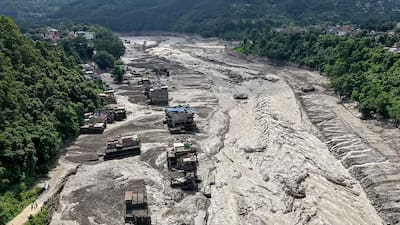
A powerful Nepal flash flood that tore through Rasuwa district on August 26 has left communities facing a new threat: the possibility of another sudden release of water from an unstable blockage upstream near the Nepal-China border.
The warning comes as scientists investigate what triggered the original disaster, which sent water, sediment and massive boulders racing through the Bhote Koshi and Trishuli river systems. The flood rose with extraordinary speed, overwhelming settlements, infrastructure and hydrological monitoring stations.
The International Centre for Integrated Mountain Development (ICIMOD), a Kathmandu-based intergovernmental organization focused on the Hindu Kush Himalayas, said scientists are investigating whether an ice-rock avalanche in the high-altitude Lhende Khola area triggered the event. ICIMOD cautioned that the cause remains unconfirmed.
What happened in Nepal on August 26?
The disaster began around 9 a.m. local time, when water levels in the Bhote Koshi basin began rising rapidly.
The river enters Nepal from Tibet and flows through the mountainous Rasuwa region before connecting with the Trishuli river system farther downstream. The sudden surge carried not just water but large quantities of sediment, ice and rock debris.
The speed of the flood wave helps explain why the event caused such extensive destruction.
According to ICIMOD’s preliminary assessment:
- Water levels in the Trishuli River at Galchchi rose by as much as 9 meters in 30 minutes.
- Levels at Malekhu increased by about 7 meters over a similar period.
- Several hydrological monitoring stations were damaged or swept away.
- Infrastructure, settlements and hydropower facilities along the river system were affected.
A useful visual here would be a timeline graphic showing the flood’s movement from Lhende Khola to Bhote Koshi and then into the Trishuli River, alongside the rapid changes in water levels.
What triggered the Nepal flash flood?
Scientists are still working to establish the precise sequence of events.
The leading hypothesis is that an ice-rock avalanche occurred at high altitude and sent a large volume of ice and rock into the Lhende Khola, a tributary of the Bhote Koshi.
The debris may have temporarily blocked the river, creating a natural dam. Water then accumulated behind the blockage before being released suddenly downstream.
ICIMOD said researchers from Nepal and China are examining satellite imagery, seismic records, hydrological data and field observations to determine what happened.
Nepal’s Department of Hydrology and Meteorology has also been examining evidence that debris blocked the river roughly 20 kilometers upstream of the Miteri Bridge, potentially forming a temporary lake that later burst.
That distinction matters. A flash flood caused by intense rainfall behaves differently from one caused by the sudden failure of a natural debris or ice dam. In the latter scenario, a large volume of water can be released almost instantaneously, leaving communities downstream with little time to react.
Was an earthquake responsible?
Scientists are also examining unusual seismic signals recorded around the time of the disaster.
ICIMOD said a seismometer near Jilong, around 12 kilometers from the affected area, recorded anomalous signals, while another station at Zhangmu also registered unusual activity. However, researchers have not established a causal connection between those signals and the flood.
This is an important distinction because early reports attributed the disaster partly to seismic activity. The scientific picture remains under investigation, and the avalanche hypothesis should not be presented as a conclusively proven chain of events.
Why is there a risk of a second flood?
The immediate concern is that the first flood may not have removed all of the unstable material upstream.
ICIMOD’s Head of Climate and Environmental Risks, Qianggong Zhang, said a blockage remains lodged near the Nepal-China border. Authorities have warned of another possible flood, with evacuation orders reportedly issued for Jilong port.
The underlying danger is relatively straightforward:
- Ice and rock debris blocks a river channel.
- Water accumulates behind the blockage.
- The temporary barrier becomes unstable.
- The barrier fails or is overtopped.
- A concentrated surge of water and debris moves rapidly downstream.
A second release could therefore occur even after the first flood has passed.
However, it is important not to interpret the warning as proof that another catastrophic flood will definitely occur. Scientists are still assessing the size, location and stability of the suspected blockage.
Consider adding an infographic here explaining how a temporary natural dam can form and fail.
Which areas are at risk?
The potential danger extends beyond Rasuwa.
The Bhote Koshi feeds into the Trishuli system, meaning that a major upstream release can affect communities considerably farther downstream.
Scientists and authorities are monitoring areas including:
- Rasuwa, where the initial event occurred;
- Nuwakot, farther downstream along the Trishuli;
- Dhading, which could also experience rising river levels;
- Settlements and infrastructure located directly along riverbanks;
- Hydropower facilities and other infrastructure in the river corridor.
The geography of the Himalayas makes the situation particularly difficult. Steep valleys can funnel water and debris into narrow channels, allowing a flood wave to travel rapidly while limiting escape routes.
How severe is the disaster?
The human toll has continued to change as rescue teams search affected areas.
Nepalese authorities initially reported at least 157 deaths, while hundreds of people remained unaccounted for. Nepal’s tourism authorities said 403 people, including 341 foreign nationals, had been reported missing in connection with the floods.
Later reports have produced higher casualty and missing-person figures as search operations expanded across Nepal and neighbouring China. Because rescue and identification efforts remain underway, casualty figures should be treated as provisional and time-stamped.
The large number of missing foreign nationals reflects the region’s importance as a gateway toward Tibet and Mount Kailash, as well as its significance for trekkers and pilgrims.
Why can Himalayan floods become so destructive so quickly?
The Himalayas contain steep terrain, glaciers, unstable slopes and numerous rivers that respond rapidly to sudden changes upstream.
An event high in the mountains can therefore have consequences far downstream.
In this case, the reported nine-meter rise at Galchchi within 30 minutes illustrates the problem. A river does not need to rise gradually for a community to be at risk. A sudden pulse of water and debris can transform a relatively normal river into a destructive torrent in a matter of minutes.
The presence of boulders and sediment makes such floods especially dangerous. The water itself is only part of the threat; rocks, trees, vehicles and structural debris can become moving projectiles capable of destroying bridges and buildings.
Is climate change behind the Nepal flood?
Climate change is an important part of the broader risk picture, but scientists are cautioning against drawing a direct conclusion about this particular event.
ICIMOD has noted that the Hindu Kush Himalaya is experiencing rapid changes affecting glaciers, snow, permafrost and mountain slopes. These changes can influence the stability of high-altitude environments and increase exposure to cryosphere-related hazards.
But ICIMOD has explicitly cautioned that it is too early to determine what role climate change played in this specific flood.
That distinction is crucial. A changing climate can alter the conditions in which hazards occur without making every individual avalanche, landslide or flood directly attributable to climate change.
What happens next?
For authorities, the immediate priority is monitoring the suspected upstream blockage and protecting communities that could be affected by another release.
Scientists are using several forms of evidence, including:
- Satellite and remote-sensing imagery;
- River-level and hydrological measurements;
- Seismic data;
- Field observations;
- Information from authorities in Nepal and China.
The cross-border nature of the hazard also makes coordination essential. The source area is near the Nepal-China border, while the river system carries the consequences deep into Nepal.
ICIMOD has called for stronger regional cooperation as cryosphere-related hazards become increasingly visible across the Himalayan region.
Why the second-flood warning matters
The most important lesson from the Nepal flash flood is that the disaster may not end when the first surge passes.
A flood generated by the failure of an unstable natural blockage can create a secondary hazard if additional debris remains upstream. That makes continued monitoring as important as the initial rescue operation.
For communities downstream, the central concern is time. A blockage failure can produce a rapid flood wave, leaving little opportunity for people near river channels to move to safety.
For scientists, the challenge is determining whether the suspected blockage is stable, how much water may be held behind it and what would happen if it fails.
For governments, the event highlights the need for reliable early-warning systems, functioning river gauges and rapid communication across borders.
The investigation into the August 26 disaster is still developing. Until researchers establish the precise cause and determine the condition of the upstream blockage, the possibility of another surge remains a serious concern — but it should be described as a risk under assessment, not a certainty.