

South Korea’s political crisis entered a decisive new phase on January 16, 2026, when a Seoul court sentenced former president Yoon Suk Yeol to five years in prison over his role in a failed attempt to impose martial law last year.
The ruling marks one of the most dramatic downfalls of a modern South Korean leader and underscores how firmly the country’s courts are willing to act when democratic norms are challenged from the top.
Within the first year after his removal from office, Yoon now faces prison time, multiple ongoing trials, and the possibility of even harsher punishment. The case has reignited debates about presidential power, accountability, and how resilient South Korea’s democracy really is under stress.
What did the court decide in Yoon Suk Yeol’s case?
On Friday, Seoul’s Central District Court found Yoon guilty of obstructing justice and related charges stemming from his actions during and after his December 2024 martial law declaration.
Judge Baek Dae-hyun ruled that Yoon deliberately blocked investigators from executing an arrest warrant and improperly excluded cabinet members from a key meeting where the martial law plan was discussed.
In sentencing Yoon to five years in prison, the judge delivered unusually blunt criticism of the former leader’s conduct.
Why obstruction of justice mattered so much
According to the court, Yoon used his position and loyal security personnel to delay or prevent investigators from carrying out their legal duties. Prosecutors argued this was not a technical violation but a direct attempt to place himself above the law.
Judge Baek agreed, stating that Yoon had a higher duty than any other official to uphold the constitution.
Charges the court rejected
The court did not find Yoon guilty of forging official documents, citing insufficient evidence. This partial acquittal spared him additional prison time but did little to soften the broader judgment of his actions.
Prosecutors had sought a 10-year sentence, arguing that Yoon’s conduct represented a sustained effort to undermine lawful governance.
Why did Yoon attempt to impose martial law?
Yoon’s December 2024 declaration of martial law shocked South Korea and triggered massive protests almost immediately. Lawmakers rushed to the National Assembly, while crowds filled the streets of Seoul demanding his removal.
Yoon has consistently argued that his decision was lawful and necessary.
Yoon’s justification, in his own words
In court, Yoon maintained that he was exercising constitutional emergency powers to protect the nation. He framed his actions as a response to what he called an “unconstitutional dictatorship” imposed by the opposition-controlled parliament.
“There was no other option but to awaken the people, who are the sovereign,” Yoon said during his defense.
From his perspective, martial law was a political warning shot rather than a coup.
Why critics rejected that argument
Legal experts and opposition lawmakers strongly disagreed. They argued that South Korea’s constitution allows emergency powers only under extreme and clearly defined conditions, such as war or widespread armed rebellion.
None of those thresholds were met in December 2024.
How did South Korea respond to the martial law declaration?
The response was swift and unusually unified for a deeply polarized political system.
Mass protests and parliamentary resistance
Within hours of the declaration, tens of thousands of protesters gathered outside the National Assembly. Lawmakers, some physically blocked by security forces, forced their way into the building and voted to nullify the order.
The images quickly went global, reinforcing South Korea’s reputation as a society unwilling to tolerate authoritarian backsliding.
Impeachment and removal from office
Following the failed martial law attempt, parliament launched impeachment proceedings. Yoon was suspended and later formally removed from office after the Constitutional Court upheld the impeachment.
That decision cleared the way for criminal investigations that ultimately led to Friday’s sentencing.
What other legal trouble does Yoon still face?
The five-year sentence does not end Yoon’s legal battles. In fact, it may be the least severe of his potential punishments.
Insurrection charges and the death penalty
In a separate and far more serious case, prosecutors are seeking the death penalty, accusing Yoon of acting as the “ringleader of an insurrection.”
They argue that the martial law attempt was not merely unconstitutional but a direct threat to South Korea’s democratic order.
Prosecutors have emphasized:
- The scale of the political disruption
- Yoon’s lack of remorse
- The precedent such actions could set if left lightly punished
A verdict in this case is expected on February 19.
Allegations involving North Korea
Yoon is also facing charges of assisting the enemy. Prosecutors allege that he ordered drone flights over North Korea to create security tensions that could justify his martial law declaration.
If proven, this would represent one of the most serious abuses of national security authority in South Korea’s modern history.
Why this verdict matters beyond Yoon Suk Yeol
This case is about more than one former president. It is a stress test of South Korea’s democratic institutions.
A warning to future leaders
By sentencing a former president to prison, the court sent a clear message: constitutional violations at the highest level will carry real consequences.
South Korea has jailed ex-presidents before, often on corruption charges. But this case is different. It centers on the misuse of emergency powers and the attempted suspension of democratic processes.
That distinction matters.
Reinforcing the rule of law
Judge Baek’s language emphasized that presidential authority does not supersede the constitution. For many South Koreans, the verdict reaffirmed confidence in the judiciary at a time when democratic erosion is a global concern.
International observers have also taken note, particularly in countries grappling with executive overreach.
How the public and political world reacted
Reactions to the verdict were sharply divided but intense.
Supporters and critics respond
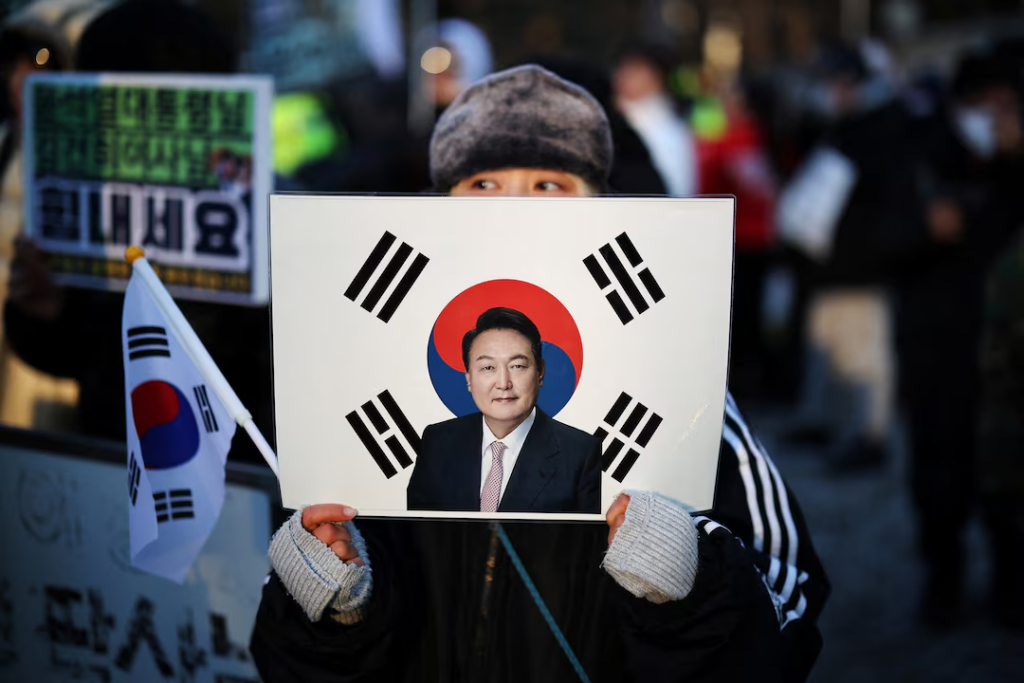
Outside the courthouse, protesters both for and against Yoon gathered, reflecting the deep polarization that marked his presidency.
Some supporters argued that the sentence was politically motivated. Critics countered that it was lenient, given the severity of the charges and the damage caused.
Yoon himself appeared calm, even smiling at times, as prosecutors reiterated their push for harsher punishment.
Political fallout for South Korea
The case has already reshaped South Korea’s political landscape. Parties across the spectrum are now debating reforms to limit presidential emergency powers and strengthen oversight mechanisms.
What happens next in Yoon’s legal saga?
Yoon has seven days to appeal the five-year sentence. Legal analysts expect him to do so, though the appeal may have limited impact given the detailed reasoning in the court’s ruling.
The more consequential moment will come in February, when the court rules on the insurrection charges.
Possible outcomes include:
- Acquittal on insurrection charges, leaving the five-year sentence intact
- A longer prison term
- A death sentence, though such penalties are rare and politically sensitive
Each scenario would carry significant domestic and international implications.
TL;DR
- Former South Korean president Yoon Suk Yeol was sentenced to five years in prison for obstructing justice linked to his failed martial law bid.
- The court found he blocked investigators and sidelined cabinet members during planning.
- He was cleared of document forgery but faces far more serious charges, including insurrection.
- Prosecutors are seeking the death penalty in a separate case, with a verdict expected on February 19.
- The ruling reinforces limits on presidential power and highlights the strength of South Korea’s democratic institutions.


