
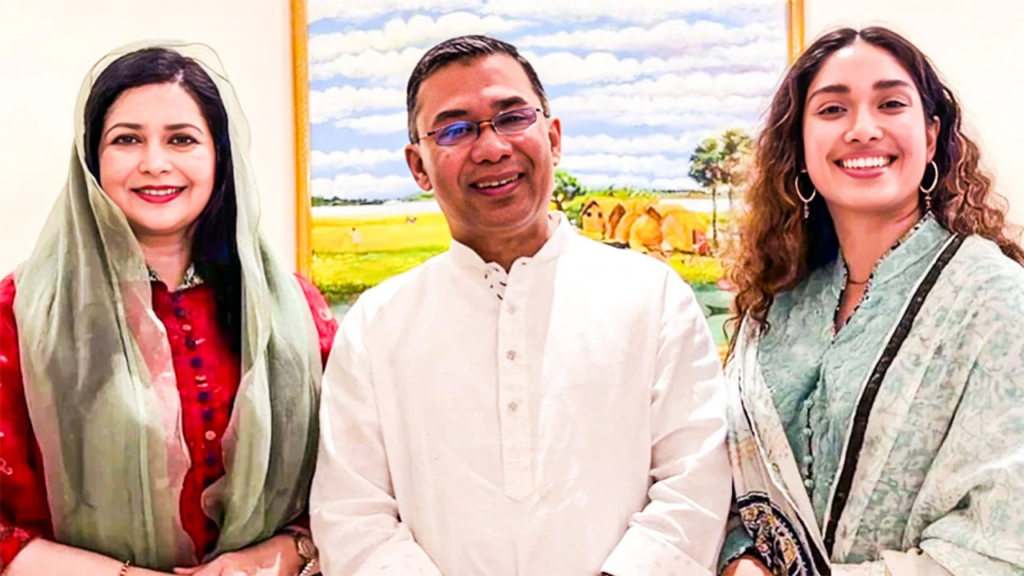
Tarique Rahman’s political comeback has reshaped Bangladesh’s post-2024 landscape—and forced New Delhi to recalibrate its regional strategy. With the Bangladesh Nationalist Party (BNP) emerging victorious in the latest elections, Rahman, the party’s acting chairperson, is now widely expected to take charge as Bangladesh’s next prime minister. India has already moved quickly to engage, signalling a pragmatic willingness to turn the page after a turbulent year in bilateral ties.
For New Delhi, the moment is delicate: balancing outreach to a new leadership while navigating the unresolved presence of former prime minister Sheikh Hasina on Indian soil.
Who is Tarique Rahman, and why does his return matter?
Tarique Rahman is the son of former prime minister Khaleda Zia and has long been one of the most polarizing figures in Bangladeshi politics. After spending 17 years in exile in London, Rahman returned to Bangladesh in December, marking a dramatic re-entry just months after the ouster of Sheikh Hasina in 2024.
The BNP’s win has been welcomed by India, which views the party as a more liberal and democratic alternative to Islamist forces such as Jamaat-e-Islami. The election outcome has opened space for diplomatic reset—something both sides appear eager to test.
Why is India warming up to the BNP now?
India’s swift congratulations were not accidental. Relations with Dhaka had cooled sharply after Hasina’s removal, creating uncertainty along a sensitive eastern border.
New Delhi’s calculus appears driven by three factors:
- Stability: India prefers a functioning, broadly acceptable civilian government in Dhaka over prolonged instability.
- Ideology: Compared with Jamaat-e-Islami, the BNP is seen as less overtly Islamist.
- Regional balance: Rahman has signaled distance from the interim administration’s perceived tilt toward Pakistan and China.
Prime Minister Narendra Modi publicly congratulated Rahman even before official results were declared—an unusually early signal of intent.
What is Rahman’s “Bangladesh First” agenda?
Rahman has framed his platform as “Bangladesh First,” echoing the nationalist tone popularised by Donald Trump’s “America First” slogan, but adapted to local realities.
Core pillars of his stated approach:
- Strategic equidistance from India, China, and Pakistan
- Avoidance of overt anti-India rhetoric, even amid domestic tensions
- Focus on sovereignty and national interest, summed up in his line:“Not Dilli, Not Pindi, Bangladesh before everything.”
For India, this is reassuring but not frictionless. Equidistance suggests engagement without alignment—a relationship likely to be transactional rather than warm.
How has India reached out to Rahman?
India’s diplomatic outreach accelerated after Khaleda Zia’s illness and subsequent death, a moment of political sensitivity.
Key steps included:
- Expressions of concern and support from PM Modi
- A visit to Dhaka by External Affairs Minister S Jaishankar
- Delivery of a personal letter from Modi to Rahman, making Jaishankar the first senior Indian leader to visit Dhaka after the 2024 unrest
This early engagement suggests New Delhi wants to establish working channels before policy lines harden.
What about violence against Hindus and security concerns?
Recent violence against Hindus in Bangladesh has been closely watched in India. Rahman has addressed the issue directly—at least rhetorically.
In a public address, he promised to:
- “Build a safe Bangladesh” for all citizens
- Uphold the principle that “Religion is individual, but the state belongs to everyone.”
These statements have offered cautious optimism in New Delhi. However, Rahman has also taken firm positions on long-standing disputes.
Issues likely to test relations:
- Border killings along the India-Bangladesh frontier
- River water sharing, especially the Teesta and Padma rivers, which Rahman calls matters of “national survival”
The Hasina factor: a diplomatic landmine?
Despite the warming rhetoric, Sheikh Hasina’s presence in India remains a potential flashpoint.
Rahman has warned that if India continues to “shelter a dictator,” it risks earning “the resentment” of the Bangladeshi public. Other BNP leaders have echoed this sentiment, suggesting Hasina’s status could become a bargaining chip—or a point of open contention.
For India, the dilemma is stark:
- Protect a former ally and risk alienating Dhaka’s new leadership
- Or distance itself from Hasina and signal neutrality going forward
Neither option is cost-free.
Rahman’s controversial past: why skepticism remains
Rahman’s reinvention as a statesman is still shadowed by his record.
During his mother’s tenure, he was accused of running Hawa Bhaban, an office described by critics as an alternative power center within the BNP government. Indian officials at the time alleged that Dhaka tolerated Pakistan-based militant groups.
A classified U.S. diplomatic cable from 2005 reportedly labelled him “The Dark Prince,” a nickname revived in later media reports, including a 2008 corruption investigation highlighted by the Dhaka Tribune.
These allegations have never fully disappeared—and they continue to shape how foreign capitals assess him.
What does this mean for India-Bangladesh relations?
If Rahman assumes office, relations with India are likely to be:
- More transactional than ideological
- Less overtly aligned, but not openly hostile
- Defined by negotiations on water, borders, and minority safety
New Delhi appears willing to give Rahman political space—while keeping its guard up.
TL;DR
- Tarique Rahman’s expected rise marks a major shift in Bangladesh’s politics.
- India has welcomed the BNP’s victory and moved quickly to re-engage.
- Rahman promises a “Bangladesh First” policy and strategic equidistance from India, China, and Pakistan.
- Violence against Hindus and river-sharing disputes remain key tests.
- Sheikh Hasina’s presence in India could strain ties.
- Rahman’s controversial past ensures skepticism will linger despite the diplomatic reset.