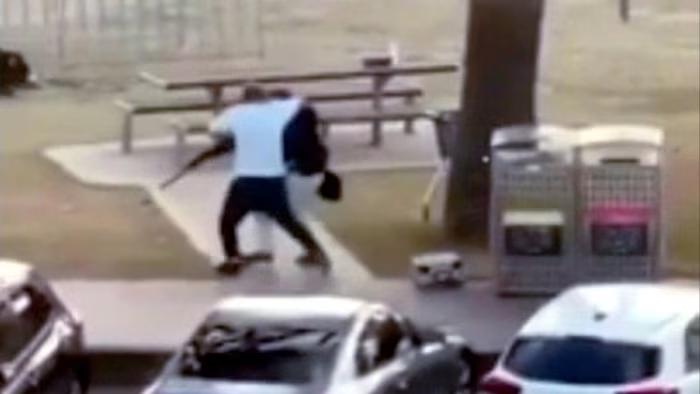
Australian authorities are facing urgent questions after revelations that one of the alleged attackers in the Bondi Beach shooting had previously been investigated for possible links to the Islamic State group. The attack, which unfolded during a Hanukkah gathering at Sydney’s iconic Bondi Beach, killed at least 15 people and injured more than 40, marking one of the deadliest terror-linked incidents in Australia in recent years.
At the center of the investigation is a father-son duo identified as Sajid Akram, 50, and Naveed Akram, 24. While police say the attack appears to have been ideologically motivated and targeted at Jewish Australians, new details about past intelligence assessments are raising difficult questions about threat monitoring, radicalization, and warning signs.
What happened at Bondi Beach?
The shooting occurred on Sunday during a Hanukkah festival attended by families and community members. Witnesses described scenes of panic as gunfire erupted along the beachfront, a place usually associated with leisure rather than violence.
Emergency responders rushed to the area as police engaged the attackers. Sajid Akram, the father, was killed in a shootout with police at the scene. His son, Naveed Akram, was critically injured and remains hospitalized under police guard.
Authorities have confirmed that the attack left 15 people dead and more than 40 injured, some with life-threatening wounds.
Australian Prime Minister Anthony Albanese described the incident as a “targeted attack on Jewish Australians,” adding that the country would “never submit to division and hatred.”
Who are the accused attackers?
Police have identified the alleged gunmen as Sajid Akram and his son Naveed Akram. Officials have not released extensive biographical details, but investigators say both men are believed to have embraced extremist Islamic State ideology.
According to senior officials cited by Australian media, investigators believe both attackers had pledged allegiance to the Islamic State group. Two Islamic State flags were reportedly found inside their vehicle at the scene, a discovery that reinforced early suspicions about ideological motivation.
The father’s death has shifted much of the legal focus to the surviving son, who may face criminal charges once his medical condition stabilizes.
Why ASIO investigated Naveed Akram in 2019
One of the most significant revelations to emerge since the attack is that Australian intelligence had previously looked into Naveed Akram.
According to public broadcaster ABC News, the Australian Security Intelligence Organisation, or ASIO, investigated Naveed in 2019 due to his links to an individual who was later arrested and convicted of preparing a terrorist act in Australia.
At the time, ASIO assessed Naveed Akram as a person of interest rather than an imminent threat. Intelligence agencies routinely investigate individuals connected to extremist networks, but only a small fraction are assessed as posing an immediate risk.
ASIO Director-General Mike Burgess confirmed that one of the attackers was known to the agency but said intelligence officials did not believe he posed a direct or urgent danger at the time.
“So, obviously we need to look into what happened here,” Burgess said, signaling an internal review of how the threat assessment was made.
How threat assessments work—and why they can fail
The revelation that Naveed Akram had been on ASIO’s radar is likely to prompt public debate about intelligence failures. But experts caution that such cases are rarely straightforward.
Australia, like other Western democracies, tracks thousands of individuals for potential extremist connections. Only a small subset are subject to active surveillance at any given time, based on factors such as intent, capability, and immediacy of threat.
Threat assessments typically consider:
- Direct communication with known extremists
- Evidence of operational planning
- Access to weapons or training
- Expressions of intent to carry out violence
In 2019, ASIO reportedly did not believe Naveed Akram met the threshold for immediate intervention. That assessment may now be reexamined, but officials stress that hindsight can distort how intelligence decisions are judged.
What officials are saying now
In the days following the attack, senior officials have sought to balance transparency with caution.
ASIO Director-General Mike Burgess acknowledged prior knowledge of one of the attackers while emphasizing that intelligence agencies must constantly weigh competing risks and limited resources.
New South Wales Police Commissioner Mal Lanyon confirmed that the surviving suspect could face criminal charges once doctors determine he is fit to be interviewed and appear in court.
“What’s really important is to say we do have a 24-year-old male in hospital at the moment,” Lanyon said at a news conference. “Based on his medical condition, it is likely that that person may face criminal charges.”
He added that police were being careful not to prejudice any future prosecution.
Why is the attack being treated as terrorism
Authorities have not yet formally announced terrorism charges, but multiple indicators point in that direction.
Investigators are focusing on:
- The alleged pledge of allegiance to the Islamic State
- The presence of Islamic State flags at the scene
- The timing and location of the attack during a Jewish religious celebration
- Statements made by officials describing it as a targeted attack
If terrorism charges are pursued, the case would fall under Australia’s strict counterterrorism laws, which carry severe penalties, including life imprisonment.
The broader threat of lone-actor and family-based extremism
The Bondi Beach shooting highlights a pattern that has increasingly concerned security agencies worldwide: attacks carried out by small cells or family members rather than large, organized networks.
Extremist groups such as Islamic State have long encouraged supporters to act independently, using whatever means are available. This strategy makes detection more difficult, particularly when individuals radicalize privately or online.
Family-based radicalization presents additional challenges. Shared ideology, trust, and proximity can accelerate planning while reducing the chance that outsiders notice warning signs.
Impact on Australia’s Jewish community
The attack has deeply shaken Australia’s Jewish community, particularly because it occurred during Hanukkah, a time typically associated with celebration and public gatherings.
Community leaders have called for increased security at synagogues, schools, and cultural events. Police have responded by boosting patrols in areas with large Jewish populations and around religious sites.
Prime Minister Albanese said the attack struck at Australia’s core values of multiculturalism and tolerance, emphasizing that antisemitism and extremist violence would not be allowed to take root.
What happens next in the investigation?
Several parallel investigations are now underway:
- A criminal investigation into the surviving suspect
- A counterterrorism inquiry into extremist links and networks
- An internal ASIO review of past intelligence assessments
- A broader security review of public events and religious gatherings
Prosecutors will ultimately decide what charges to bring, based on medical evaluations, evidence gathered at the scene, and intelligence findings.
As with all major terror cases, authorities are urging the public to avoid speculation and rely on verified information.
Why this case matters beyond Australia
While the Bondi Beach shooting is a national tragedy, its implications extend beyond Australia’s borders.
It underscores:
- The enduring threat posed by Islamic State-inspired extremism
- The difficulty of predicting which radicalized individuals will turn violent
- The limits of intelligence monitoring in open societies
For policymakers and security agencies globally, the case is likely to be studied as another example of how past intelligence flags do not always translate into timely prevention.
TL;DR
Australian intelligence investigated Naveed Akram in 2019 for links to an Islamic State member but did not assess him as an immediate threat. In December 2025, he and his father allegedly carried out a deadly shooting at a Hanukkah event at Bondi Beach, killing 15 people. The father was killed by police, while the son remains hospitalized and may face criminal charges. Authorities are now reviewing both the attack and earlier intelligence decisions.