
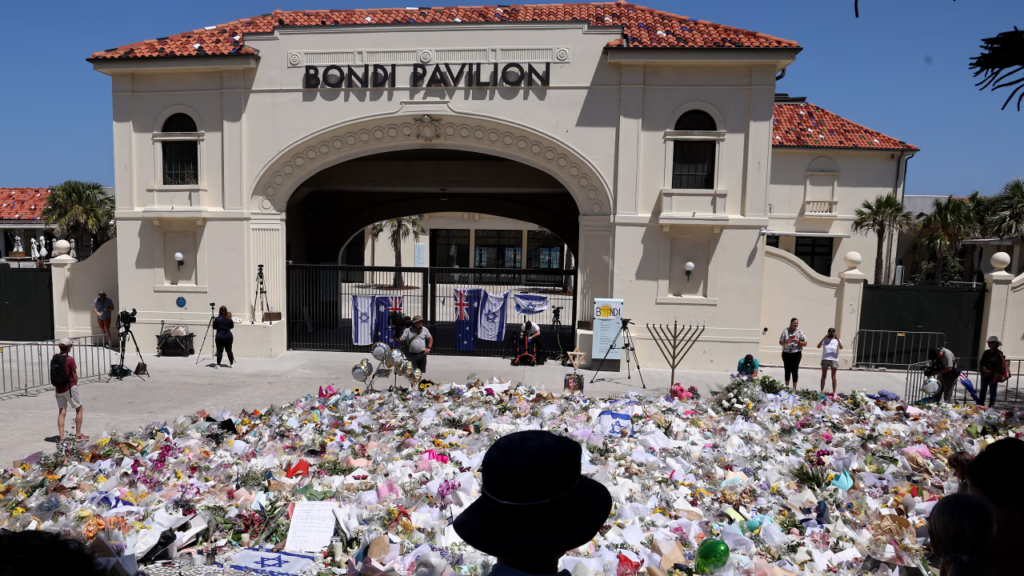
Australian investigators probing the Bondi Beach terror attack have revealed new details about the movements of the attackers in the weeks leading up to the deadly shooting in Sydney. According to authorities, the father-and-son duo behind the attack spent several weeks staying quietly at a budget hotel in the Philippines before returning to Australia.
The disclosures have added an international dimension to the investigation, prompting firm pushback from Manila, which has rejected any suggestion that the Philippines was used as a training ground for terrorism.
Here’s a clear breakdown of what is known so far, what remains disputed, and why these revelations matter.
What Do We Know About the Bondi Beach Shooters’ Stay in the Philippines?
A Low-Profile Hotel Stay
According to the reporting cited, the attackers, Sajid Akram and his son Naveed Akram, checked into room 315 of the GV Hotel in the Philippines on the same day.
Key details from hotel staff include:
- The room cost 930 Philippine pesos per night (roughly $16 USD)
- It contained two single beds
- The men reportedly stayed there for several weeks
- They rarely left the room, usually for only about an hour a day
Despite their withdrawn behavior, staff said the pair did not cause disturbances and even left a tip when they checked out.
Night desk manager Angelica Ytang told AFP that the men were noticeably different from other foreign guests.
“They weren’t approachable like other foreigners,” she said, adding that Naveed was the only one who spoke to her, while Sajid avoided eye contact and “always looked down.”
Why Are Authorities Focusing on the Philippines?
Australian Claims and Regional Sensitivities
Australian authorities have stated that both Sajid and Naveed entered the Philippines on November 1, drawing attention to the country’s southern regions—particularly Mindanao, which has a long history of Islamist insurgencies.
Officials have confirmed that:
- At least two Islamic State (ISIS) flags were found in the attackers’ car
- The attack is being investigated as an act of terrorism targeting the Jewish community
- Naveed Akram has been charged with terrorism, 15 counts of murder, and multiple other offenses.
Sajid Akram was killed during the shooting, while Naveed was arrested at the scene.
These findings prompted questions about whether the attackers may have received extremist training abroad.
Philippines Pushes Back: “Misleading Characterisation”
Strong Rejection From Manila
The Philippine government has categorically denied claims that the country served as a terrorist training hub for the attackers.
Presidential spokeswoman Claire Castro said President Ferdinand Marcos Jr. rejected what he called a sweeping and unfair portrayal of the country.
“President Ferdinand Marcos strongly rejects the sweeping statement and the misleading characterization of the Philippines as the ISIS training hotspot,” Castro said during a press briefing.
Philippine officials emphasized that no evidence has been found linking the attackers’ stay to any form of terrorist training.
What Does the Philippine Military Say?
Insurgency Groups “Largely Degraded”
While acknowledging the region’s troubled past, the Philippine military stressed that Islamist militant groups have been significantly weakened in recent years.
Military spokeswoman Colonel Francel Padilla stated:
- Armed groups have been fragmented
- They lack central leadership
- No major terrorist training or operations have been recorded since early 2024
“We have not recorded any major terrorist operations or training activities… since the beginning of 2024,” Padilla said.
Officials pointed to the aftermath of the 2017 Marawi siege, noting that sustained military operations have dismantled much of the infrastructure once used by extremist groups.
How Does This Fit Into Australia’s Investigation?
Terrorism Charges and Evidence
Australian police say the Bondi Beach shooting is being treated as a terrorist attack, citing:
- Ideological material recovered from the suspects
- The alleged targeting of the Jewish community
- Naveed Akram’s actions during the attack
The discovery of ISIS flags has intensified scrutiny of the attackers’ international movements, even as investigators stress that travel alone does not prove training or coordination.
Authorities are now working with international partners, including agencies in the Philippines and India, to reconstruct the attackers’ full timeline.
The India Connection: Sajid Akram’s Background
Origins in Hyderabad
It has also emerged that Sajid Akram was originally from Hyderabad, India, before migrating to Australia in November 1998.
According to the Telangana police:
- Akram visited India only six times in 27 years
- His family in Hyderabad did not know any radical ideology
- There were no local intelligence flags related to him
Indian authorities have stated they are fully cooperating with Australian investigators and other international agencies.
Why the Hotel Details Matter
Behavior, Not Just Geography
Security experts note that the significance of the hotel stay lies less in where the attackers stayed and more in how they behaved.
Red flags often assessed by investigators include:
- Extended isolation
- Minimal social interaction
- Low-cost accommodations used for long stays
- Lack of tourism or business activity
That said, officials caution against concluding without corroborating evidence.
As Philippine authorities have stressed, there is currently no proof that the men met extremists or received training during their stay.
A Delicate Balance: Security vs. Stigma
The episode highlights a recurring challenge in global counterterrorism reporting: balancing legitimate security concerns with the risk of stigmatizing entire regions or countries.
Mindanao’s past insurgencies are well-documented, but experts warn that outdated narratives can:
- Undermine regional cooperation
- Fuel misinformation
- Alienating communities is crucial to counterterrorism efforts
This is why Manila’s sharp response has resonated across Southeast Asia.
What Happens Next in the Bondi Beach Case?
Australian authorities say the investigation is ongoing, with a focus on
- Digital communications and online radicalization
- Financial records and travel patterns
- Possible local or international facilitators
Naveed Akram remains in custody and is expected to face a lengthy legal process. Prosecutors have indicated they will rely on both physical evidence and ideological material to support terrorism charges.
Why This Story Has Global Attention
International outlets have closely followed the case because it touches on:
- Lone-actor terrorism
- Cross-border travel and radicalization
- The responsibility of states in global counterterrorism narratives
The Philippines’ response, in particular, reflects broader concerns about how quickly countries can be labeled in the aftermath of attacks elsewhere.
TL;DR
- Bondi Beach attackers stayed for weeks in a Philippine budget hotel
- Hotel staff described them as quiet, withdrawn, and reclusive
- Australia raised concerns due to Mindanao’s insurgency history
- Philippines strongly denied being a terrorist training hub
- Military says extremist groups are fragmented and weakened
- Attack is being investigated as terrorism targeting the Jewish community
- India, Australia, and the Philippines are cooperating on the probe