China is rapidly expanding parts of its nuclear weapons infrastructure, with satellite imagery revealing a growing network of construction and testing facilities across the country, according to a report by The Daily Telegraph.
The analysis identifies at least seven sites that have undergone significant development in recent months. The facilities reportedly include large-scale testing infrastructure, research complexes and support facilities built around China’s nuclear program.
The developments come as President Xi Jinping has publicly backed nuclear non-proliferation and called for efforts to reduce nuclear risks. China also maintains a declared “no first use” nuclear policy.
The contrast between Beijing’s stated position and the expansion of its nuclear infrastructure is drawing renewed attention to the pace at which China is modernizing its nuclear forces.
What do satellite images show about China’s nuclear expansion?
Satellite imagery analyzed by The Daily Telegraph reportedly shows extensive construction around several Chinese nuclear facilities.
The sites are spread across China’s countryside and include infrastructure that appears designed to support nuclear-weapons research, testing and military operations.
Among the reported developments are:
- New buildings and large testing complexes
- Residential facilities and supporting infrastructure for workers
- Underground and enclosed testing areas
- High-powered laser research facilities
- Transport infrastructure and staff facilities
- Expansion of existing nuclear-related sites
At one location, the report says an entire town has developed around a nuclear facility. The complex reportedly includes apartment buildings, a bus depot for staff and playing fields.
The scale of the supporting infrastructure provides an indication of the resources being directed toward China’s nuclear program.
What is the 2,000-foot testing tube China reportedly built?
One of the more unusual facilities identified in the satellite analysis is reportedly a tube measuring about 2,000 feet in length.
According to The Daily Telegraph, Chinese researchers use the structure to study how nuclear weapons could be affected by an attack.
Large-scale experimental facilities can allow researchers to study the behavior of materials, shock waves and other physical effects under controlled conditions. However, satellite imagery alone cannot establish exactly what experiments are being conducted inside a facility.
That distinction is important when interpreting imagery-based reporting. Buildings and infrastructure can provide clues about a site’s purpose, but determining precisely what happens inside them generally requires additional intelligence or official documentation.
Are lasers being used in China’s nuclear research?
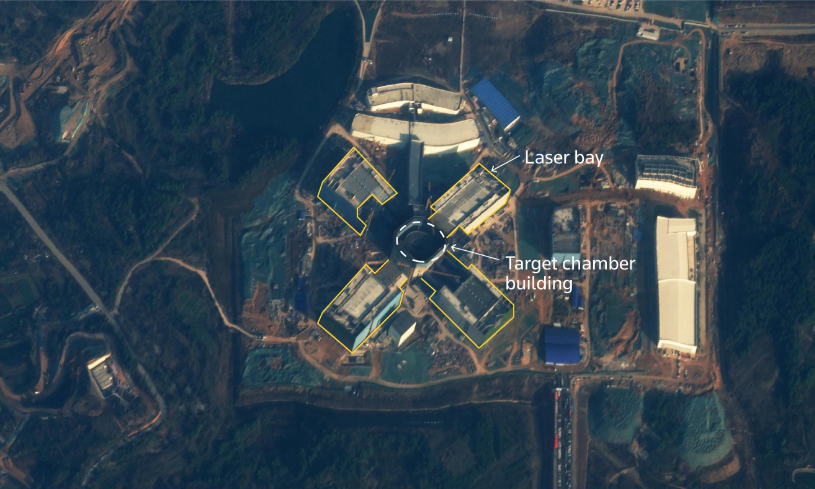
Another facility reportedly identified in the satellite analysis is believed to involve high-powered lasers.
Researchers can use sophisticated laser systems to recreate or study conditions relevant to nuclear weapons physics without conducting an actual nuclear explosion.
Such research is particularly relevant to countries seeking to maintain or modernize nuclear capabilities while observing restrictions on explosive nuclear testing.
China’s reported investment in these facilities therefore appears consistent with a broader effort to expand its ability to research and develop advanced nuclear technologies.
Has China’s nuclear arsenal grown under Xi Jinping?
China’s nuclear arsenal has expanded significantly during Xi’s leadership.
The Stockholm International Peace Research Institute (SIPRI) estimated that China had approximately 600 nuclear warheads in January 2025, up from an estimated 500 in January 2024. SIPRI said China was the fastest-growing nuclear arsenal among the world’s nine nuclear-armed states at the time.
The Pentagon has also projected substantial growth in China’s nuclear stockpile. Its 2024 report to Congress estimated that China possessed more than 600 operational nuclear warheads as of mid-2024 and could have more than 1,000 by 2030.
These estimates vary depending on methodology and the definition of an operational or total stockpile. They should therefore not be treated as an exact count.
China’s nuclear modernization also extends beyond simply increasing the number of warheads. Beijing is developing and deploying delivery systems capable of launching nuclear weapons from land, sea and air.
How far can China’s nuclear missiles reach?
China has developed a broad range of nuclear-capable delivery systems.
Its arsenal includes land-based ballistic missiles, submarine-launched ballistic missiles and nuclear-capable aircraft. Some of its intercontinental ballistic missiles have ranges sufficient to reach targets thousands of miles away.
The development of longer-range systems gives China the ability to hold targets at considerable distances at risk.
China’s growing nuclear capabilities are also being examined in the context of its development of a nuclear triad—the ability to deploy nuclear weapons from land, submarines and aircraft.
What is China’s official nuclear policy?
China says its nuclear strategy is fundamentally defensive.
Beijing has maintained a declared “no first use” policy, meaning it says it will not be the first to use nuclear weapons in a conflict.
China has also repeatedly called for nuclear disarmament and non-proliferation.
The country signed the Comprehensive Nuclear-Test-Ban Treaty (CTBT) in 1996, although the treaty has not entered into force because several required states, including China and the United States, have not ratified it.
China has nevertheless maintained its declared commitment to the no-first-use principle.
The expansion of its nuclear forces has consequently raised questions among other nuclear powers about how Beijing’s nuclear strategy is evolving.
Why is China’s nuclear buildup drawing international attention?
China’s nuclear expansion is taking place against a backdrop of already enormous US and Russian arsenals.
The United States and Russia continue to possess by far the world’s largest nuclear inventories. SIPRI estimated that Russia had about 5,459 total nuclear warheads and the United States about 5,177 in January 2025, although only a portion of those weapons were deployed.
China’s arsenal remains substantially smaller than either country’s.
However, the pace of China’s expansion is attracting attention because Beijing is simultaneously modernizing its delivery systems and building new nuclear infrastructure.
For Washington and other governments, the issue is therefore not simply the number of warheads China possesses today, but how quickly its capabilities are changing.
How much does China spend on nuclear weapons?
Estimating China’s nuclear-weapons spending is difficult because Beijing does not publicly provide a comprehensive nuclear budget.
The International Campaign to Abolish Nuclear Weapons estimated that China spent approximately $12.5 billion on its nuclear weapons program in 2024. Such figures are estimates rather than official Chinese budget disclosures.
The spending covers more than warheads themselves. Maintaining a nuclear force requires investment in missiles, submarines, aircraft, command-and-control systems, research facilities, personnel and supporting infrastructure.
The reported construction of new testing and research facilities therefore forms part of a much larger modernization effort.
What does the expansion mean for global nuclear security?
China’s buildup is changing the strategic environment for the world’s other nuclear powers.
For decades, nuclear planning was dominated by the enormous US and Russian arsenals. China’s growing force introduces another major variable, particularly as Beijing develops more sophisticated delivery systems and expands its ability to deploy nuclear weapons across different platforms.
That could complicate future arms-control negotiations.
A three-way strategic environment involving the United States, Russia and China is fundamentally different from the bilateral framework that shaped many previous US-Russian arms-control agreements.
It also raises questions about transparency.
China has historically disclosed considerably less information about the size and structure of its nuclear arsenal than the United States and Russia. The lack of detailed public information makes independent estimates and satellite imagery particularly important to analysts attempting to track developments.
Does China’s nuclear expansion contradict its no-first-use policy?
Not necessarily, but it creates questions about how China’s nuclear strategy is evolving.
A country can maintain a no-first-use policy while expanding and modernizing its nuclear forces. The two positions are not inherently incompatible.
The more difficult question is what role China intends its larger and more sophisticated arsenal to play in its long-term security strategy.
Outside governments and analysts can observe missile deployments, construction projects and other physical developments, but those observations do not necessarily reveal Beijing’s intentions.
China has continued to describe its nuclear weapons as defensive and has called for other nuclear-armed states to reduce their arsenals.
At the same time, the scale of its modernization has prompted the United States and other countries to scrutinize whether China’s nuclear posture is changing.
What happens next?
The reported expansion of China’s nuclear infrastructure is likely to remain a major issue in discussions about global strategic stability.
The satellite imagery offers evidence of extensive construction and modernization, but individual facilities should not automatically be described as nuclear weapons production or testing sites without corroborating evidence.
The broader trend is clearer: China’s nuclear forces are growing and becoming more sophisticated, while Beijing continues to describe its strategy as defensive.
That combination presents a complicated challenge for arms-control efforts.
The central question for policymakers is no longer simply how large China’s nuclear arsenal is. It is how China’s expanding capabilities, its no-first-use policy and the nuclear strategies of the United States and Russia will interact in the years ahead.