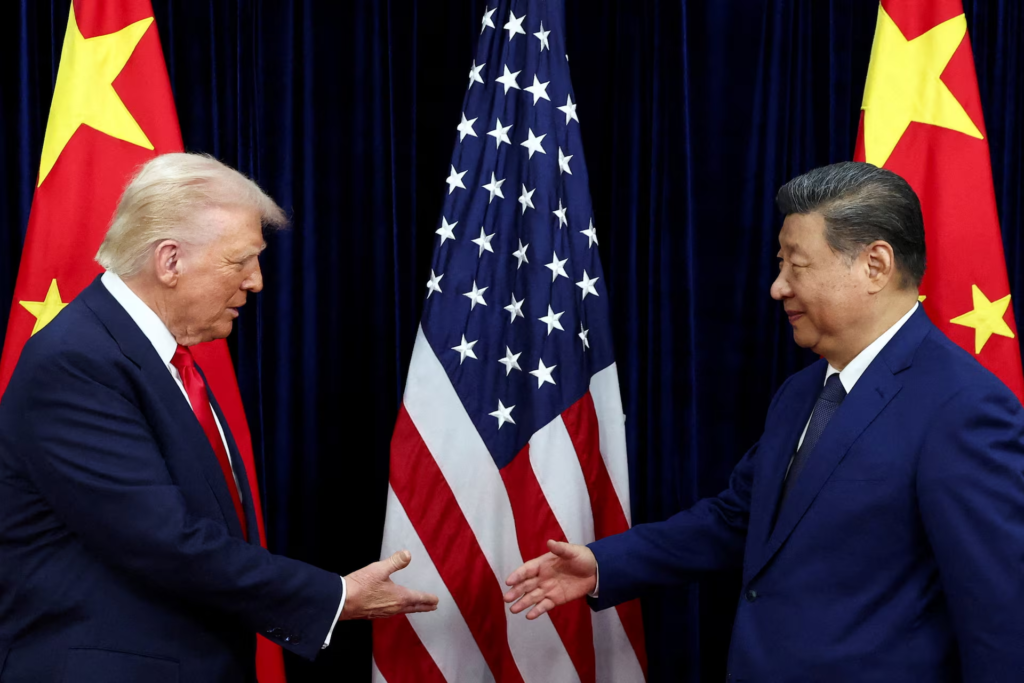
China’s rare earth exports to the United States have come under renewed scrutiny ahead of a scheduled summit between US President Donald Trump and Chinese President Xi Jinping, with declining shipments raising questions about the durability of the countries’ fragile trade truce.
China, the world’s largest producer of rare earth elements and magnets, has maintained controls over exports of these strategically important materials. The restrictions have become a point of friction between Washington and Beijing, given the minerals’ importance to advanced manufacturing, consumer electronics, electric vehicles and military equipment.
The average monthly volume of China’s rare earth exports to the US has reportedly remained below levels recorded before the controls took effect. The figures have added to concerns in Washington that Beijing may not be fully honoring its commitment to maintain uninterrupted supplies under the trade agreement reached last November.
The timing is significant. With senior officials from both countries holding discussions ahead of the leaders’ meeting, rare earths could become an important bargaining issue in negotiations over trade and technology.
What do the latest rare earth export figures show?
China’s rare earth shipments to the US have reportedly declined compared with both the previous month and the same period last year.
The available figures indicate that:
- The average monthly export volume so far this year stands at approximately 504 tons.
- That is below the monthly average of 621 tons recorded in 2024, before the export controls took effect.
- The reported decline has intensified concerns over the availability of Chinese rare earth materials for American manufacturers.
The figures suggest that shipments have yet to return to their earlier levels. However, export volumes alone do not establish whether China has breached its commitments. A fuller assessment would require information on licensing decisions, delivery schedules, the specific rare earth products involved and the terms of the trade agreement.
Why are rare earths important to the US?
Rare earth elements are a group of 17 metallic elements used in a range of technologies. Despite their name, they are not necessarily scarce in the Earth’s crust. The difficulty often lies in extracting, separating and processing them economically.
Their importance extends well beyond consumer electronics. Certain rare earth elements are essential for producing powerful permanent magnets, which help make electric motors and other equipment smaller, lighter and more efficient.
These materials are used in:
- Electric vehicles: Permanent magnets containing rare earth elements are used in many electric motors.
- Consumer electronics: Rare earth materials support components used in smartphones, computers and other electronic devices.
- Renewable energy: Some wind turbines use rare earth permanent magnets in their generators.
- Defense equipment: Certain military systems, including aircraft, guidance systems and advanced electronics, depend on rare earth materials and associated components.
- Industrial manufacturing: Specialized magnets and other rare earth applications support equipment used across several industrial sectors.
For the US, access to these materials is therefore both an economic and a strategic concern. Disruptions can affect manufacturers that rely on specialized components, while the concentration of processing capacity in China creates additional supply-chain risks.
How has China used rare earth exports in its trade dispute with the US?
Rare earths have become part of the broader economic contest between Washington and Beijing.
China’s dominant position in rare earth mining, processing and magnet production gives it considerable influence over global supply chains. Export restrictions can create uncertainty for overseas manufacturers and increase pressure on governments seeking to protect their domestic industries.
Beijing has previously used restrictions on rare earth exports as leverage amid disputes involving US tariffs. The measures have highlighted how control over critical minerals can become a negotiating tool in trade discussions.
For American businesses, the consequences can extend beyond the immediate availability of raw materials. Uncertainty over export licenses and delivery schedules can complicate procurement, production planning and investment decisions.
The issue also illustrates a broader challenge for the US: reducing dependence on a single country for materials that are difficult to replace quickly.
Building alternative supply chains requires investment in mining, refining, magnet manufacturing and recycling. Even where deposits exist outside China, developing the infrastructure and expertise needed to process them at scale can take considerable time.
Is China honoring its rare earth supply commitments?
Washington has expressed concern that Beijing has not fully met its commitment to ensure uninterrupted rare earth supplies under the trade truce agreed by the two countries in Busan last November.
The agreement was intended to ease trade tensions, but the continued decline in shipments has raised questions about how effectively it is being implemented.
Analysts at Capital Economics have argued that Beijing appears to be testing the limits of the arrangement by keeping export-license approvals slow and selective.
“Beijing appears willing to test the limits of the truce. It has deliberately kept licence approvals slow and selective,” the analysts said, according to the information provided.
The distinction between export restrictions and licensing delays is important. Even without a complete ban, slow or unpredictable approvals can make it difficult for companies to secure materials when they need them.
For manufacturers operating on tight production schedules, uncertainty over when shipments will arrive can be almost as disruptive as a direct restriction.
Nevertheless, a decline in exports does not, by itself, prove a violation of the agreement. Determining compliance would require examining the precise commitments made by both governments and whether the relevant shipments were covered by those terms.
Could rare earth licenses become a bargaining chip at the summit?
China may seek to use export-license approvals as leverage during the upcoming meeting between Trump and Xi, according to people familiar with Beijing’s strategy.
Those people reportedly indicated that Beijing hopes to offer more licenses during the summit. However, they did not specify what concessions China might seek from Washington in return.
That possibility places rare earths at the intersection of trade policy, industrial supply chains and broader US-China relations.
For Beijing, licensing decisions could provide a way to offer limited relief without necessarily abandoning its export-control framework. For Washington, securing predictable access to critical minerals could help reduce uncertainty for manufacturers and support the implementation of the existing trade truce.
The negotiations could also touch on other areas of economic and technological competition. Both governments have incentives to address supply-chain disruptions, although their wider policy differences may complicate any agreement.
At this stage, the reported strategy remains an indication of what Beijing may seek, rather than confirmation of a final negotiating position or an agreement already reached.
What happened in the latest US-China trade discussions?
Senior officials from both countries met in New York ahead of the planned presidential summit.
US Treasury Secretary Scott Bessent and Chinese Vice Premier He Lifeng held a full-day session at JPMorgan Chase’s headquarters on Sunday. US Trade Representative Jamieson Greer also participated in the discussions.
Bessent said the two sides had agreed to establish a dialogue mechanism on artificial intelligence. They also discussed extending the trade truce.
The AI dialogue is notable because the relationship between the two countries extends beyond tariffs and critical minerals. Technology policy, access to advanced computing and the development of artificial intelligence have become important areas of bilateral engagement.
However, the reported discussions do not establish that the two sides reached a new agreement on rare earth exports. Any claim that the talks resolved the dispute would require confirmation from official statements or the text of a subsequent agreement.
The discussions nevertheless provide a diplomatic setting in which the rare earth issue could be addressed before the leaders meet.
What does the dispute mean for global supply chains?
The rare earth dispute highlights the vulnerability of industries that depend heavily on concentrated sources of critical materials.
When one country controls a large share of processing and manufacturing capacity, export restrictions or licensing delays can affect businesses far beyond its borders. Companies may face higher costs, production delays or pressure to find alternative suppliers.
The consequences can be particularly significant for industries such as electric vehicles, renewable energy and defense, where specialized materials and components may not have readily available substitutes.
Governments and companies have several potential ways to reduce these risks:
- Diversifying suppliers: Developing sourcing relationships with producers in multiple countries can reduce dependence on a single market.
- Expanding processing capacity: Investment in refining and separation facilities outside China could help broaden the available supply.
- Developing alternative materials: Research into technologies that use fewer rare earths, or different materials altogether, could reduce exposure to supply disruptions.
- Increasing recycling: Recovering rare earth materials from used equipment could supplement newly mined supplies.
- Building strategic inventories: Stockpiles may provide a buffer against temporary interruptions, although they cannot replace long-term supply-chain development.
These measures involve financial, technical and environmental challenges. Diversification is therefore unlikely to eliminate dependence immediately, but it could give manufacturers more options over time.
What should markets and manufacturers watch next?
The next developments will depend on whether the US and China can translate their diplomatic discussions into clearer commitments on trade and critical minerals.
Several indicators could help show whether tensions are easing:
- Export-license approvals: Whether China speeds up approvals and provides greater predictability for shipments.
- Actual export volumes: Whether shipments rise toward earlier levels in subsequent customs reports.
- Official statements: Whether Washington and Beijing clarify the terms of the trade truce or announce an extension.
- Summit outcomes: Whether the leaders address rare earth supplies directly or link them to broader trade negotiations.
- Supply-chain investment: Whether companies and governments accelerate efforts to develop alternative sources of rare earth materials and magnets.
The distinction between announcements and implementation will be important. A commitment to approve more licenses would need to be assessed against subsequent approvals and actual deliveries.
For manufacturers, reliable access and predictable delivery schedules may matter as much as the headline volume of exports. For policymakers, the dispute underscores the difficulty of separating trade negotiations from strategic competition over technology and industrial capacity.
The bottom line
China’s rare earth exports remain a significant issue ahead of the Trump-Xi summit, with reported shipment levels below the monthly average recorded before export controls took effect.
The US has raised concerns about the implementation of Beijing’s supply commitments, while analysts have pointed to slow and selective licensing as a source of uncertainty. Reports that China may offer additional licenses during the summit suggest that the issue could feature in broader negotiations.
The outcome remains uncertain. The key test will be whether diplomatic discussions produce measurable changes in licensing decisions, shipments and the reliability of supplies reaching American manufacturers.