
Quick Summary
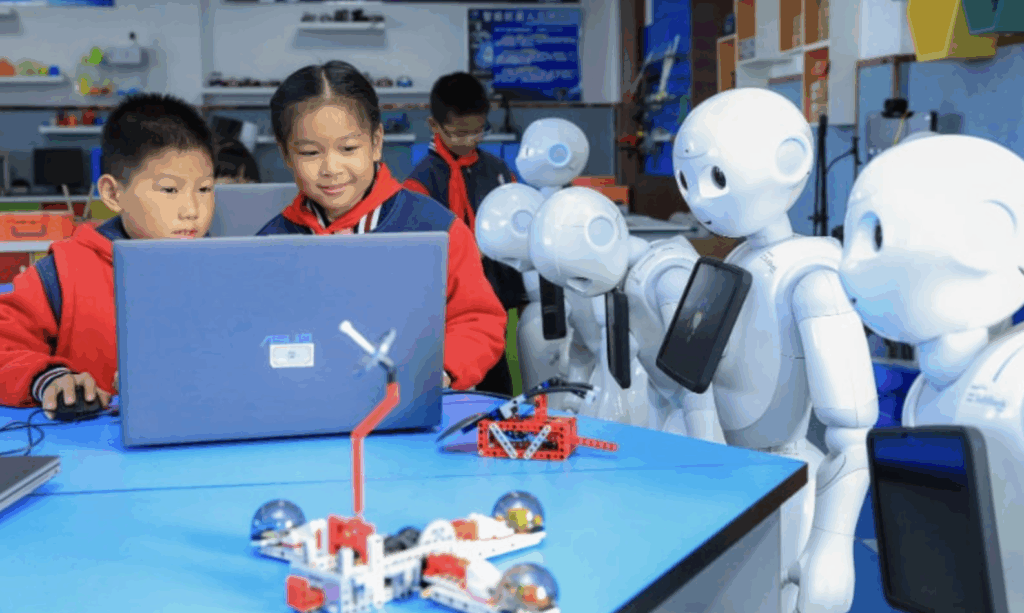
Hangzhou, China, is making AI education mandatory in primary and secondary schools. Students will take at least 10 hours of AI lessons each year, with content tailored by grade level, from recognizing AI tools in first grade to building AI projects in high school. The program also emphasizes ethics, privacy, and responsible use. Hangzhou’s bold move positions it as a leader in preparing students for an AI-driven future, a strategy that contrasts with more fragmented efforts in the U.S. and Europe.
Artificial intelligence is no longer confined to research labs, Silicon Valley startups, or sci-fi novels. In Hangzhou, China—a city best known as a rising innovation hub and home to AI challenger DeepSeek—AI is about to become a classroom subject alongside math and science. Starting this academic year, primary and secondary schools in the city must provide at least 10 hours of AI education annually, according to local authorities.
This move signals a broader ambition: preparing students for a world where AI literacy will be as essential as reading and writing.
What does the new AI mandate include?
The Hangzhou Education Bureau has issued two guiding documents—one outlining curriculum plans and another setting AI competency standards for teachers. Together, they aim to:
- Introduce AI in a structured, age-appropriate way.
- Train educators to teach both technical and ethical aspects of AI.
- Ensure flexibility in how schools adopt the new requirement.
Schools can choose to:
- Offer a stand-alone AI course concentrated into one intensive week.
- Blend AI lessons into existing subjects like information technology or science.
- Run AI-themed activities as part of after-school programs.
This variety allows schools to adapt based on resources and staffing, while ensuring all students get exposure.
How will AI be taught at different grade levels?
The curriculum has been designed to grow in complexity as students advance:
- Grades 1–2: Students learn what AI is and recognize its everyday applications. They’ll interact with AI-enabled devices and use them for simple tasks—think voice assistants or smart toys.
- Grades 3–4: AI is tied to schoolwork. Students practice using AI to gather text, images, and audio, and begin creating basic projects under teacher guidance.
- Middle school: Lessons move into data preparation, model training, and understanding the principles behind algorithms.
- High school: The focus shifts to design and development. Students are expected to build their own AI projects, applying both technical knowledge and ethical considerations.
At every stage, the curriculum stresses responsible use of AI—covering topics like privacy, bias, and safety.
Why is Hangzhou leading this initiative?
Hangzhou has about eight million residents and is one of China’s fastest-growing tech hubs. It’s also the birthplace of DeepSeek, an AI company that recently gained attention for challenging OpenAI’s ChatGPT.
By embedding AI education in schools, Hangzhou is making a long-term bet: today’s students will form the backbone of its future tech workforce. The city’s strategy mirrors China’s broader national goals of becoming a world leader in AI by 2030.
This isn’t just about creating more engineers. It’s about ensuring that every citizen has a baseline understanding of AI—whether they end up working in healthcare, law, business, or creative fields.
How does this compare to the U.S. and elsewhere?
While AI courses are gaining ground in U.S. high schools and universities, they remain optional and inconsistent. For example, a handful of states have piloted AI literacy programs, but there is no federal mandate.
Europe is experimenting as well: the European Commission has released frameworks for digital skills, including AI, but implementation varies across countries.
Hangzhou’s model stands out for its citywide mandate and the clear roadmap for progression from grade school to high school.
What challenges could schools face?
Rolling out AI classes at scale is no small task. Key hurdles include:
- Teacher training: Educators must not only understand AI but also be able to explain it simply. The competency standards released by Hangzhou will be crucial here.
- Resource gaps: Not every school may have enough devices, software, or internet connectivity to support AI-driven projects.
- Ethical dilemmas: Teaching kids about bias, misinformation, and privacy requires careful curriculum design.
Experts suggest that success will depend on balancing technical skills with critical thinking about AI’s social impact.
Why does this matter for the future?
AI is increasingly woven into everyday life—from personalized recommendations on streaming platforms to self-driving cars and automated hiring tools. By teaching AI early, Hangzhou hopes to:
- Give students a head start in a global economy where AI skills are highly valued.
- Promote digital literacy and reduce future tech skill gaps.
- Encourage responsible innovation, ensuring that ethical awareness develops alongside technical know-how.
For parents and educators outside China, this experiment raises a pressing question: Should AI be a mandatory subject everywhere?