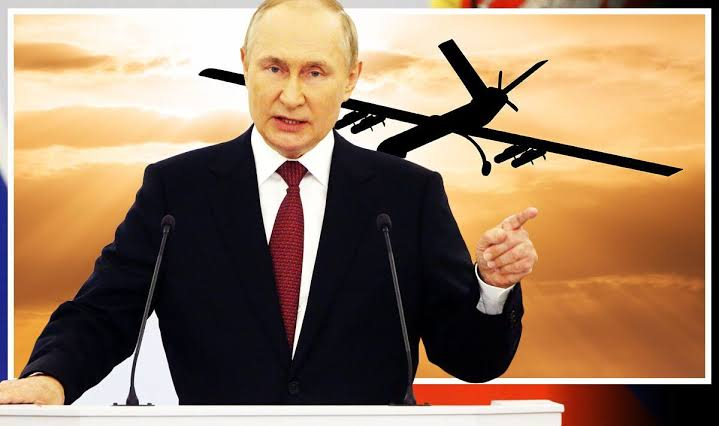
A new investigation has raised fresh questions about the role of China in sustaining Russia’s long-range drone production after shipping records reportedly showed a Chinese state-owned company sending a key carbon-fiber precursor to a sanctioned Russian entity.
The documents, obtained by POLITICO and reviewed by Western officials, reportedly show Jilin Chemical Fibre Group shipping up to 46 metric tons of polyacrylonitrile, or PAN, precursor to Alabuga-Volokno, a subsidiary of Russia’s state nuclear corporation Rosatom.
The material can be processed into high-performance carbon fiber used in lightweight aerospace structures. Weapons expert David Albright estimates that the shipment could have produced enough carbon fiber for components in as many as 1,300 long-range attack drones.
That does not mean 1,300 drones were actually built with the shipment. The number is an estimate of the potential output from the amount of material involved.
What did the Chinese company reportedly ship to Russia?
According to the documents examined by POLITICO, Jilin Chemical Fibre Group shipped up to 46 tons of polyacrylonitrile tow, commonly referred to as PAN precursor.
PAN is an important feedstock for producing carbon fiber. Through a series of industrial processing steps, the precursor is transformed into fibers with a very high strength-to-weight ratio.
That makes carbon fiber particularly useful for aircraft and unmanned aerial vehicles, where reducing weight while maintaining structural strength can improve range and endurance.
The shipment reportedly arrived in two 40-foot containers at Alabuga-Volokno in Russia’s Tatarstan region.
Why is Alabuga-Volokno important?
Alabuga-Volokno is part of the Russian state-owned Rosatom ecosystem and produces high-specification carbon fiber and composite materials.
The facility has been targeted by Western sanctions and has been linked to Russia’s military-industrial production network.
Its location is especially significant because the Alabuga special economic zone has become a major center for Russia’s production of long-range Geran attack drones, which are based on the Iranian-designed Shahed family.
Carbon fiber is useful in those systems because structural components need to be light enough to support long-range flight while remaining strong enough to withstand the stresses of operation.
Could the shipment really support 1,300 drones?
That is possible under the estimate cited by weapons expert David Albright.
Albright, founder of the Washington-based Institute for Science and International Security, told POLITICO that the quantity of PAN precursor was enough to produce carbon fiber for structural elements and fuel-tank reinforcement for roughly 1,300 attack drones.
The figure should be treated as an estimate, not a confirmed production count.
The documents demonstrate the movement of material. They do not independently prove that every kilogram was converted into drone components or that exactly 1,300 drones were subsequently manufactured.
Why does carbon fiber matter for attack drones?
Carbon fiber is valuable because it is both lightweight and exceptionally strong.
In an aircraft or drone, shaving weight from the structure can free capacity for fuel, electronics, explosives or additional equipment.
The material can be used in wings, internal structural components and other parts where strength and low weight are both important.
That gives carbon fiber a dual-use character. It has extensive civilian applications in aerospace, automotive manufacturing, sporting equipment and other industries, but the same properties can make it strategically important for military systems.
Was the material deliberately misclassified?
According to the investigation, the shipping documents used a customs classification associated with civilian synthetic fibers such as nylon and polyester rather than a classification that more clearly identified the material as a dual-use industrial product.
Experts cited in the reporting said the apparent mismatch could have helped obscure the nature of the shipment.
Former US Treasury official Kerri Bitsoff described such a practice as a potential way of disguising a controlled item under a more routine civilian category.
However, the available documents alone do not establish who ordered the classification or whether the discrepancy was deliberately intended to evade sanctions. That would require further evidence.
Why is this significant for China?
Beijing has repeatedly denied supplying lethal military assistance to Russia for its war in Ukraine.
China has acknowledged its extensive economic relationship with Moscow but has argued that its trade with Russia does not amount to providing weapons for use against Ukraine.
The new documents are significant because they allegedly trace a shipment from a Chinese state-owned company directly to a Russian company involved in a military-related production network.
That is more specific than simply finding a Chinese-made component inside a Russian drone after it has been shot down.
Does the shipment prove China is supplying weapons to Russia?
Not by itself.
The distinction between weapons and dual-use industrial materials is central to the story.
PAN precursor is not a missile, warhead or completed drone. It is an industrial input that can be used for both civilian and military purposes.
The allegation is therefore not that Jilin shipped finished weapons to Russia. It is that a Chinese state-controlled company supplied material that could support the manufacture of Russian military equipment.
That distinction will likely be central to any debate over sanctions or China’s responsibility for the end use of the material.
What evidence supports the report?
The investigation is based on internal Russian shipping and customs records obtained through the Ukrainian Security and Cooperation Centre.
The documents were reportedly shared with Western governments, and the US House Select Committee on China has confirmed their authenticity, according to reporting cited by POLITICO.
Ukrainian officials have also vouched for the records.
That does not eliminate every uncertainty surrounding the shipment, but it gives the allegations a substantially stronger evidentiary basis than anonymous claims about Chinese components found in Russian weapons.
What are US officials saying?
Former US officials have argued that the scale of the shipment makes it difficult to believe that Chinese authorities were unaware of it.
Dennis Wilder, a former CIA deputy assistant director, said the idea that Chinese state-owned companies could independently conduct a transfer of this magnitude without government knowledge was difficult to accept.
Former Deputy Secretary of State Kurt Campbell also said Chinese companies are helping sustain parts of Russia’s defense-industrial capacity through transfers of dual-use goods and technology.
Those are assessments from former officials, not an official US government finding that Beijing authorized the specific shipment.
Could the Chinese company face US sanctions?
Potentially.
David Albright argued that the shipment could provide grounds for sanctions because the Russian recipient, Alabuga-Volokno, had already been designated by Western governments.
Whether Jilin Chemical Fibre Group itself would be sanctioned would depend on the legal basis available to US authorities, the specific evidence establishing knowledge or intent and the nature of the transaction.
The case also raises a broader enforcement problem.
Even when a country prohibits direct exports of military goods to a sanctioned state, industrial supply chains can still move through civilian categories, intermediaries and dual-use products.
Is this connected to Russia’s Geran drones?
The Alabuga industrial zone is a major center for Russia’s manufacture of Geran-series attack drones, which are derived from Iran’s Shahed-136 design.
The drones have become a major component of Russia’s long-range strike campaign against Ukraine.
Their production at scale requires far more than engines and explosives. It also depends on industrial materials, electronics, machine tools, composites and other components.
That makes seemingly ordinary industrial exports strategically important.
A shipment of raw material can become part of a military supply chain even when the cargo itself does not resemble a conventional weapon.
Why are China-Russia dual-use exports under scrutiny?
Since Russia’s full-scale invasion of Ukraine, China has remained one of Moscow’s most important trading partners.
Western governments have increasingly focused on what they describe as China’s supply of dual-use products that can strengthen Russia’s defense industry.
These transactions are often harder to police than direct weapons transfers because the products may have legitimate civilian uses.
For example, an advanced machine tool, electronic component or carbon-fiber precursor can be sold legally for commercial purposes but later incorporated into a military production system.
That creates a difficult enforcement challenge for governments trying to prevent sanctions evasion without shutting down legitimate international trade.
What does China say?
China has repeatedly rejected accusations that it is supplying weapons to Russia for use in the Ukraine war.
Beijing has argued that it handles military and dual-use exports responsibly and has accused Western governments of politicizing normal China-Russia trade.
The latest documents could nevertheless intensify pressure on Beijing because they allegedly show a state-owned Chinese company conducting a direct transaction with a Russian entity already subject to sanctions.
A formal response from the Chinese government to the specific shipping records will be important in determining how Beijing explains the transaction.
What happens next?
The immediate questions concern the authenticity and full context of the shipping documents, the exact nature of the material, who authorized the transaction and how the PAN precursor was ultimately used.
There is also the larger diplomatic question of whether Washington and its allies conclude that the transaction warrants additional sanctions or export controls.
For Russia, the case highlights the importance of access to global industrial supply chains in sustaining drone production.
For China, it puts another spotlight on the fine line between legitimate commercial trade and material assistance that can strengthen Russia’s military-industrial complex.
And for Ukraine’s Western supporters, it raises a difficult question: how far should sanctions enforcement extend when an apparently civilian industrial product can ultimately become part of a weapon?