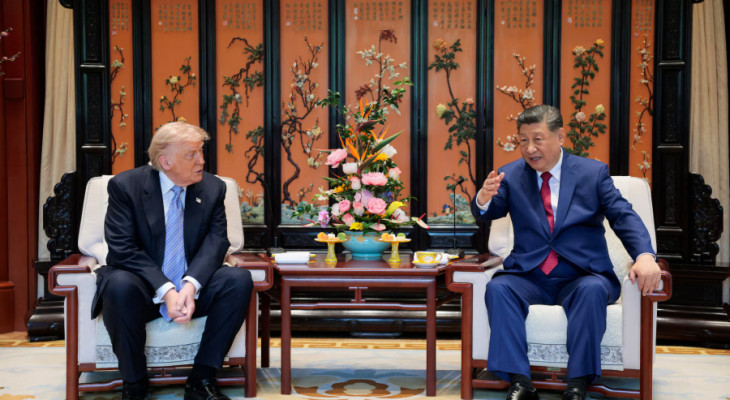
China has issued a fresh warning to the United States ahead of President Donald Trump’s meeting with Chinese President Xi Jinping in Washington, saying Taiwan, democracy and human rights, China’s political system and its development interests are among the issues Beijing considers non-negotiable.
Chinese Ambassador to the United States Xie Feng outlined what he called four “red lines” in an article published in the Communist Party’s official People’s Daily on Wednesday, the same day Xi was due to leave for Washington. The warning comes as the two leaders prepare for another high-level meeting aimed at managing tensions between the world’s two largest economies.
Xie said China and the US should manage their differences through “good faith” and accused Washington of using issues including national security, economic imbalances and forced labor as pretexts to constrain China’s development.
The remarks underline how Taiwan and other sovereignty-related issues could complicate a summit that is also expected to focus on trade, technology, rare earths and broader efforts to stabilise bilateral relations.
What are China’s four ‘red lines’?
Xie identified four issues that Beijing says cannot be challenged:
- The Taiwan question
- Democracy and human rights
- China’s development path and political system
- China’s development rights
He said China’s sovereignty, security and development interests must not be violated.
The ambassador also said China remained committed to peaceful development and expressed hope that the US would take a similar approach.
The list puts territorial sovereignty, domestic political issues and economic development into the same category of concerns that Beijing considers fundamental to its national interests.
Why is Taiwan the biggest flashpoint?
Taiwan remains one of the most sensitive issues in US-China relations.
Beijing claims Taiwan as part of China, while Taiwan is self-governed, and its authorities reject Beijing’s sovereignty claim. The United States does not have formal diplomatic relations with Taiwan, but it remains the island’s most important international backer and a major supplier of military equipment.
China has repeatedly demanded that Washington stop selling weapons to Taiwan.
At an earlier meeting between Trump and Xi, the Chinese leader reportedly pressed the US president over American arms sales to Taiwan. The issue remains closely tied to wider US-China negotiations and Washington’s relationships with its Asian allies.
What has China said about US support for Taiwan?
China’s foreign ministry has repeatedly opposed US arms sales to Taiwan, describing the Taiwan issue as a core interest and a major foundation of the bilateral relationship.
Beijing has said it prefers peaceful reunification but has not renounced the possibility of using force to bring Taiwan under its control.
Taiwan, meanwhile, maintains its separate political system and rejects Beijing’s claim of sovereignty.
That leaves Washington navigating a long-standing balance between its unofficial relationship with Taipei and its formal diplomatic relationship with Beijing.
Why is human rights on China’s list?
Human rights have been another longstanding source of disagreement between Washington and Beijing.
US officials and lawmakers have repeatedly raised concerns about human rights conditions in China, while Chinese authorities have rejected what they describe as foreign interference in the country’s internal affairs.
By grouping democracy and human rights among its “red lines,” Beijing is signaling that it considers such issues closely connected to its sovereignty and political system rather than matters open to external pressure.
Xie’s statement therefore goes beyond Taiwan. It places questions about China’s internal political model alongside territorial sovereignty and national development as issues Beijing wants Washington to treat with caution.
What does China mean by its ‘development path and systems’?
The phrase refers broadly to China’s chosen political and economic model.
Beijing has long rejected the idea that its development should follow a Western political template. In Xie’s statement, the country’s “development paths and systems” were explicitly included among the four issues that China says cannot be challenged.
That makes the warning broader than a dispute over a specific policy.
It suggests Beijing wants the United States to distinguish between negotiating on areas such as trade and challenging what China regards as its right to determine its own political and economic system.
What are China’s ‘development rights’?
The fourth red line is China’s “development rights.”
In practical terms, the phrase reflects Beijing’s long-running argument that restrictions imposed by the United States on Chinese technology, trade and investment can constrain China’s economic growth.
The two countries have been engaged in disputes over tariffs, advanced technology, critical minerals and export controls. Those disagreements have increasingly blurred the line between economic policy and national security.
Xie accused Washington of invoking national security, economic imbalances and forced labor to constrain China, framing those issues as part of a broader US approach that Beijing opposes.
What will Trump and Xi discuss in Washington?
Taiwan is only one item on a much longer summit agenda.
The two leaders are expected to discuss trade, tariffs, agricultural purchases, aircraft sales, rare earths and critical minerals, as well as technology restrictions and other economic issues.
The future of the tariff truce between Washington and Beijing is also expected to be an important topic, particularly for companies operating in global supply chains.
The two governments are simultaneously seeking economic cooperation while trying to manage disputes over technology, security and geopolitical influence.
Why are rare earths important to the summit?
Rare earths have become an important source of leverage in US-China economic relations.
China dominates major parts of the global rare-earth supply chain, including mining, refining and production of rare-earth metals and magnets. These materials are important for industries ranging from automobiles and electronics to aerospace and defense.
Beijing has previously used export restrictions involving critical minerals during periods of tension with Washington.
That history means any agreement affecting critical minerals could have implications well beyond the two countries.
Has the US recently reaffirmed support for Taiwan?
Yes.
Ahead of the Xi-Trump summit, US Secretary of State Marco Rubio met with counterparts from Japan and South Korea.
The three governments reiterated the importance of peace and stability across the Taiwan Strait and expressed support for maintaining regional stability.
The timing is notable because the trilateral discussions came just before Xi’s Washington visit.
It also demonstrates that Taiwan policy is not only a bilateral US-China issue. Japan and South Korea, both key US security partners in Asia, have a direct interest in developments across the Taiwan Strait and the wider Indo-Pacific.
What is Beijing saying about US policy toward China?
A separate People’s Daily commentary on Wednesday accused Washington of having “erroneous” perceptions of China and of being unwilling to move away from the concept of strategic competition.
Published under the pen name “Zhong Sheng,” which is commonly used for Chinese foreign-policy commentary, the article called on both governments to preserve recent momentum in bilateral relations.
It also urged Washington to maintain consistency in its policies, honor its commitments and provide greater certainty in the relationship.
The message combines a warning with an appeal for stability: Beijing is drawing boundaries around issues it considers fundamental while also calling for cooperation where possible.
Why does the warning matter before the summit?
The timing gives Xie’s statement particular significance.
Xi’s visit is taking place as Washington and Beijing attempt to manage a relationship that has been strained by trade disputes, technology controls, Taiwan tensions and disagreements over other geopolitical issues.
The summit is therefore taking place against a backdrop of competing priorities. Both governments have economic incentives to reduce friction, while several security and political disputes remain unresolved.
That creates a delicate negotiating environment.
Trade and economic cooperation may offer areas where the two governments can find common ground, while Taiwan, human rights and political-system issues remain areas where Beijing has explicitly stated that it does not want concessions.
Could Taiwan become a bargaining issue?
The issue is already intertwined with the broader US-China negotiating relationship.
Trump has previously discussed US arms sales to Taiwan in the context of his negotiations with Beijing. At the same time, US allies in Asia have been watching closely for signs of any shift in Washington’s approach to Taiwan.
For Beijing, reducing US military support for Taiwan would address a major strategic concern.
For Washington, decisions involving Taiwan also affect US relations with Japan, South Korea and other regional partners.
That makes Taiwan an issue with consequences well beyond the immediate US-China relationship.
What happens next?
Xi is due in Washington for the summit with Trump, where the two leaders are expected to address both economic disputes and broader strategic tensions.
China’s latest warning makes Beijing’s position clear: Taiwan, democracy and human rights, its political and development model, and what it calls its development rights are not issues it wants challenged by Washington.
Whether those boundaries limit the scope of any agreement, or simply define the issues where negotiations will be most sensitive, will become clearer as Trump and Xi hold their talks.
For now, the statement from Beijing serves as both a warning and a reminder of how many layers sit beneath the US-China relationship. Trade may dominate the headlines, but Taiwan and questions over sovereignty remain central to the broader dispute.