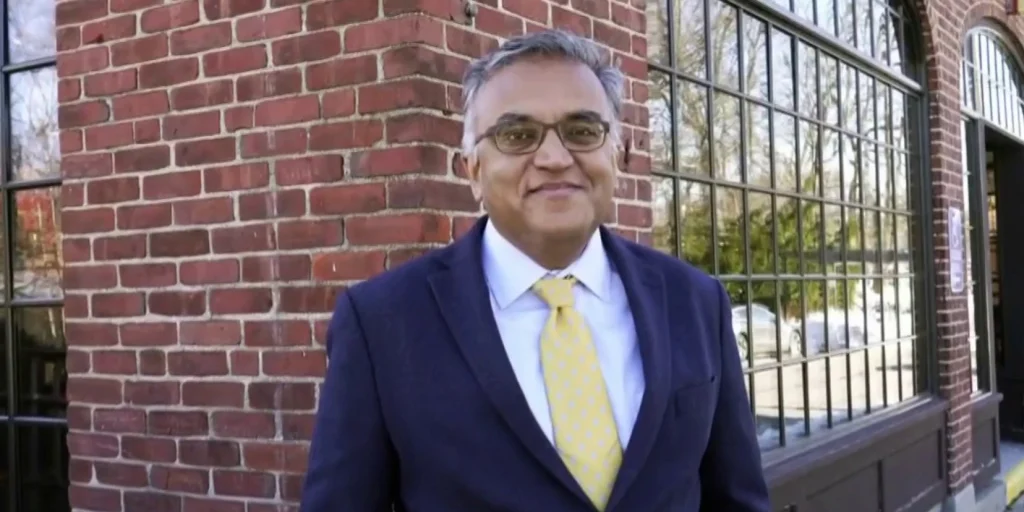
Former White House COVID-19 Response Coordinator Dr. Ashish Jha says he now believes the COVID-19 pandemic was “more likely” caused by an accidental laboratory leak than by a natural spillover from animals. His comments have reignited one of the pandemic’s most contentious debates, but they have not settled it.
Speaking in a recent CNN interview, Jha emphasized that his view is an assessment based on circumstantial evidence, not proof. He also stressed that no one outside China can definitively determine how the pandemic began.
His remarks come as the scientific community and intelligence agencies continue to examine competing theories about the virus’s origins, with no consensus reached.
What did Dr. Ashish Jha say about COVID-19’s origins?
Dr. Ashish Jha told CNN’s Dana Bash that his thinking has evolved since serving as the White House’s COVID-19 Response Coordinator under President Joe Biden.
He said that before joining the administration, he believed a natural animal-to-human transmission was the more likely explanation, with a laboratory accident being less probable. After reviewing additional information during his time in government, he said he now considers an accidental lab leak to be the more likely scenario.
However, Jha repeatedly cautioned against presenting his opinion as fact.
According to Jha:
- His conclusion is based on circumstantial evidence.
- There is no definitive public evidence proving either theory.
- Chinese authorities possess information that could help resolve the question, but greater transparency is needed.
He also clarified that his assessment does not suggest the virus was engineered or deliberately released.
Why has the lab leak theory returned to the spotlight?
The lab leak hypothesis has remained part of the discussion since the early months of the pandemic, but public attention has shifted over time.
Jha’s comments gained renewed attention after he shared a post by commentator Jamie Metzl, who argued that an accidental leak from the Wuhan Institute of Virology is the most plausible explanation.
Following the interview, Jha reiterated his position on X, writing that he has held the same view since his time in the White House. He added that “reasonable people can look at the same evidence and disagree”, underscoring that uncertainty remains.
His remarks reflect a broader shift in public debate, where some scientists, intelligence officials, and policymakers have become more open to discussing the laboratory accident hypothesis than they were during the early stages of the pandemic.
What are the two leading theories about COVID-19’s origin?
The debate generally centres on two competing explanations.
Natural spillover
The natural origin theory proposes that SARS-CoV-2 passed from animals to humans, either directly or through an intermediate species.
This explanation is consistent with how previous coronavirus outbreaks emerged, including:
- SARS in 2002
- MERS in 2012
Many virologists argue that zoonotic spillover remains a scientifically plausible explanation because similar viruses circulate in wildlife populations.
Accidental laboratory leak
The lab leak hypothesis suggests that researchers studying naturally occurring coronaviruses may have accidentally allowed the virus to escape from a laboratory, such as the Wuhan Institute of Virology.
Supporters of this theory generally argue that
- Wuhan is home to a major coronavirus research laboratory.
- Early access to data and samples was limited.
- Greater transparency from Chinese authorities has been lacking.
Importantly, the mainstream lab leak hypothesis discussed by many experts refers to an accidental release of a naturally occurring virus, not a deliberately engineered bioweapon.
What do scientists and intelligence agencies say?
There is still no global scientific consensus on how COVID-19 originated.
Several investigations conducted since 2020 have reached different conclusions, often because of incomplete data.
Key points include:
- Some intelligence agencies have assessed that a laboratory accident is the more likely explanation, although often with low or moderate confidence.
- Other agencies continue to favor natural transmission or say there is insufficient evidence to conclude.
- The World Health Organization (WHO) has repeatedly stated that all scientifically credible hypotheses should remain under investigation until more evidence becomes available.
Because critical data from the earliest days of the outbreak remain unavailable, investigators have been unable to conclusively confirm or rule out either theory.
Why does the debate remain unresolved?
Determining the origin of a virus years after an outbreak begins is extremely challenging.
Investigators continue to face several obstacles, including:
- Limited access to early patient records.
- Missing or incomplete laboratory data.
- Restricted international access to key locations.
- Political tensions between governments.
As Jha noted during his interview, no publicly available evidence definitively establishes either a laboratory accident or a natural spillover event.
That uncertainty has fueled continued scientific research and political debate.
Why does identifying COVID-19’s origin matter?
Understanding how the pandemic began is about more than assigning responsibility.
Experts say identifying the source could help governments:
- Improve laboratory biosafety standards.
- Strengthen wildlife disease surveillance.
- Detect emerging pathogens earlier.
- Prevent future pandemics.
- Build stronger international reporting systems during disease outbreaks.
Regardless of which theory ultimately proves correct, researchers agree that improving global preparedness remains essential.
TL;DR
Former White House COVID-19 Response Coordinator Dr Ashish Jha says he now believes an accidental laboratory leak is the more likely explanation for the origin of COVID-19. He stressed, however, that this is an assessment based on circumstantial evidence, not definitive proof, and acknowledged that reasonable experts can disagree. Scientists, intelligence agencies, and the WHO continue to say that the pandemic’s origins remain unresolved because critical evidence is still unavailable.