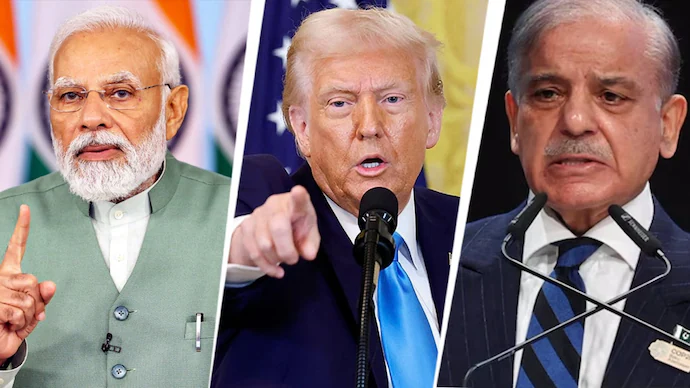
After India’s firm rejection of his involvement, US president modifies stance during Qatar address
US President Donald Trump has softened his earlier assertions about mediating a ceasefire between India and Pakistan, following India’s explicit rejection of any third-party involvement in the bilateral arrangement. Speaking to American troops and officials during his visit to Qatar on Thursday, Trump appeared to modify his previous claims about his role in the recent agreement.
“I don’t want to say I did, but I sure as hell helped settle the problem between Pakistan and India last week, which was getting more and more hostile, and all of a sudden, you’ll start seeing missiles of a different type, and we got it settled,” Trump told the gathered audience.
Shifting to focus on trade relations
Pivoting away from direct claims of ceasefire negotiation, Trump emphasized potential trade discussions instead: “I hope I don’t walk out of here and two days later find out that it’s not settled, but I think it is settled, and we talked to them about trade. Let’s do trade instead of, and Pakistan was very happy with that, and India was very happy with that, and I think they’re on the way…”
The president acknowledged the historical complexity of India-Pakistan relations, noting that the two nations have been in conflict “for about 1000 years in all fairness.” He added, “So I said, you know. I could settle that up. I could settle; let me settle it up, and let’s get them all together.”
However, Trump then appeared to scale back his confidence further: “I’m not sure about settling. That’s a tough one. They’ve been fighting for a long time… It was really going to be escalating out of control.”
India’s firm rejection of third-party involvement
On Tuesday, India’s Ministry of External Affairs (MEA) issued a clear rebuke to Trump’s earlier claims of US involvement in the ceasefire agreement. MEA spokesperson Randhir Jaiswal stated that the ceasefire understanding was reached directly between India and Pakistan without any outside mediation.
Without specifically naming Trump, Jaiswal emphasized India’s longstanding position: “We have a long-standing national position that any issues pertaining to the Union Territory of Jammu and Kashmir have to be addressed by India and Pakistan bilaterally. That stated policy has not changed.”
The statement confirmed that talks had been conducted directly between the Director Generals of Military Operations of both countries, with no third-party participation.
The diplomatic exchange highlights the sensitivity surrounding Indo-Pakistani relations and India’s consistent resistance to international mediation in what it considers strictly bilateral matters.