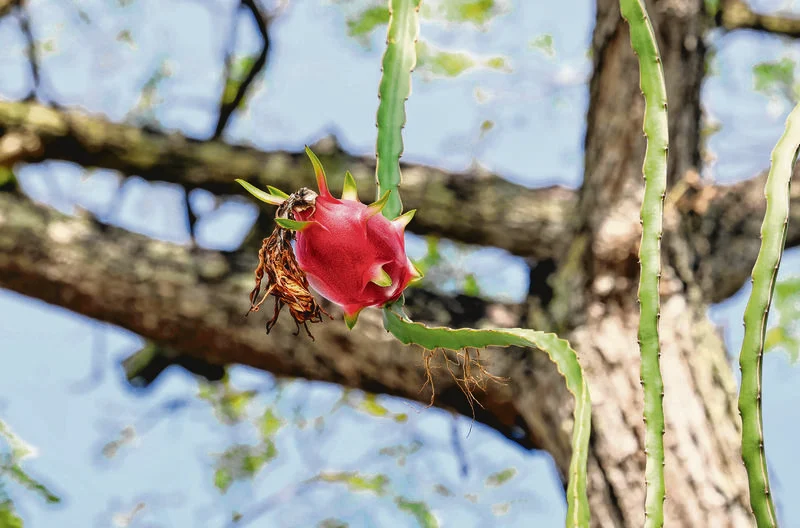
What caught residents by surprise?
In an unexpected urban twist, residents of Ang Mo Kio, Singapore, were taken aback when several dragon fruits were seen growing from a towering 50-year-old tree in a heavy vehicle car park along Ang Mo Kio Street 32. The phenomenon came to public attention after a lorry driver, Mr. Wang (62), spotted the fruits and notified the local Chinese-language newspaper Shin Min Daily News.
Photographs shared by Mr. Wang showed vibrant red dragon fruits hanging from vines growing out of the tree’s trunk. When reporters visited the site, they confirmed the sighting, noting that the trees stood more than 10 meters tall and at least two of them had visible dragon fruit vines. One tree had three dragon fruits in various stages of ripeness, including one fully matured fruit with deep red skin.
How long have the vines been growing?
Mr. Jiang (59), a regular at the car park who drives a bus, said the trees had been there for decades. According to him, the dragon fruit vines started appearing about three years ago, but this was the first time he had seen them bear fruit.
“These dragon fruit trees have been growing for over three years, but I had never seen any fruit before,” he said. “Seeing them now feels quite novel.”
Other locals shared theories about how the plants took root. Mr. Zhang (40) suggested that seeds from dragon fruits discarded by a nearby fruit shop may have been carried by birds, whose droppings deposited the seeds onto the trees.
Why is this unusual?
Dragon fruit, also known as pitaya, typically grows on climbing cacti of the genus Hylocereus. These plants are often cultivated on trellises or upright frames and need ample sunlight and nutrients to thrive. It is uncommon to see them growing on the trunks of large, mature trees, especially in urban settings.
However, experts say it’s not impossible.
What do experts say?
Cai Changyao, a Malaysian fruit farmer with experience growing dragon fruit, explained that vines can grow on trees if the branches collect enough dead leaves and organic debris to support nutrient absorption.
Plants like the dragon fruit cactus, which have shallow root systems, can cling to a range of surfaces, including trees, concrete pillars, and even metal frames.
Mr Cai said that while cultivated dragon fruit plants can flower and fruit within a year, wild ones take longer—often several years—due to limited sunlight and poor nutrient conditions. He also emphasised that dragon fruit thrives in strong sunlight, and in its absence, the plant may continue growing without flowering.
“Dragon fruit prefers strong light; if there isn’t enough light, the stems will keep growing, delaying fruiting. Still, it’s very rare for several dragon fruits to grow on a tree,” he said.
Is this a rare occurrence?
While dragon fruit vines can grow on other surfaces, including trees, seeing them flower and produce multiple fruits in a city setting is rare. Typically, the plant is supported by structures built specifically for its cultivation. The fact that several dragon fruits have matured on a tall tree, without deliberate care or agricultural conditions, makes this case especially unusual.
Residents and passersby have been stopping to observe the fruits, intrigued by the contrast of tropical cactus fruits dangling from a tree more commonly found in Singapore’s roadside greenery.
What does this say about urban biodiversity?
This unexpected fruiting event highlights how nature can adapt and flourish in surprising ways within city environments. With minimal human intervention, plants like dragon fruit may find new habitats by latching onto older trees or man-made structures.
While this case may be an exception rather than a trend, it serves as a reminder of the biodiversity that can exist, even in the most unassuming corners of an urban landscape.