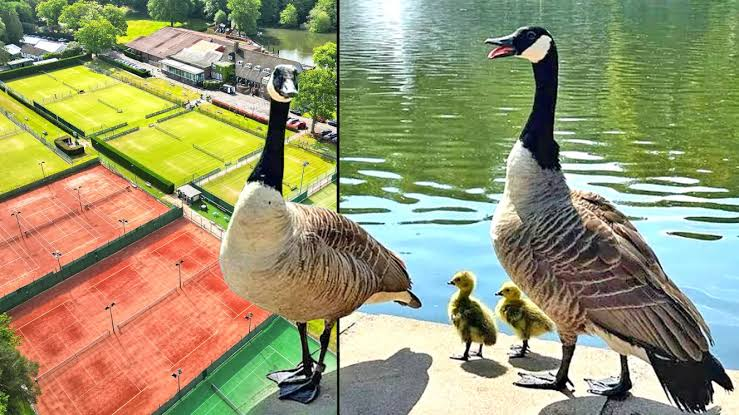
A private tennis club in England is facing criticism after culling several Canada geese that had lived on its grounds for years, citing health and safety concerns linked to bird droppings on its courts and surrounding areas.
The decision has angered many club members and residents, who say they were not consulted before the birds were killed. Critics argue the geese had become part of the club’s identity and that non-lethal alternatives, such as relocation, should have been explored.
The incident has reignited debate over how organisations balance wildlife management with public safety and animal welfare.
What happened at the tennis club?
According to reports, the club hired professional marksmen to cull a group of Canada geese on July 16.
Neighbours reported hearing gunshots that morning, and later that day eight geese, including goslings, were found dead.
Two birds reportedly survived the cull and were later seen wandering nearby, with some members describing them as appearing distressed.
The club has not publicly disputed that the cull took place but says the action was taken following safety concerns.
Which club is involved?
The incident occurred at St George’s Hill Lawn Tennis Club, an exclusive private club in Weybridge, Surrey, England.
The club is located within the gated St George’s Hill estate, an area known for its affluent residents and sporting facilities.
Over the years, the estate has been associated with several well-known figures from sports and entertainment, including musicians and former professional athletes.
Why did the club decide to remove the geese?
The club’s chief executive said the decision was based on public health and safety considerations.
According to the statement, Canada geese produce large amounts of droppings that staff struggled to remove from:
- Tennis courts
- Walkways
- Outdoor seating areas
- Grounds surrounding the lake
The club noted that maintaining clean playing surfaces had become increasingly difficult and argued that the volume of waste created hygiene concerns for members and visitors.
Canada geese are known to produce frequent droppings, particularly when living in large groups near lakes, parks, and recreational facilities.
Why are members criticizing the decision?
Several members told British media they were shocked to learn the birds had been culled.
Among the concerns raised were:
- Members were reportedly not consulted before the decision.
- The geese had lived on the estate for years.
- The birds had become part of the club’s landscape.
- Some believe relocation would have been a more humane solution.
One member reportedly said the occasional inconvenience of cleaning bird droppings did not justify killing the animals.
The criticism has largely centered on whether lethal action was necessary rather than on the existence of the sanitation problem itself.
Didn’t the club previously celebrate the geese?
Yes.
The controversy has drawn additional attention because the club had previously featured the birds on its social media accounts.
In 2025, it shared photos of two adult Canada geese with goslings near the lakeside terrace, welcoming the seasonal arrivals.
An earlier post also showed geese walking across the tennis courts during rainy weather.
Those posts have since been widely shared online as critics argue they contrast sharply with the club’s later decision to remove the birds.
Could the geese have been relocated instead?
Wildlife experts often note that managing resident Canada geese is complex.
Possible non-lethal approaches can include:
- Habitat modification.
- Egg addling or nest management (where legally permitted).
- Fencing and deterrents.
- Trained herding dogs.
- Relocation, where allowed by wildlife regulations.
However, relocation is not always practical or legally permissible. In many jurisdictions, moving wild geese requires government authorization, and relocated birds may return to their original habitat or struggle to adapt elsewhere.
Whether those alternatives were considered in this case has become a central question raised by critics.
Why are Canada geese difficult to manage?
Canada geese have adapted well to urban parks, golf courses, sports clubs, and residential communities because these areas often provide:
- Open grassy spaces for grazing.
- Freshwater lakes or ponds.
- Few natural predators.
- Year-round food sources.
Large resident populations can create challenges including:
- Extensive droppings.
- Damage to turf.
- Aggressive behavior during nesting season.
- Increased maintenance costs for property owners.
These issues have led municipalities and private property owners in several countries to adopt wildlife management programs, though the methods used often generate public debate.
TL;DR
A private tennis club in Weybridge, England, has come under fire after culling several Canada geese that had lived on its grounds for years. Club officials say the decision was necessary because bird droppings created public health and safety concerns, while many members argue they were not consulted and believe non-lethal alternatives should have been pursued. The incident has renewed discussion about how organizations should balance wildlife management with animal welfare.