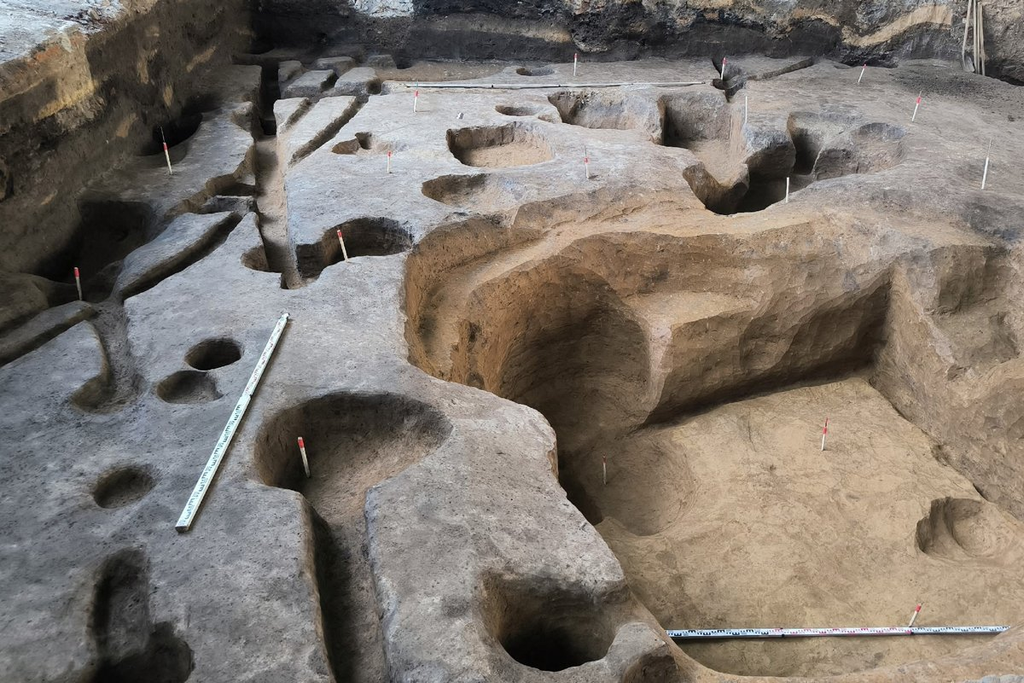
A remarkable archaeological discovery beneath Germany’s Lake Arendsee could challenge long-held assumptions about when hunter-gatherers began building substantial structures and shaping their surroundings.
Underwater archaeologists have recovered pieces of worked wood dating back about 10,500 years, including a roughly 1.6-metre-long wooden post bearing cutting marks and split boards measuring up to about 1.3 metres.
The finds come from the Mesolithic, a period when communities in Central Europe generally lived by hunting, fishing, and gathering rather than farming. Researchers now want to determine whether the wooden remains belonged to huts, other buildings, or a type of construction that has not previously been recognised in the region.
That question is important because direct evidence of Mesolithic buildings is exceptionally rare. If the wood is ultimately shown to be part of permanent structures or deliberately developed living spaces, it could push back the accepted timeline for some forms of settlement and landscape modification in Central Europe by roughly 3,000 years.
The discovery does not yet prove that people were living in permanent houses at Lake Arendsee. That conclusion remains under investigation.
What was found beneath Lake Arendsee?
Researchers from the State Office for Heritage Management and Archaeology of Saxony-Anhalt recovered several pieces of remarkably well-preserved wood from the lake.
Among the most striking finds is a wooden post about 1.6 meters long. It carries clear signs of felling and human processing, suggesting that it was not simply a branch or tree fragment that entered the lake naturally.
Archaeologists also recovered split wooden boards measuring up to about 1.3 meters.
The combination of size, shape and working marks has made the material especially interesting. Researchers believe the objects could represent components of structures built by Mesolithic hunter-gatherers.
However, they are not yet certain what those structures were.
Why was the ancient wood preserved so well?
The lake itself appears to have created unusually favorable conditions for preserving organic material.
The archaeological remains lie beneath a relatively thin layer of sediment at a depth of around 20 meters, or about 66 feet.
Lake Arendsee also has an unusual geological history. Its lakebed is gradually sinking because of geological processes associated with a salt structure beneath the area.
That continuing subsidence helped preserve sections of the ancient shoreline and material associated with earlier human activity underwater.
For archaeologists, this is a rare advantage. Wood normally decays quickly and is therefore dramatically underrepresented in prehistoric archaeological records compared with stone or bone.
At Arendsee, the underwater environment effectively created a time capsule.
Who made the wooden structures?
The researchers attribute the material to Mesolithic hunter-gatherers who lived around the lake roughly 10,500 years ago.
This was thousands of years before farming became established in Central Europe.
The Mesolithic is generally understood as the period between the earlier Paleolithic hunter-gatherer societies and the Neolithic communities that adopted agriculture and animal husbandry.
People living during this transitional period were not simply wandering continuously from place to place. Archaeology has increasingly shown that hunter-gatherer communities could have complex social lives, seasonal camps, managed resources and strong relationships with particular landscapes.
The Arendsee wood could add another piece to that picture.
Could these be the remains of houses?
Possibly, but researchers are deliberately cautious.
The 1.6-meter post could have served as a structural support, while the split boards may have formed part of a larger wooden construction.
That raises the possibility of huts or other buildings.
But several alternative explanations remain possible. The wood could have been used for structures serving purposes other than permanent housing, or it could belong to an architectural form that archaeologists have not yet identified.
More excavation and analysis will be necessary before the researchers can determine how the pieces were originally arranged.
This is why describing the discovery as evidence of “10,500-year-old houses” would go beyond what the evidence currently demonstrates.
Why would permanent structures be such a big deal?
The answer lies in what the construction of a building says about how people used a landscape.
A temporary shelter can be constructed quickly and abandoned. A substantial or repeatedly maintained structure requires a different investment of time, labor and resources.
Permanent or semi-permanent buildings can therefore indicate that a community returned regularly to the same location or developed a more sustained relationship with it.
Archaeologists have traditionally associated the emergence of enduring settlements and heavily modified cultural landscapes in Central Europe with Neolithic farming communities.
Those early farmers began arriving in parts of the region around 5500 BCE and constructed longhouses and other substantial settlements.
If Mesolithic groups at Arendsee were already building persistent structures around 10,500 years ago, the transition from mobile hunter-gatherer life to more settled communities may have been considerably less straightforward than the traditional narrative suggests.
How much earlier would that be?
The timing is potentially striking.
The Arendsee material dates to approximately 10,500 years ago.
The first Neolithic farmers reached Central Europe roughly 7,500 years ago, depending on the region and the chronology used.
That creates a gap of around 3,000 years.
Researchers from Saxony-Anhalt say that if the Arendsee structures were permanent buildings or intensively modified living areas, the finding could therefore move the evidence for such activities thousands of years earlier than previously known in Central Germany.
That does not mean agriculture itself began 3,000 years earlier. The potential change concerns architecture, settlement behavior and the deliberate shaping of landscapes.
What does “cultural landscape” mean?
A cultural landscape is an environment that has been substantially shaped by human activity.
It can include settlements, fields, pathways, managed vegetation, water infrastructure and other features that show people were not simply passing through a natural environment.
Today, cultural landscapes are found almost everywhere humans have lived for extended periods.
The important archaeological question is when this kind of intensive landscape relationship began.
Researchers have often linked the development of Central Europe’s familiar cultural landscapes with farming because agriculture requires long-term management of land.
The Arendsee discovery raises the possibility that hunter-gatherers were already modifying and organizing parts of their surroundings much earlier.
What makes Mesolithic wood so rare?
Stone tools and animal bones dominate many archaeological sites from the Mesolithic because they survive far better than organic materials.
Wood, leather, woven materials and plant remains normally decay unless special environmental conditions preserve them.
That makes the Arendsee discovery particularly valuable.
The researchers are not merely finding an old piece of timber. They are recovering information about an activity that would usually disappear from the archaeological record.
Cutting and felling marks can reveal whether wood was deliberately selected and modified. The shape and dimensions of the pieces can then provide clues about their original purpose.
If more wooden components are found in the same area, researchers may be able to reconstruct an entire structure.
How are researchers searching for more evidence?
The archaeological team is combining traditional underwater excavation with modern technology.
Researchers have worked with the Fraunhofer Institute to use a remotely operated vehicle, or ROV, to conduct high-resolution sonar scans of the lakebed.
The goal is to map the ancient shoreline and identify areas where additional archaeological remains may be concentrated.
This matters because the currently recovered pieces may represent only a tiny part of a larger site.
Mapping the submerged landscape can show where ancient activity was concentrated and help archaeologists decide where future dives and excavations should take place.
It also reduces the need to disturb large areas of the lakebed without first identifying promising locations.
What else has been found in Lake Arendsee?
The Mesolithic wood is not the first important archaeological discovery from Arendsee.
Previous underwater investigations have recovered remains from several different periods, including Neolithic fish weirs and medieval boats.
That makes the lake an unusually rich archaeological environment.
The preservation of an ancient shoreline beneath the modern lake means that archaeologists can study evidence from different eras within the same submerged landscape.
The newly discovered wood takes researchers much further back in time than some of the more recent finds.
Does this prove hunter-gatherers were permanently settled?
No.
This is perhaps the most important qualification surrounding the discovery.
The archaeological team has not yet established that the wooden remains belonged to permanent homes.
Even if they were part of buildings, those structures might have been seasonal, repeatedly occupied or used for specialized activities rather than serving as year-round residences.
A community can also invest heavily in a particular location without becoming permanently settled in the later agricultural sense.
Researchers therefore need more evidence before changing the broader understanding of Mesolithic settlement patterns.
What could change if the structures are confirmed?
If future investigations show that the wood belonged to permanent or repeatedly maintained buildings, several assumptions about early European societies could require revision.
It could suggest that hunter-gatherers were capable of investing in architecture much earlier than the surviving archaeological record currently demonstrates.
It could also indicate that some communities developed stronger territorial relationships with particular landscapes before the arrival of agriculture.
That would add to a growing body of archaeological evidence showing that the transition from mobile hunting and gathering to farming was not a simple overnight switch.
Different communities adopted different strategies depending on local resources, climate and environmental conditions.
What happens next?
Researchers plan to continue underwater investigations at Lake Arendsee.
The next phase will focus on determining the extent of the archaeological site, identifying additional wooden elements and reconstructing the ancient shoreline.
Scientists will also need to establish how the individual pieces relate to one another.
The central question is simple but potentially transformative: were these isolated pieces of worked wood, or are they the surviving fragments of a much larger Mesolithic structure?
For now, the evidence supports the existence of deliberately worked timber dating back around 10,500 years. It does not yet prove that the wood came from permanent homes.
But that uncertainty is precisely what makes the discovery important.
For thousands of years, water concealed the wooden remains of a prehistoric landscape beneath Lake Arendsee. Archaeologists are now beginning to bring that landscape back into view, piece by piece.