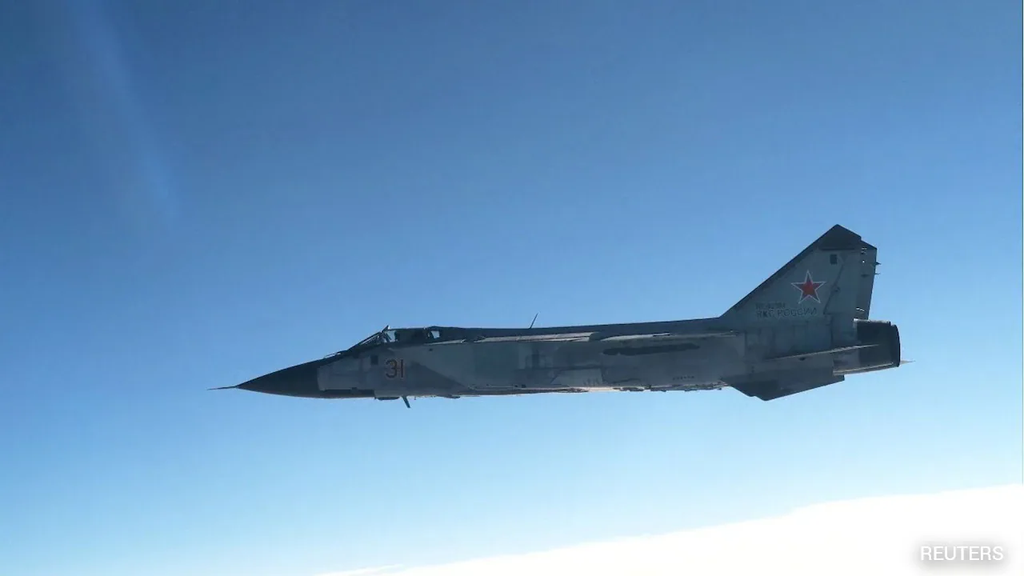
Finland and Sweden have carried out their first joint operational fighter mission to identify Russian military aircraft over the Gulf of Finland, marking a new phase in military cooperation between the two Nordic NATO members.
On September 24, Finnish F/A-18 Hornets and Swedish JAS 39 Gripens were scrambled under Quick Reaction Alert procedures after a Russian aircraft formation was detected over the Gulf of Finland.
The Russian group consisted of a Tu-134 transport aircraft, MiG-31 fighter jets and Su-30 fighters. The Swedish Armed Forces said the aircraft were flying in international airspace and were intercepted and identified by the Finnish and Swedish fighters.
The operation was directed by the Finnish Air Force’s Air Operations Centre and was described by Sweden as the first joint operational identification mission conducted by the two air forces.
It was not simply another routine patrol. The mission demonstrated that the two countries can now connect their air-defense systems and deploy fighters from both nations as part of a single operational response.
What happened over the Gulf of Finland?
The incident unfolded on September 24 as Russian military aircraft operated over the Gulf of Finland.
Finnish and Swedish Quick Reaction Alert, or QRA, aircraft were ordered into the air to determine the identity and activity of the Russian formation.
Finland contributed F/A-18 Hornet fighters, while Sweden sent JAS 39 Gripens.
The Russian group included three distinct aircraft types: a Tu-134 transport aircraft, MiG-31 interceptors and Su-30 fighters. The Swedish Armed Forces identified them as a Russian detachment operating in international airspace.
The mission therefore involved interception and identification rather than an announced shoot-down response or a confirmed breach of national territory.
That distinction is important. Interceptions over international airspace are a standard element of air policing and surveillance, while an actual airspace violation would involve an aircraft entering sovereign airspace without authorization.
Why this mission was a first
The headline development is not that Finnish and Swedish fighters have never flown alongside each other.
They have.
The two air forces have conducted cross-border training sorties almost weekly for several years and have built increasingly close operational links through Nordic defense cooperation.
What happened on September 24 was different.
For the first time, aircraft from both countries were involved in a real-world joint operational identification mission against the same Russian formation, with the Finnish Air Force’s Air Operations Centre directing the operation.
Swedish and Finnish authorities describe this as the first joint operational identification mission between their air forces.
Swedish Major General Jonas Wikman said the countries can now operate more seamlessly together as air forces, nations and NATO allies. Finnish Colonel Vesa Mäntylä said the deeper cooperation allows QRA fighters to operate from each country’s air bases when necessary.
That creates something more substantial than symbolic cooperation.
It means the two countries are building the ability to share responsibilities during an actual alert rather than limiting their partnership to exercises.
What is Quick Reaction Alert?
Quick Reaction Alert is essentially an air force’s rapid-response system.
Fighter aircraft are kept ready so that they can launch quickly when unidentified or potentially concerning aircraft appear in monitored airspace.
The aircraft used for QRA missions are not necessarily being sent into combat. Their initial task can simply be to establish what is flying, determine where it is operating and monitor its behavior.
That is what happened in the Gulf of Finland.
The Finnish and Swedish fighters identified the Russian formation without either country announcing that Russian aircraft had entered its sovereign airspace.
QRA therefore sits at the quieter end of military operations, but it is strategically important because response time matters when unidentified aircraft are operating close to national or alliance territory.
Why the Gulf of Finland matters
Geography makes the Gulf of Finland particularly sensitive.
Finland occupies the gulf’s northern shore, Estonia lies to the south and Russia controls the eastern end around St. Petersburg.
The area is therefore surrounded by NATO territory on multiple sides while also sitting close to Russian military aviation activity.
For Finland and Sweden, maintaining awareness of aircraft movements in the region has become increasingly important since both countries joined NATO.
Finland became NATO’s 31st member on April 4, 2023. Sweden followed on March 7, 2024, becoming the alliance’s 32nd member.
That changed the broader strategic context of Nordic air defense.
Military cooperation that once focused heavily on national defense and regional exercises now also operates inside NATO’s collective-defense framework.
The real change happened before this mission
The September 24 operation did not appear out of nowhere.
Finland and Sweden had already spent years building interoperability through cross-border training and Nordic Air Power cooperation, which also includes Norway and Denmark.
According to the Swedish Armed Forces, the Finnish and Swedish air forces have conducted cross-border training almost weekly for several years.
That experience matters because aviation cooperation requires more than putting two different fighter types in the same sky.
Pilots and controllers need compatible procedures, communications and command arrangements. Operational centers need to know where aircraft are positioned and how quickly they can respond. The countries also need rules for when fighters can operate from each other’s bases.
The new cooperation allows Finnish and Swedish QRA fighters to use bases in one another’s countries when necessary.
In practical terms, that can give both countries more flexibility when planning responses across the region.
Why Russian aircraft were being monitored
The Russian formation itself was notable because it combined different aircraft roles.
The Tu-134 served as the transport element, while the MiG-31 and Su-30 are combat aircraft with very different capabilities.
The MiG-31 is a long-range interceptor designed to engage airborne targets, while the Su-30 is a multirole fighter.
Their presence alongside a transport aircraft does not by itself establish an offensive intent.
Military aircraft regularly operate in formations for training, patrols, escort missions and other purposes.
The key fact supplied by the Swedish authorities is therefore the location: the Russian formation was operating in international airspace over the Gulf of Finland when Finnish and Swedish QRA aircraft were launched.
No public statement accompanying the mission indicated that Russia had attacked or attempted to enter Finnish or Swedish sovereign airspace.
A wider NATO security picture
The mission nevertheless comes at a time of increased NATO attention to air activity along the alliance’s eastern flank.
NATO says the number of airspace violations and other hostile activities involving Russia has increased, and the alliance launched Eastern Sentry in September 2025 to strengthen vigilance along its eastern flank.
NATO’s current posture includes air policing, integrated air and missile defense and additional surveillance capabilities. The alliance describes those measures as defensive and says they are intended to protect NATO territory.
The Gulf of Finland sits near the northern portion of that broader security architecture.
Finland also hosts NATO’s Forward Land Forces battlegroup, with Sweden serving as the framework nation. That gives the Nordic region an increasingly integrated military structure extending beyond bilateral cooperation.
Denmark issues a separate warning about Russia
The fighter mission coincided with a new assessment from Denmark’s Defence Intelligence Service, or DDIS.
On September 24, the agency said it assessed that Russia would likely intensify what it describes as its hybrid campaign against NATO and the West during the coming months.
DDIS assessed the risk of a limited Russian military attack against a NATO member as “low but growing.” It also said a full-scale Russian invasion of a NATO country remained unlikely, although it could no longer be completely ruled out.
That assessment does not specifically link Russia’s Gulf of Finland flight to preparations for an attack.
It does, however, help explain why Nordic and Baltic countries are placing greater emphasis on rapid surveillance, interoperability and air-defense readiness.
Putin rejects the idea that Russia is preparing to attack Europe
Against that backdrop, Russian President Vladimir Putin offered a sharply different assessment.
Speaking in St. Petersburg on September 25, Putin said Russia was not preparing for military action against European countries and said Moscow had no such plans.
He also dismissed warnings from European officials about a possible Russian attack as provocations and criticized comments attributed to Estonia’s defense leadership.
Putin described the warnings as “complete nonsense” and mocked them with a reference to the Russian expression that “the circus has left, but the clowns remain.” Russian reporting of his remarks placed them in the context of broader criticism of European support for Ukraine.
Those remarks underline the sharply different interpretations surrounding Europe’s current security environment.
European governments and NATO are increasing surveillance and defense readiness because of what they describe as a worsening security environment.
Moscow, meanwhile, rejects the suggestion that it is preparing for a war with NATO.
What Finland and Sweden’s new cooperation means
The significance of the September 24 mission lies less in the number of aircraft involved than in what the operation demonstrates.
Finland and Sweden have moved from years of training together toward a system in which their air forces can participate in the same live operational response.
That could become increasingly important in a region where distances are short, air activity is closely monitored and several countries share responsibility for the same wider security environment.
The ability to launch Finnish and Swedish fighters, coordinate them through a shared operational structure and potentially use bases in either country gives the partnership a flexibility that did not exist at the same level before.
It also reflects how rapidly Nordic defense arrangements have changed over the past few years.
The September 24 mission was not a battle and did not involve a reported violation of Finnish or Swedish airspace.
But it was a visible demonstration that Finland and Sweden are no longer merely practicing interoperability on an exercise schedule.
They are beginning to use it in real-world air surveillance.
And over the Gulf of Finland, that difference matters.