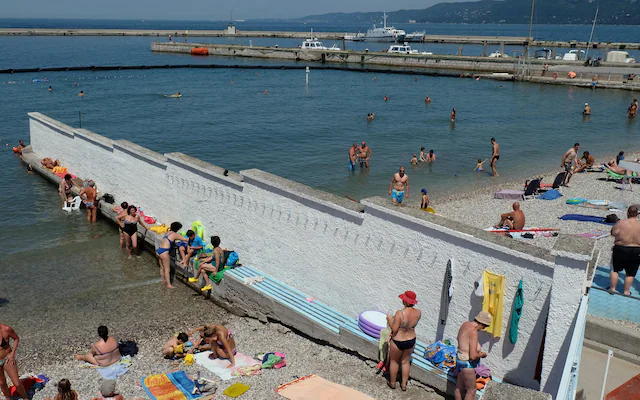
A historic beach in northeastern Italy has found itself at the center of an unlikely tourism boom after a controversy over its decades-old policy of separating male and female bathers. La Lanterna beach in Trieste, which has operated since 1903, recorded a sharp increase in visitors in July after an incident involving a couple reignited debate over whether its gender-separated bathing areas still belong in modern Italy.
Rather than keeping people away, the controversy appears to have made the unusual beach more popular.
According to local newspaper Il Piccolo, La Lanterna sold 53,610 tickets in July 2026, compared with 34,885 in July 2025. That means the council-run beach recorded an increase of 18,725 tickets, or about 54% year over year.
Women accounted for much of the additional attendance, according to the newspaper.
Why is La Lanterna beach divided between men and women?
La Lanterna is one of the few remaining beaches in Europe known for maintaining separate bathing areas for men and women.
A 74-meter wall extends into the Adriatic Sea, physically dividing the beach into two sections.
The arrangement dates back more than a century and reflects an older approach to privacy at public bathing facilities.
The wall does more than divide the beach on land. It continues into the water, creating distinct swimming areas for male and female bathers.
There is, however, a way to communicate across the divide.
People can walk through the shallow water toward the end of the wall, where the two sides meet.
The separation also offers women greater privacy if they want to sunbathe topless, as they can do so without being directly visible to male bathers on the other side.
What triggered the controversy at the Italian beach?
The debate intensified in June after a man and woman visiting from Milan entered the men’s section of the beach together.
According to reports, staff asked the woman to move to the women’s side.
She initially refused and criticized the policy, reportedly calling it discriminatory and describing the arrangement as “medieval.”
The couple eventually left the beach.
But the incident did not end there.
It quickly spread through Italian media and social media, turning a relatively obscure local tradition into a national conversation about gender segregation, personal freedom and cultural heritage.
The controversy also raised a question that many historic institutions eventually face: when does preserving tradition become preserving a practice that no longer fits modern social expectations?
Why do some Trieste residents want to preserve the beach?
Supporters of La Lanterna argue that the beach should not be judged solely by contemporary standards.
For many Trieste residents, the separation is part of the city’s cultural identity and history.
Social media comments defending the beach emphasized that the wall is not a recent invention or an arbitrary rule. It has been part of La Lanterna for generations.
One supporter described the beach as part of Trieste’s traditions and argued that it had become a target of “cancel culture.”
Another said the arrangement was part of Trieste’s history and that local residents did not want the wall removed.
For supporters, preserving La Lanterna is therefore less about enforcing separation between men and women and more about keeping an unusual piece of the city’s heritage alive.
Why do critics call the arrangement discriminatory?
Critics see the issue differently.
Their objection is not necessarily to the existence of a historic beach, but to a public facility continuing to divide bathers according to sex.
The incident involving the Milan couple highlighted the tension between two competing ideas:
- Tradition and cultural heritage: The beach has maintained its arrangement for more than a century.
- Modern equality and inclusion: Critics argue that men and women should be able to use the same public recreational spaces.
That disagreement explains why a relatively small dispute involving two visitors quickly became a much broader debate.
For critics, the fact that the policy is old does not automatically make it appropriate today.
For supporters, changing it would mean removing a distinctive part of Trieste’s identity.
Did the controversy actually increase visitors?
The visitor figures suggest that it did — at least during July.
La Lanterna sold:
| Period | Tickets sold |
|---|---|
| July 2025 | 34,885 |
| July 2026 | 53,610 |
| Increase | 18,725 |
| Year-over-year increase | ~54% |
The increase is striking because it came shortly after the beach became the subject of widespread discussion.
Women reportedly made up the majority of the additional visitors.
That could indicate that the publicity attracted people who were curious about the unusual arrangement or interested in experiencing a historic beach that had suddenly become a talking point.
But the figures alone cannot prove that the controversy caused the increase.
Visitor numbers can be affected by many factors, including weather, tourism trends, local events, pricing and broader travel patterns.
The timing, however, makes the controversy a plausible contributor.
Why might women have been particularly interested?
The beach’s unusual structure may itself be part of the attraction.
The women’s section provides a degree of privacy that is uncommon at mainstream European beaches.
Women who prefer not to share a bathing area with men may find the arrangement appealing. The same privacy can also allow women to sunbathe topless without being directly visible from the male section.
That may help explain why women represented a substantial portion of the increase reported after the controversy.
In other words, the same feature that critics see as outdated may be exactly what some visitors value.
That creates an unusual contradiction: a policy criticized as discriminatory may simultaneously be attractive to people seeking privacy.
Is La Lanterna really one of Europe’s last segregated beaches?
La Lanterna is widely described in media reports as one of Europe’s last remaining gender-segregated beaches.
However, that description should be used carefully.
There are other locations around Europe where beaches, swimming facilities or bathing times may be separated by gender for religious, cultural or privacy reasons.
La Lanterna is unusual because it is a public, historic beach in a European city that has maintained a permanent physical division between male and female bathing areas.
The 74-meter wall makes the arrangement particularly distinctive.
A beach caught between history and modern expectations
La Lanterna’s controversy reflects a broader question faced by historic public spaces around the world.
Should traditions be preserved simply because they are old?
Or should long-standing practices change when social attitudes evolve?
There is no simple answer.
A historic custom can carry genuine cultural value while simultaneously raising legitimate questions about equality and inclusion.
In La Lanterna’s case, the debate has also revealed something less predictable: controversy can make a little-known place more attractive.
A beach that might otherwise have remained a local curiosity suddenly became a destination people wanted to see for themselves.
The controversy may have created its own tourism effect
There is an irony in what happened next.
The dispute was initially framed as a challenge to La Lanterna’s future.
Instead, it appears to have generated publicity that benefited the beach.
More than 53,000 tickets were sold in July, giving the historic facility its strongest burst of attention in years.
Visitors may have arrived for different reasons:
- Some may support the traditional arrangement.
- Others may have wanted to experience a historic Trieste institution.
- Some may have been curious after seeing the controversy online.
- Others may simply value the privacy provided by the separate bathing areas.
Whatever brought them there, the result was the same: the controversy put La Lanterna firmly back on the map.
Will the beach’s tradition survive?
For now, there is no indication from the supplied information that Trieste authorities plan to remove the dividing wall or abandon the gender-separated arrangement.
That means La Lanterna remains what it has been for generations: a beach where history is not simply displayed in a museum but built into the way the space is used.
The recent surge in visitors may even strengthen the argument among supporters that the arrangement remains relevant.
At the same time, the controversy has shown that the tradition is unlikely to escape scrutiny simply because it is historic.
The debate over La Lanterna is therefore far from being just about one beach wall.
It is about how modern societies decide which traditions deserve to survive, who gets to define cultural heritage, and whether an old practice can remain meaningful when social expectations around equality have changed.
For La Lanterna, at least this summer, the answer has been unexpectedly good for business: the controversy did not empty the beach.
It filled it.