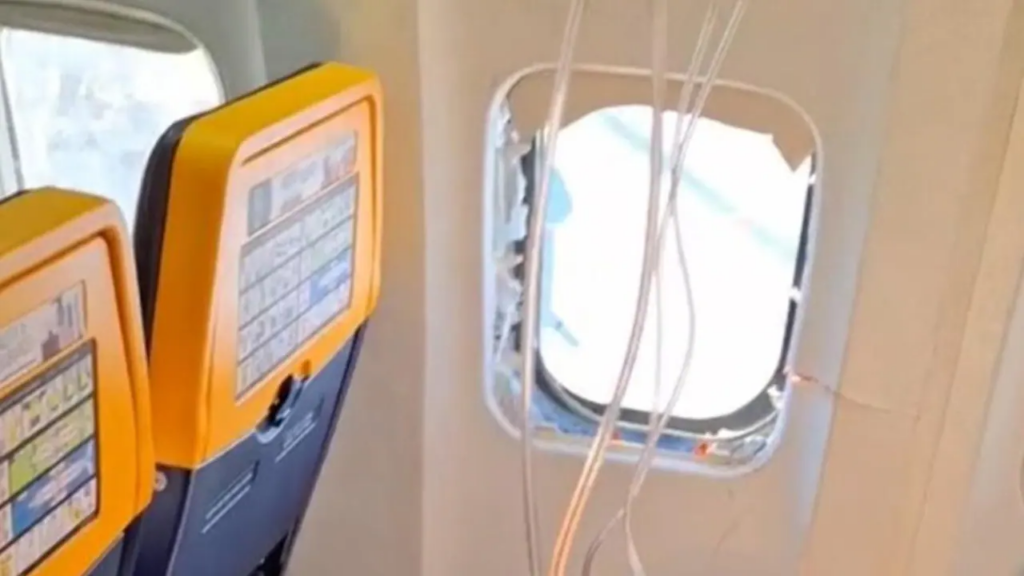
A routine flight from Greece to Germany turned into a terrifying mid-air emergency after a passenger window reportedly failed during flight, causing rapid cabin decompression. According to passenger accounts, a 61-year-old man was partially pulled through the damaged window, with only his seatbelt and the quick actions of nearby passengers—including his wife—preventing a far more serious tragedy.
The aircraft returned safely to Thessaloniki, and Ryanair confirmed that the flight diverted after a passenger window became dislodged. While investigators continue examining what caused the incident, aviation experts say the episode highlights both the dangers of rapid decompression and the life-saving importance of wearing seatbelts throughout a flight.
What happened on the Ryanair flight?
The incident occurred aboard a Ryanair Boeing 737 operating from Thessaloniki, Greece, to Memmingen, Germany. According to the airline, the aircraft returned to Thessaloniki shortly after departure after a passenger window became dislodged during flight.
Passengers reported hearing a loud bang before oxygen masks automatically deployed and the cabin rapidly lost pressure. The aircraft landed safely, and one passenger received medical attention after landing.
Was the passenger really sucked out of the window?
According to eyewitness accounts reported by Greek media, a 61-year-old Serbian passenger seated next to the damaged window was partially pulled toward the opening during the decompression.
Passengers said:
- His upper body was forced toward the broken window.
- His head and shoulders were outside the aircraft.
- Nearby passengers and his wife pulled him back inside.
- His seatbelt prevented him from being completely ejected.
These descriptions are based on witness accounts. Aviation authorities have not yet released an official reconstruction of the incident.
Why didn’t he fall out of the aircraft?
Several factors likely prevented a fatal outcome.
The seatbelt
The passenger was reportedly wearing his seatbelt.
During rapid decompression, the pressure difference between the cabin and the outside air can generate powerful forces. A properly fastened seatbelt helps keep occupants secured in their seats, dramatically reducing the risk of being thrown against openings in the aircraft.
Quick action by nearby passengers
Witnesses said the man’s wife and several other passengers held onto him until the aircraft stabilized. Their actions may have helped prevent further injury while the crew responded to the emergency.
What causes rapid cabin decompression?
Commercial aircraft cruise at altitudes where outside air pressure is too low for humans to breathe normally.
Cabins are therefore pressurized.
Rapid decompression can occur if the aircraft’s pressure vessel is compromised through:
- Window failure
- Structural damage
- Door seal failure
- Hull damage
- Mechanical malfunction
When cabin pressure suddenly drops, oxygen masks deploy automatically while pilots initiate an emergency descent to a lower altitude where breathing becomes safer.
Can someone really be sucked out of an airplane?
Popular movies often exaggerate decompression events.
In reality, the initial rush of escaping air can create strong forces capable of pulling unsecured objects—or in rare cases, people positioned immediately next to a large opening—toward the breach.
However, once cabin pressure equalizes, those forces diminish quickly.
Passengers who are properly restrained with seatbelts are far less likely to be ejected.
What did Ryanair say?
In a statement, Ryanair confirmed that:
- The aircraft returned to Thessaloniki shortly after takeoff.
- The diversion occurred after a passenger window became dislodged during flight.
- The aircraft landed normally.
- Passengers returned to the terminal.
- A replacement aircraft later transported passengers to their destination.
The airline also said one passenger requested and received medical assistance.
What did passengers describe?
Witnesses interviewed by local media described a scene of panic inside the cabin.
Passengers reported:
- A loud explosive noise.
- Oxygen masks dropping from the ceiling.
- A rapid loss of cabin pressure.
- People initially believing an emergency exit had opened.
- The aircraft descending shortly afterward.
These accounts have not yet been independently verified by investigators.
How safe are aircraft windows?
Aircraft windows are engineered with multiple layers of acrylic and are designed to withstand significant pressure differences throughout thousands of flights.
Window failures remain extremely rare.
When they do occur, aviation authorities conduct detailed investigations examining factors such as:
- Structural integrity
- Manufacturing defects
- Maintenance records
- Impact damage
- Pressurization systems
The investigation into this incident is expected to determine the exact cause of the reported window failure.
Why wearing your seatbelt matters
This incident serves as another reminder of why airlines recommend keeping seatbelts fastened whenever passengers are seated.
Seatbelts help protect against:
- Unexpected turbulence.
- Hard landings.
- Rapid decompression.
- Sudden aircraft movements.
Even when the seatbelt sign is turned off, aviation safety experts recommend keeping the belt loosely fastened while seated.
TL;DR
- A Ryanair Boeing 737 returned safely to Thessaloniki after a passenger window reportedly became dislodged during flight.
- Witnesses said a 61-year-old passenger was partially pulled toward the opening during rapid decompression.
- The passenger’s seatbelt and assistance from nearby passengers reportedly prevented him from being fully ejected.
- Oxygen masks deployed as the aircraft safely returned to the departure airport.
- Aviation authorities are expected to investigate the cause of the reported window failure.