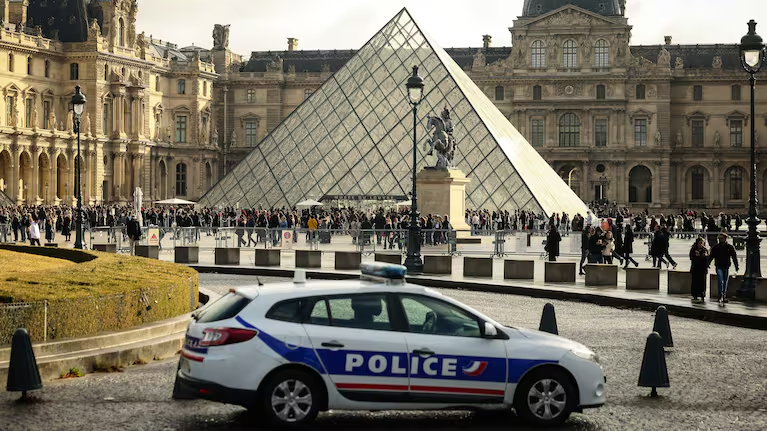
Paris police arrest suspects in $100 million Louvre jewel theft
French authorities have arrested at least two suspects over the daring daylight theft of royal crown jewels from Paris’s Louvre Museum, in what investigators have described as one of the most audacious art crimes of the century.
According to the Paris prosecutor’s office, the arrests were made late Saturday evening (October 26). One suspect was detained while reportedly attempting to leave the country from Roissy, Charles de Gaulle Airport. The arrests come a week after the jewel theft, which stunned France and sent shockwaves through the global art world.
How the Louvre Museum heist unfolded
The brazen operation took less than eight minutes. French officials said the intruders used a basket lift to scale the Louvre’s façade, broke open a window, and smashed several glass display cases in the museum’s 19th-century jewels wing before escaping undetected.
The stolen treasures, valued at around €88 million ($102 million), were part of the museum’s collection of crown jewels once belonging to French queens and empresses, including Marie-Amélie, Hortense, and Empress Eugénie.
Investigators believe the thieves had precise knowledge of the museum’s layout and security systems. Louvre director Jean-Luc Martinez described the theft as a “terrible failure,” calling for an urgent internal review of security protocols.
What the thieves stole
The robbers targeted eight priceless artifacts, including
- A sapphire diadem, necklace, and single earring linked to 19th-century queens Marie-Amélie and Hortense
- An emerald necklace and earrings belonging to Empress Marie-Louise, Napoleon Bonaparte’s second wife
- A reliquary brooch believed to have been commissioned by a royal household
- Empress Eugénie’s diamond diadem and corsage-bow brooch, an intricate set known for its imperial craftsmanship
One piece, Eugénie’s emerald-set imperial crown, encrusted with more than 1,300 diamonds, was later found damaged but recoverable near the museum’s exterior grounds.
Investigators race to recover the jewels
More than 100 investigators from France’s anti-gang brigade are currently working on the case. Paris prosecutor Laure Beccuau confirmed the arrests but did not disclose the suspects’ identities or the total number of detainees.
She also criticized the premature leak of details to the press, warning that “it could hinder the ongoing efforts to recover the stolen jewels and apprehend all of the perpetrators.”
Both BFM TV and Le Parisien reported that two suspects were being questioned in custody, though authorities have not ruled out additional accomplices.
French Interior Minister Laurent Nunez praised the arrests, saying, “The investigators have worked tirelessly, just as I asked them to, and they have my full confidence.”
Louvre reopens as France reckons with the shock
The Louvre reopened its doors to visitors earlier this week, three days after the heist. Security has since been significantly reinforced, and visitors have expressed relief over the arrests but lingering disbelief at how such a crime could occur at one of the world’s most protected institutions.
“It’s important for our heritage,” said visitor Freddy Jacquemet. “A week later, it feels late; we wonder how this could even happen. But it’s good that they caught them.”
“I think the main thing now is whether they can recover the jewels,” added tourist Diana Ramirez. “That’s what really matters.”
The theft has been compared by some commentators to the 2019 fire at Notre-Dame Cathedral, symbolizing another blow to France’s cultural legacy.
The heist’s significance in global art crime history
The Louvre theft immediately joins the ranks of history’s most notorious museum crimes, from the 1990 Isabella Stewart Gardner Museum heist in Boston to the 2003 diamond robbery at Antwerp’s Diamond Centre.
Experts say such high-value cultural thefts are rarely about resale. Instead, the jewels are often dismantled, smuggled, or used as collateral in the criminal underworld. Interpol has already released photos of the stolen items to member countries, hoping to track their movement through black-market channels.
What happens next
As the investigation continues, French authorities remain focused on recovering the missing jewels before they vanish into private collections or are broken down for parts.
Cultural preservation experts are also calling for a reassessment of museum security protocols, especially at high-profile institutions like the Louvre that draw millions of visitors annually.
For now, the arrests mark a breakthrough, but until the jewels are found, France’s crown collection remains incomplete, and a key part of its royal history lies hidden somewhere beyond the museum’s glass walls.
TL;DR
- Two suspects arrested over the €88 million Louvre Museum crown jewel heist.
- The theft took under eight minutes, with intruders scaling the museum via lift and breaking display cases.
- Eight royal jewels were stolen, including items tied to Napoleon’s family and French empresses.
- One jewel, Eugénie’s emerald crown, has been recovered damaged.
- Over 100 investigators are still searching for the rest of the stolen treasures.