
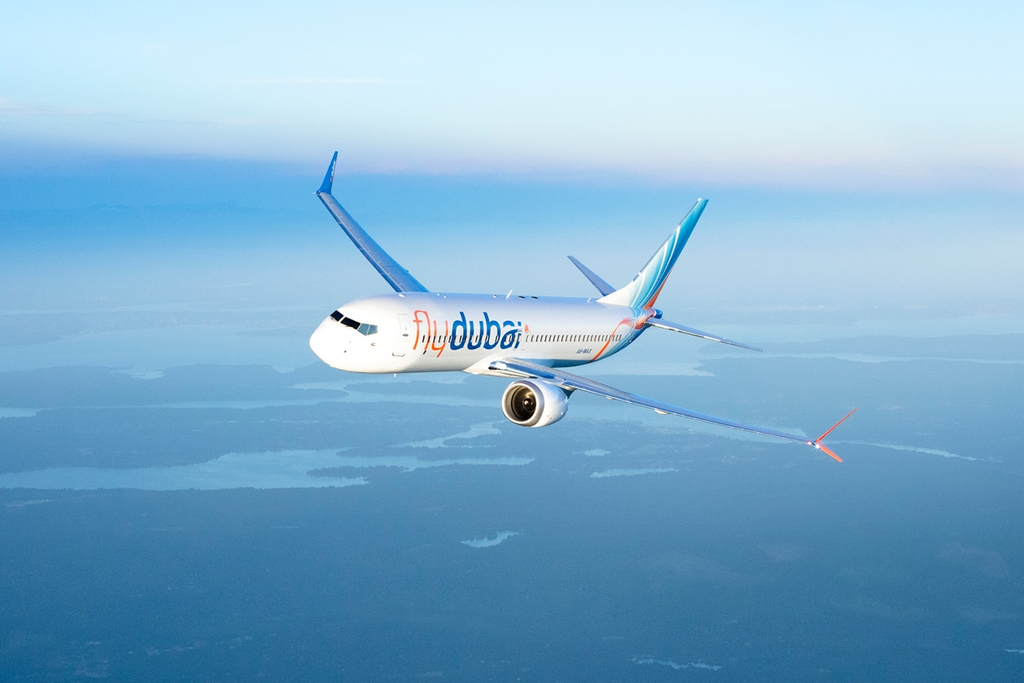
A Flydubai flight traveling from Dubai to Tel Aviv was diverted to Saudi Arabia on Wednesday after a serious incident involving the pilots triggered emergency signals and briefly raised fears of a hijacking.
Flight FZ1073, operated by a Boeing 737 MAX, was carrying more than 170 passengers when it turned away from Israel and headed toward Tabuk, Saudi Arabia. The aircraft transmitted the general emergency code 7700 before briefly switching to squawk 7500, the international transponder code associated with unlawful interference or a possible hijacking.
Israeli officials initially treated the situation as a major security incident, and Israeli fighter aircraft were scrambled while authorities worked to establish what was happening.
The aircraft ultimately landed safely at Tabuk Airport. Flydubai later said the emergency was linked to an altercation between the pilots and confirmed that all passengers were safe.
What happened aboard the Flydubai flight?
The flight departed Dubai International Airport for Tel Aviv’s Ben Gurion Airport on Wednesday morning.
According to flight-tracking data, the aircraft initially transmitted squawk 7700, the standard code used to indicate a general emergency. Several minutes later, it briefly switched to 7500 before eventually returning to 7700 as it diverted toward Saudi Arabia.
The 7500 signal immediately raised the possibility of an unlawful takeover of the aircraft.
However, Israeli authorities later said the emergency was connected to a physical fight between the pilots rather than a conventional hijacking. Flydubai said it was working with the relevant authorities and had opened an investigation into the incident.
The aircraft made a dramatic diversion
The plane had been heading toward Israel when it changed course and flew toward Saudi Arabia.
Flight-tracking data cited by multiple outlets showed substantial changes in the aircraft’s altitude during the incident. Reuters reported that the Boeing 737 descended rapidly by nearly 14,000 feet within roughly 30 seconds before stabilizing.
The aircraft eventually landed safely at Tabuk, a city in northwestern Saudi Arabia.
Flydubai said another aircraft would be sent from Dubai to Saudi Arabia to transport the passengers onward to Israel.
Why did the plane transmit hijack code 7500?
Squawk codes allow pilots to communicate important information to air traffic controllers through the aircraft’s transponder.
The three codes most relevant to this incident are:
- 7700: A general emergency requiring immediate attention.
- 7500: Unlawful interference, commonly associated with a hijacking.
- 7600: Loss of radio communications.
The brief appearance of 7500 on the Flydubai flight was therefore significant. It suggested to authorities that someone might have unlawfully interfered with the aircraft.
But the code itself does not establish exactly what happened inside the cockpit.
In this case, later assessments by Israeli officials indicated that the signal arose during a violent altercation between the pilots rather than a planned hijacking of the aircraft.
What do we know about the reported fight between the pilots?
Reports about the cockpit confrontation have changed as authorities and media outlets obtained more information.
Israeli media initially reported that the pilots had become involved in a physical confrontation. Some passenger accounts described screams coming from the front of the aircraft, followed by blood being seen after the cockpit door was opened.
Some reports also alleged that one pilot stabbed the other with a pocketknife.
That detail, however, should be treated as a reported allegation rather than an independently established fact. The nationalities and identities of the pilots were also reported inconsistently in the first hours following the incident.
Some early reports identified the pilots as Russian and Ukrainian, while later reports gave different nationalities. Reuters noted that conflicting accounts were circulating regarding both the pilots’ identities and the circumstances of the confrontation.
The safest description at this stage is that a physical altercation occurred between the pilots, the aircraft experienced a dangerous loss of altitude, emergency codes were transmitted, and the plane was diverted to Saudi Arabia.
The precise sequence of events remains under investigation.
What did passengers say?
Passengers described a chaotic scene inside the aircraft.
One passenger told Israeli media that people heard screams toward the front of the plane before the cockpit was opened and blood was seen. Another passenger described the aircraft suddenly plunging and said those onboard feared they were about to crash.
These accounts help explain the panic inside the cabin, but passenger testimony does not by itself establish what happened in the cockpit or why the aircraft changed altitude.
Authorities will need to reconcile those accounts with cockpit recordings, flight-data information, crew statements and other evidence.
Why were Israeli fighter jets scrambled?
The transmission of squawk 7500 while an aircraft was approaching Israeli airspace created a potentially serious security situation.
Israeli officials said fighter aircraft were scrambled while authorities assessed the aircraft’s status. Israel also held urgent security discussions as officials attempted to determine whether the aircraft had been hijacked or was experiencing another type of emergency.
The response illustrates why an aircraft transmitting 7500 is treated seriously.
Authorities cannot initially assume that the signal is accidental. They must determine whether someone has taken control of the aircraft, whether there is a security threat onboard, or whether another emergency has produced the signal.
In this case, the aircraft eventually diverted to Saudi Arabia and landed without passengers being killed or injured, according to the reports available so far.
Was this actually a hijacking?
Based on the latest reporting, Israeli authorities did not ultimately describe the event as a conventional hijacking.
Instead, officials said the emergency signal was triggered during a confrontation between the pilots. Reuters reported that the hijacking scenario was not believed to explain the incident, while other reports similarly described the event as a cockpit fight.
That distinction is important.
A hijacking normally involves an unauthorized person attempting to seize control of an aircraft. What happened aboard FZ1073 appears, based on current reporting, to have involved a confrontation within the cockpit itself.
However, authorities are still investigating the circumstances and motivation behind the confrontation.
Why did the aircraft land in Saudi Arabia?
Once the aircraft experienced the emergency and turned away from Israel, Tabuk provided a suitable diversion airport.
The Boeing 737 MAX ultimately landed safely at Tabuk Airport in northwestern Saudi Arabia. Flydubai said its teams were working with the relevant authorities following the incident.
The diversion was particularly notable because the flight was headed for Israel and the emergency occurred in a region where aviation security is closely monitored.
The safe landing also meant that investigators could begin examining the aircraft, interviewing the crew and passengers, and reconstructing the sequence of events.
What happens next?
The investigation will need to establish several key questions:
- What triggered the physical confrontation between the pilots?
- Who transmitted the 7700 and 7500 emergency codes?
- Why did the aircraft experience its rapid descent?
- Whether a weapon was involved in the cockpit.
- Whether either pilot attempted to deliberately alter the aircraft’s flight path.
- How the other crew members and passengers intervened.
- Why the aircraft’s emergency response unfolded as it did.
Investigators are likely to rely on cockpit voice recordings, flight-data recordings, air-traffic-control communications and statements from the crew and passengers.
Those sources should provide a more reliable picture than the conflicting early reports circulating online.
What we know — and what remains unconfirmed
The incident developed quickly, and several details remain unsettled.
Confirmed or reported by multiple authorities
- Flydubai flight FZ1073 was traveling from Dubai to Tel Aviv.
- The aircraft diverted to Tabuk, Saudi Arabia.
- The aircraft transmitted emergency code 7700.
- It briefly transmitted code 7500.
- The aircraft experienced a significant altitude change.
- Israeli authorities scrambled fighter aircraft while assessing the situation.
- The aircraft landed safely.
- Flydubai said the incident involved an altercation between the pilots.
- Passengers were reported safe.
Still under investigation
- The exact sequence of the cockpit confrontation.
- Whether one pilot stabbed another.
- The identities and nationalities of the pilots.
- Whether the incident was an attempted deliberate crash.
- The precise reason for the aircraft’s rapid descent.
- The motive behind the altercation.
That distinction is particularly important because several dramatic claims emerged on social media before authorities had completed their assessment.
A frightening flight that ended safely
For passengers aboard FZ1073, the incident was understandably terrifying. A sudden descent, screams from the front of the aircraft and the appearance of an emergency hijacking code would have created an extraordinary level of uncertainty.
But the available evidence now points away from an external hijacking and toward a serious confrontation involving the flight crew.
The aircraft landed safely in Saudi Arabia, and investigators now face the task of establishing exactly what happened inside the cockpit.
The incident is also a reminder of why aviation investigations often take time. Early reports can change as flight data, cockpit recordings and witness statements are examined together.
For now, the most significant fact is that a potentially catastrophic situation aboard a Dubai-to-Tel Aviv flight ended with the aircraft safely on the ground and passengers accounted for.
TL;DR
A Flydubai Boeing 737 MAX flying from Dubai to Tel Aviv diverted to Tabuk, Saudi Arabia, after an altercation between the pilots triggered emergency signals.
The aircraft first transmitted squawk 7700 and briefly switched to 7500, the code associated with unlawful interference or a suspected hijacking. Israeli authorities scrambled fighter aircraft while assessing the threat.
Later reporting indicated that the emergency was caused by a fight between the pilots rather than a conventional hijacking. Reports that one pilot stabbed another or deliberately attempted to crash the aircraft remain under investigation and should not be treated as established facts.
The aircraft landed safely in Saudi Arabia, and Flydubai said authorities were investigating the incident.