• About BreezyScroll
  • Privacy & Policy
  • Contact Us
Thursday, June 4, 2026
BreezyScroll
  • Home
  • Breezy Stories
  • Technology
  • Gaming
  • Entertainment
  • Lifestyle
  • World
  • Money
  • Sports
  • Breezy Explainer
No Result
View All Result
  • Home
  • Breezy Stories
  • Technology
  • Gaming
  • Entertainment
  • Lifestyle
  • World
  • Money
  • Sports
  • Breezy Explainer
No Result
View All Result
BreezyScroll
No Result
View All Result

Home  /  Science  /  Gaia BH3: Milky Way’s most massive black hole, 33 times bigger than the Sun, discovered lurking near Earth

Gaia BH3: Milky Way’s most massive black hole, 33 times bigger than the Sun, discovered lurking near Earth

by Shriya Kataria
April 16, 2024
in Science, World
Reading Time: 2 mins read
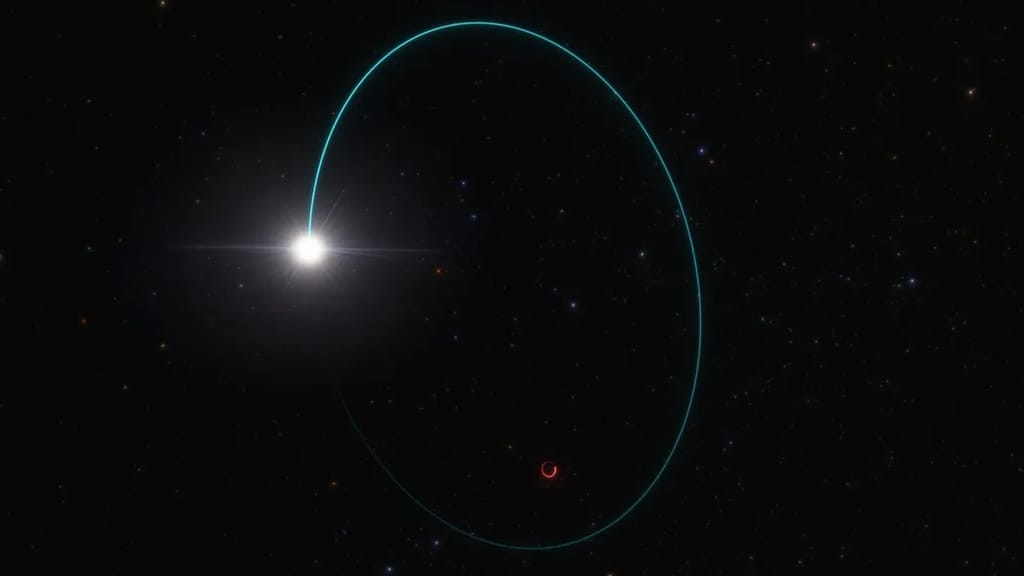
Gaia BH3: Milky Way's most massive black hole, 33 times bigger than the Sun, discovered lurking near Earth

Astronomers have made a groundbreaking discovery, identifying what they describe as the “most massive” black hole in the Milky Way yet. This black hole is at least 33 times larger than the Sun and is situated approximately 2,000 light years away from Earth.

The discovery was made by astronomers at the European Southern Observatory’s Gaia mission, who noticed a star exhibiting a wobbling motion as it orbited the area.

Named Gaia BH3, this black hole is the second closest to Earth and is located in the Aquila constellation. The word “Gaia” is of Latin origin, meaning “the eagle.”

“No one was expecting to find a high-mass black hole lurking nearby, undetected so far,” said Pasquale Panuzzo, an astronomer from the National Centre for Scientific Research at the Observatoire de Paris. “This is the kind of discovery you make once in your research life,” the astronomer added.

The star that collapsed to form the Gaia BH3 black hole was likely a metal-poor star

When stars reach the end of their lives, they can form black holes. While most stars expand, lose mass, and cool down to become “white dwarfs,” some stars, known as “metal-poor stars,” lose less mass and do not contain heavy elements. Instead of becoming white dwarfs, these stars collapse in on themselves, forming black holes.

This suggests that the star that collapsed to form the Gaia BH3 black hole was likely a metal-poor star. Further clues can be gathered from the “wobbly” star orbiting the black hole, as stars in pairs tend to have similar properties. Intriguingly, the wobbly star is also a metal-poor star.

NASA scientists believe that there are more than 50 stellar black holes in the Milky Way galaxy. In a separate discovery earlier in January, astronomers announced the finding of the oldest black hole ever discovered, dating back to the early universe over 13 billion years ago. This black hole is located in an ancient galaxy known as GN-z11, which is located 13.4 billion light-years away. The discovery was made using the James Webb Space Telescope.


Tags: black holeGaia BH3
ShareTweetShareSend

Recent Articles

WWDC 2026: What to Expect From Apple’s Biggest Software Event of the Year

WWDC 2026: What to Expect From Apple’s Biggest Software Event of the Year

June 4, 2026
US Wildlife Officials Urge Residents to Kill Invasive Tegu Lizards Spreading Across Southern States

US Wildlife Officials Urge Residents to Kill Invasive Tegu Lizards Spreading Across Southern States

June 4, 2026
Monako Glass: Chinese Smart Glasses Can Run Claude Code and Codex

Monako Glass: Chinese Smart Glasses Can Run Claude Code and Codex

June 4, 2026
Prince Harry Reportedly Not Invited to Peter Phillips’s Wedding Amid Royal Rift

Prince Harry Reportedly Not Invited to Peter Phillips’s Wedding Amid Royal Rift

June 4, 2026
BreezyScroll Logo

BreezyScroll is a global content platform that provides a unique experience of enhancing the knowledge quotient for its audience by providing the latest news and updates from various categories such as politics, sports, entertainment, technology, and more.
The platform aims to provide a concise and easy-to-read format for its users. BreezyScroll covers news stories from around the world, majorly the United States. The platform was launched in 2021 and has become one of the fastest-growing content companies in the US.

Follow Us

Browse by Category

  • Africa
  • Alaska
  • Animals
  • Asia
  • Athletics
  • Australia
  • Auto
  • Basketball
  • Bollywood
  • Brand
  • Breezy Explainer
  • Breezy Feature
  • Breezy Soul
  • Business
  • Canada
  • Chess
  • China
  • Coronavirus
  • Cricket
  • DIY
  • Education
  • Entertainment
  • Environment
  • EPL
  • Europe
  • Exclusive Interview
  • Exclusive Review
  • Football
  • Gaming
  • Health
  • Hollywood
  • India
  • International
  • K Pop
  • Law
  • Lifestyle
  • Middle East
  • Money
  • NFL
  • North America
  • OTT
  • Paris Olympics
  • Pets
  • Press Releases
  • Russia
  • Science
  • South America
  • Space
  • Sports
  • Startup
  • Technology
  • Tennis
  • Tennis
  • The Achievers
  • The US
  • Travel
  • UK
  • UK
  • Uncategorized
  • World
  • WWE

Trending Topics

AI Apple Australia Biden California Canada ChatGPT China Climate Change Coronavirus COVID-19 Donald Trump Elon Musk Featured Florida Google IPL Iran Japan Joe Biden Mars Meta Moon NASA NBA Netflix New York North Korea Ohio OpenAI Putin Russia Russia-Ukraine crisis South Korea Taliban Tesla Texas TikTok Trump Twitter UFO UK Ukraine USA Virat Kohli

No Result
View All Result
  • About BreezyScroll
  • Privacy & Policy
  • Contact Us

© 2024 · BreezyScroll.com

No Result
View All Result
  • Home
  • Breezy Stories
  • Technology
  • Gaming
  • Entertainment
  • Lifestyle
  • World
  • Money
  • Sports
  • Breezy Explainer

© 2024 · BreezyScroll.com

Go to mobile version