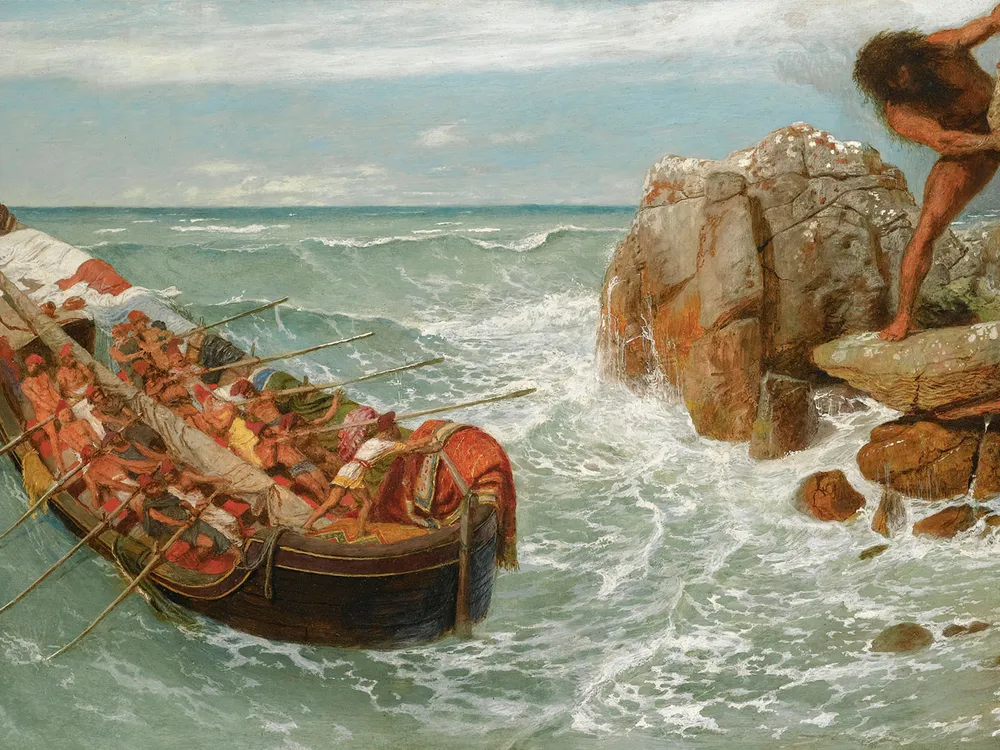
Christopher Nolan’s The Odyssey has introduced a new generation of moviegoers to one of Greek mythology’s most unforgettable encounters: Odysseus versus the Cyclops Polyphemus. While the sequence unfolds as a gripping survival thriller on screen, its real brilliance lies not in brute force, but in language.
More than 2,800 years after Homer composed The Odyssey, the story of Odysseus calling himself “Nobody” remains one of literature’s greatest examples of psychological warfare. It is a tale where intelligence triumphs over strength, and a single word changes the course of an impossible escape.
TL;DR
- Odysseus tells the Cyclops Polyphemus that his name is “Nobody” (Greek: Outis).
- After blinding the giant, Polyphemus cries for help, saying, “Nobody is killing me.”
- The other Cyclopes assume no one is attacking him and leave, allowing Odysseus to escape.
- The episode highlights the Greek concept of mētis, or cunning intelligence, which defines Odysseus throughout The Odyssey.
- The myth remains one of the most famous examples of deception and strategic thinking in world literature.
What Happens in the Cyclops Story?
The encounter takes place during Odysseus’ long journey home after the Trojan War.
Landing on the island of the Cyclopes, Odysseus and his crew enter a cave filled with sheep, cheese, and supplies. Expecting to receive hospitality under the ancient Greek custom of xenia—a sacred obligation requiring hosts to welcome and protect strangers—they decide to wait for the cave’s owner.
Instead, they meet Polyphemus, a one-eyed giant and son of the sea god Poseidon.
Rather than welcoming his guests, Polyphemus seals the cave with an enormous boulder and begins eating Odysseus’ men alive.
Odysseus quickly realizes that killing the Cyclops immediately would only doom everyone inside. The giant is the only one strong enough to move the massive stone blocking the cave entrance.
The problem becomes not how to defeat Polyphemus, but how to outsmart him.
Suggested visual: An illustration comparing Homer’s Cyclops with Christopher Nolan’s cinematic interpretation.
Why Does Odysseus Say His Name Is “Nobody”?
Recognizing that physical strength won’t save him, Odysseus turns to deception.
He offers Polyphemus a supply of exceptionally strong, undiluted wine. In ancient Greece, wine was normally mixed with water before drinking, making the Cyclops’ heavy drinking all the more intoxicating.
As the giant becomes drunk, he asks Odysseus for his name, promising a guest gift in return.
Odysseus replies:
“My name is Nobody.”
In the original Greek, the name is Outis, meaning “no one” or “nobody.”
Polyphemus jokingly promises that “Nobody” will be the last member of the crew he eats.
The exchange seems humorous at first, but it lays the foundation for one of mythology’s most famous tricks.
How Does the “Nobody” Trick Work?
Once Polyphemus falls asleep, Odysseus and his remaining men heat a sharpened olive-wood stake in the fire before driving it into the Cyclops’ single eye.
Blinded and screaming in pain, Polyphemus calls out to the other Cyclopes for help.
The neighboring giants ask:
“Who is attacking you?”
Polyphemus answers:
“Nobody is killing me!”
Taking the statement literally, the other Cyclopes conclude that no one is attacking him and assume his suffering must be the work of the gods or an illness.
Believing there is nothing they can do, they leave.
Without ever raising another weapon, Odysseus has turned his enemy’s own words into a shield.
What Is Mētis and Why Does It Matter?
The episode reflects one of the central ideas in ancient Greek thought: mētis.
Mētis refers to cleverness, strategic intelligence, adaptability, and the ability to solve problems through wit rather than force.
Unlike heroes such as Achilles, whose strength lies in combat, Odysseus is defined by his intelligence.
Throughout The Odyssey, he repeatedly survives impossible situations because he thinks faster than his opponents.
The Cyclops episode is perhaps the clearest illustration of that defining trait.
It also demonstrates a recurring lesson in Greek mythology: intelligence can be more powerful than physical strength.
Is There Really a Hidden Greek Wordplay?
Many scholars have noted that Homer’s choice of the name Outis creates a memorable linguistic joke.
The name literally means “no one,” allowing Polyphemus’ cries for help to be misunderstood.
Some modern interpretations also connect the episode to the Greek concept of mētis because the entire escape hinges on cunning intelligence.
However, it’s important to distinguish between literary interpretation and linguistic fact.
While mētis certainly represents the quality Homer celebrates in Odysseus, scholars do not universally agree that the dialogue itself contains a direct grammatical pun equating “Nobody” with “mētis.” The stronger and widely accepted point is thematic rather than literal: Odysseus survives because of his intelligence.
Why Is This Story Still So Influential?
The “Nobody” episode has inspired writers, filmmakers, military strategists, psychologists, and storytellers for centuries.
Its themes continue to resonate because they explore timeless ideas:
- Intelligence over brute force
- Psychological manipulation in conflict
- The importance of patience under pressure
- Using an opponent’s assumptions against them
- The power of language as a strategic tool
These ideas appear in countless modern novels, films, and television series, making the episode one of the most enduring narratives in Western literature.
How Does Christopher Nolan’s The Odyssey Bring It to Life?
Christopher Nolan’s adaptation reportedly emphasizes the survival aspects of the encounter, presenting the cave sequence as an intense battle against impossible odds.
The confined setting, towering Cyclops, and desperate escape naturally lend themselves to large-format filmmaking, especially on IMAX screens.
Yet the heart of the story remains unchanged.
The real victory does not come from defeating a monster through strength but from understanding how words, perception, and timing can become powerful weapons.
That is why the “Nobody” story has endured for nearly three millennia, and why it continues to captivate audiences long after Homer first told it.