
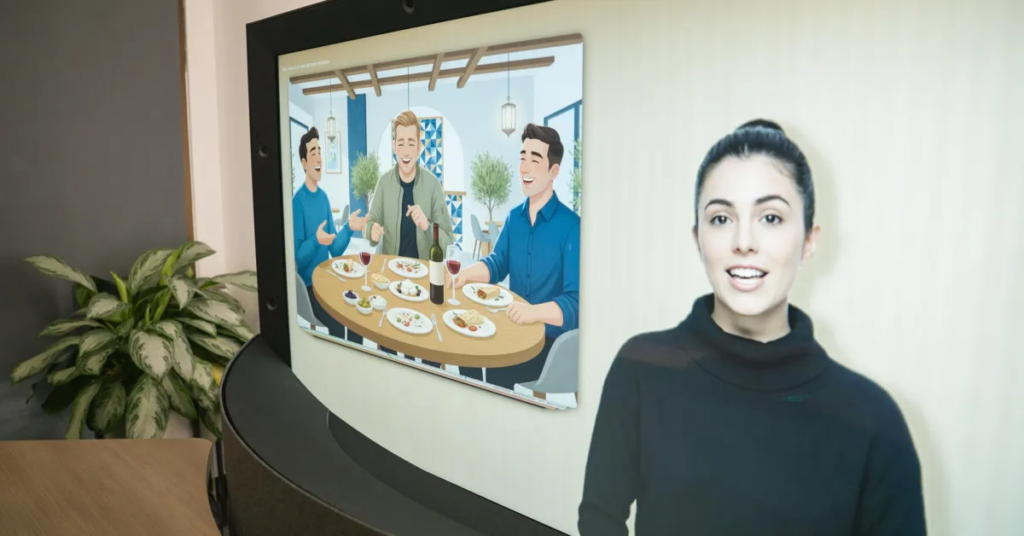
Google has unveiled a striking new artificial intelligence avatar called Sophie at its Mountain View labs, offering one of the clearest glimpses yet into how the company imagines the future of digital communication.
The lifelike AI agent can see users, respond in real time, speak multiple languages, and interact conversationally while performing Google-powered tasks like checking maps or retrieving information.
But Sophie is more than just another chatbot with a face. It is part of Google’s experimental “Beam video agents” initiative, which combines AI avatars with the company’s futuristic Google Beam telepresence technology.
The broader goal is ambitious: creating AI-powered communication systems that feel less like video calls and more like interacting with a real person sitting across from you.
What Is Google Beam Technology?
At the center of the project is Google Beam, a next-generation teleconferencing platform designed to simulate in-person interaction using AI-generated 3D projections.
Unlike traditional video calls, Beam creates the illusion of depth and physical presence without requiring headsets or glasses.
How Beam works
The system uses:
- Multiple cameras positioned around the user
- AI-generated volumetric modeling
- Real-time rendering
- Spatial audio technology
Instead of transmitting a flat video feed, Beam reconstructs a three-dimensional representation of the speaker.
The first commercial hardware using the technology, HP Dimension, reportedly costs around $25,000 and uses six cameras to generate lifelike projections.
Importantly, users are not seeing raw video footage. They are seeing AI-generated models designed to replicate natural movement, eye contact, and facial expressions in real time.
That distinction matters because it shifts video communication from passive streaming to active AI reconstruction.
Who Is Sophie, Google’s New AI Avatar?
Sophie is the most human-facing demonstration yet of Google’s Beam ambitions.
The AI avatar can:
- Hold conversations in real time
- Speak multiple languages
- Read text from books or phones
- Retrieve Google services like maps or weather
- Maintain eye contact during conversations
- Respond visually and verbally during interactions
In demos, Sophie appears seated like a real participant in a conversation rather than functioning as a floating assistant interface.
That design choice is intentional. Google appears to be testing whether users interact differently with embodied AI compared to text-only assistants or voice bots.
Sophie still falls into the “uncanny valley”
Despite its realism, Sophie is not fully natural yet.
Reports from demonstrations suggest the AI still:
- Responds with slight delays
- Uses repetitive gestures
- Speaks with robotic pacing
- Occasionally misses conversational rhythm
These limitations place the avatar in what technologists often call the “uncanny valley” — the uncomfortable zone where AI appears almost human but not convincingly enough.
That may sound minor, but conversational timing is one of the hardest challenges in human-computer interaction.
Even tiny pauses or unnatural expressions can make interactions feel artificial.
Why Google Is Betting on AI Avatars
Google’s Beam video agents are part of a broader industry trend toward “embodied AI” — systems that combine artificial intelligence with visual presence.
Companies increasingly believe the future of AI won’t just involve typing prompts into chat windows.
Instead, AI could eventually appear as:
- Virtual coworkers
- Digital tutors
- Customer service agents
- Shopping assistants
- Healthcare guides
- Personalized productivity companions
The workplace may become the first major testing ground
Google says Beam video agents could eventually be useful in:
- Offices
- Retail stores
- Schools
- Customer support environments
That makes sense strategically.
Businesses already spend heavily on:
- Remote collaboration software
- AI customer service tools
- Virtual onboarding systems
- Productivity automation
An AI avatar capable of participating in meetings or assisting employees could fit naturally into those workflows.
Still, the technology remains experimental, and Google has not announced commercial launch plans or pricing for Sophie-like agents.
Google Beam Now Supports Group Calls
Alongside Sophie, Google also showcased a major expansion of Beam’s communication capabilities: group calls.
That feature had been missing from earlier demonstrations.
The new system blends Beam with traditional video conferencing
Users can now join Beam sessions from:
- Laptops
- Smartphones
- Standard video conferencing setups
The experience works similarly to a regular Google Meet call but adds positional audio technology.
Positional audio helps participants identify who is speaking based on where voices originate in the virtual space.
That feature may sound subtle, but it addresses one of the biggest frustrations in video meetings: conversational overlap and confusion in larger groups.
By simulating directional sound, Beam attempts to recreate the dynamics of physical conversation.
The Bigger Goal: Making AI Feel Present
The most important aspect of Sophie may not be what it can do today, but what it represents.
For years, AI development focused heavily on intelligence:
- Better answers
- Faster reasoning
- Improved coding
- Stronger search capabilities
Now, companies are increasingly focused on presence.
The next generation of AI products may compete on:
- Emotional realism
- Conversational flow
- Visual embodiment
- Social interaction
- Memory and personalization
Google’s Beam project sits directly at that intersection.
AI avatars could reshape digital interaction
If the technology matures, AI avatars could change:
- Remote work culture
- Online education
- Virtual healthcare
- Digital entertainment
- Customer support experiences
For example:
- A tutor avatar could teach students interactively
- A healthcare assistant could guide patients visually
- Retail AI agents could offer real-time product help
- Workplace AI assistants could attend meetings continuously
The challenge will be balancing realism with trust and transparency.
Because once AI avatars become highly human-like, questions around disclosure, manipulation, privacy, and emotional dependency become much more significant.
Why Google Is Moving Carefully
Despite the attention around Sophie, Google continues to label Beam video agents as experimental.
That caution is likely intentional.
The company is still trying to determine:
- Who the product is actually for
- Whether users want embodied AI
- How comfortable people are interacting with AI faces
- What ethical guardrails are needed
The hardware limitations are also significant.
Beam currently relies on expensive equipment and controlled environments, making widespread consumer adoption difficult in the short term.
The technology is impressive — but still early
Sophie demonstrates how quickly AI interfaces are evolving from invisible software into visible personalities.
But the demos also highlight how much work remains before AI avatars feel genuinely natural.
That includes improvements in:
- Latency
- Emotional nuance
- Body language
- Conversational pacing
- Real-time reasoning
- Visual rendering
The gap between “technically functional” and “socially comfortable” remains large.
TL;DR
- Google introduced a new AI avatar called Sophie using its Beam telepresence technology.
- Sophie can speak, respond in real time, and perform Google-powered tasks.
- Beam creates AI-generated 3D projections that simulate face-to-face interaction.
- Google also added group call support with positional audio to Beam.
- The technology remains experimental, with no confirmed release timeline.
- Google believes AI avatars could eventually be used in workplaces, schools, and customer-facing environments.