
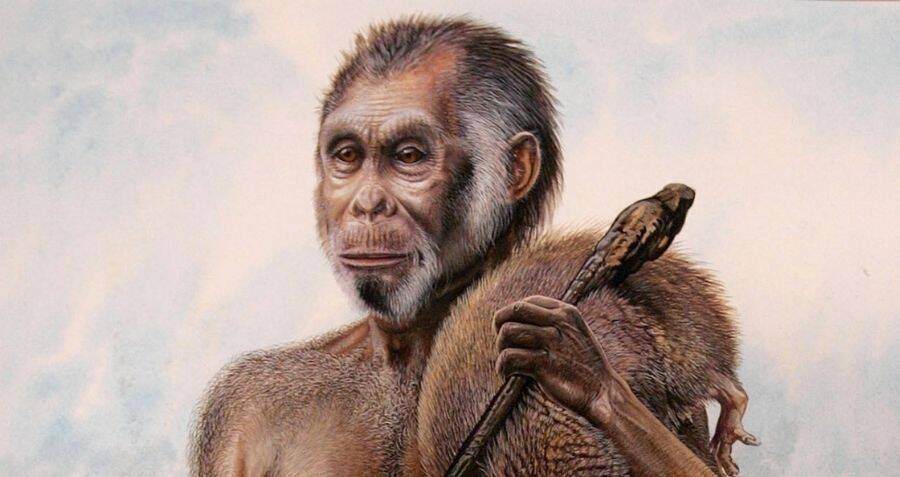
More than two decades after the discovery of the tiny human species known as Homo floresiensis, an unusual claim has reignited debate over one of anthropology’s most fascinating mysteries. Anthropologist Gregory Forth believes the extinct human relative may not be extinct after all, suggesting that small, ape-like beings described in local folklore could represent a surviving population hidden in the forests and mountains of Indonesia’s Flores Island.
The idea has captured the public imagination, but most scientists remain unconvinced. Paleoanthropologists say there is currently no credible evidence that Homo floresiensis—popularly known as the “Hobbit”, survived beyond its known extinction roughly 50,000 years ago.
Here’s why the claim is generatingattention andd why the scientific community remains skeptical.
Who were the “Hobbits” of Flores?
Homo floresiensis was one of the most remarkable discoveries in human evolution.
Scientists first described the species in a landmark 2004 study published in Nature after excavating skeletal remains from the Liang Bua limestone cave on Indonesia’s Flores Island. The initial discovery included the nearly complete skeleton of an adult female, followed by the remains of at least 12 more individuals.
The species quickly earned the nickname “Hobbit” because of its remarkably small stature.
Researchers found that Homo floresiensis:
- Stood about 3.5 feet (roughly 1.1 meters) tall.
- Walked upright like modern humans.
- Had relatively large feet for its body size.
- Possessed a small skull with a brain much smaller than that of Homo sapiens.
- Used simple stone tools.
The fossils date to the Late Pleistocene, making the species one of the last known human relatives to coexist with modern humans.
Why does Gregory Forth believe they could still exist?
Gregory Forth, an anthropologist who has spent decades studying the culture and folklore of Flores, argues that reports from Indigenous communities deserve greater scientific attention.
According to Forth, residents have long described mysterious, short, hairy beings that are neither fully human nor fully ape. He believes these accounts may not simply be myths but could represent memories—or even observations—of a surviving population of Homo floresiensis.
He has suggested that these creatures may have remained isolated in the island’s mountainous forests and caves for tens of thousands of years.
Speaking to Popular Mechanics, Forth pointed out that local communities identified several animal species before they were formally recognized by science.
“Bear in mind that a lot of species have been known to local people… before scientists accepted them,” he said, citing the Komodo dragon as one example.
At the same time, Forth acknowledges that extraordinary claims require extraordinary evidence. Without a living specimen, DNA, or physical remains, the hypothesis cannot be confirmed.
Why are most scientists skeptical?
While the theory has attracted public curiosity, paleoanthropologists overwhelmingly reject the idea that Homo floresiensis still survives.
Their reasoning is straightforward: there is no scientific evidence supporting the claim.
Researchers who study human evolution rely on verifiable evidence such as:
- Fossils
- DNA
- Archaeological artifacts
- Photographs or biological samples
- Reproducible field observations
To date, none of these have been found.
Matthew Tocheri of the Smithsonian Institution’s Human Origins Initiative said he would be thrilled if the species were rediscovered.
“I would be one of the most excited people in the world if Homo floresiensis were still around,” he said.
However, he added that such a scenario is extremely unlikely based on everything scientists currently know.
Many researchers compare the claims to stories surrounding Bigfoot or Sasquatch—persistent folklore supported by eyewitness accounts but lacking physical evidence despite decades of searching.
Could folklore preserve memories of extinct humans?
One reason Forth’s hypothesis continues to attract attention is that folklore has occasionally preserved information about real animals.
History offers several examples where Indigenous knowledge helped scientists identify species previously unknown to Western science.
The Komodo dragon is perhaps the best-known example from Indonesia. Long before scientists documented the giant lizard, local communities were already familiar with it.
However, scientists caution that this comparison has limits.
Large reptiles leave physical evidence that is relatively easy to verify. A surviving human species would likely leave behind a much broader range of evidence, including bones, tools, genetic traces, food remains, shelters, or repeated sightings supported by photographs and biological samples.
None of this evidence currently exists for living Hobbits.
What do scientists know about Homo floresiensis?
Although many questions remain, decades of research have revealed much about the species.
Scientists believe an ancient human ancestor reached Flores roughly one million years ago.
Over hundreds of thousands of years, isolation on the island may have caused the population to evolve into a much smaller-bodied species through a process known as island dwarfism.
This evolutionary phenomenon occurs when animals living on isolated islands become significantly smaller because of limited food resources and unique environmental pressures.
The exact evolutionary origins of Homo floresiensis remain debated, however.
Some anatomical features resemble much earlier human ancestors, including Australopithecus afarensis, a species that disappeared nearly 2.8 million years before the Hobbits appeared. This unexpected combination of primitive and more modern traits continues to puzzle researchers.
New research is reshaping what scientists know
Research on Homo floresiensis continues to evolve.
A study published in Science Advances on July 3 suggested that the species may not have hunted large animals or regularly used fire, challenging earlier assumptions about its behavior.
Previous interpretations proposed that Hobbits hunted Stegodons—extinct elephant-like mammals that once inhabited Flores.
More recent analyses, however, indicate that many marks found on Stegodon bones were likely caused by Komodo dragons rather than stone tools.
Instead of hunting these large animals, researchers now believe Homo floresiensis may have scavenged carcasses after predators had fed.
Scientists also believe their diet was varied and likely included:
- Fruits
- Plants
- Nuts
- Insects
- Small animals
- Meat obtained through scavenging
As discoveries emerge, researchers continue refining their understanding of how these ancient humans lived.
Is there any chance the Hobbits survived?
From a scientific perspective, the possibility cannot be ruled out with absolute certainty.
Science rarely proves a negative. Instead, it weighs the available evidence.
At present, every known fossil, archaeological site, and genetic study indicates that Homo floresiensis disappeared approximately 50,000 years ago.
For scientists to accept that the species still exists, they would need compelling evidence, such as:
- Verified photographs or videos.
- DNA samples.
- Recently dated skeletal remains.
- Living individuals observed and documented by researchers.
Until such evidence emerges, the idea remains an intriguing hypothesis rather than an accepted scientific conclusion.
The bottom line
The story of Homo floresiensis remains one of the most remarkable chapters in human evolution. The discovery of a tiny human species living alongside modern humans fundamentally changed scientists’ understanding of our evolutionary history.
Gregory Forth’s proposal that these “Hobbits” may still inhabit remote parts of Flores has revived interest in the species and the role Indigenous traditions can play in scientific discovery.
However, extraordinary claims require equally extraordinary evidence. While local folklore deserves careful study, the overwhelming consensus among anthropologists is that there is currently no credible evidence that Homo floresiensis survived into the present day.
For now, the Hobbits remain a fascinating extinct branch of the human family tree—one whose story continues to evolve with every new fossil and scientific study.