
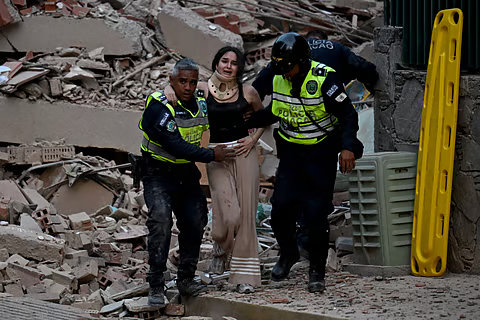
Google’s earthquake alert system is back in the spotlight after millions of Android users in Venezuela received warnings seconds before a devastating pair of earthquakes struck the country. While the alerts did not predict the disaster, they provided precious seconds for people to react, move to safer locations, and prepare for the incoming shaking.
The event has sparked renewed interest in how smartphones can function as a global earthquake detection network, transforming everyday devices into miniature scientific instruments capable of saving lives.
Android phones became an early warning network in Venezuela
Just moments before a magnitude 7.2 earthquake hit Venezuela on June 24, Android users across affected regions received emergency notifications on their phones. The alert displayed key information, including the estimated magnitude of the earthquake and the user’s distance from the epicenter.
The first quake was followed by a stronger magnitude 7.5 tremor only 39 seconds later, creating widespread destruction. According to reports, the disaster has left at least 164 people dead and nearly 1,000 injured.
Many survivors later shared on social media that the warning prompted them to leave buildings or move to safer locations before the strongest shaking began.
The alerts came from Google’s Android Earthquake Alerts System, a technology designed not to predict earthquakes, but to detect them in their earliest moments and provide rapid warnings.
Did Google predict the Venezuela earthquake?
The short answer is no.
Scientists still cannot predict earthquakes with reliable accuracy. Despite decades of research, there is currently no technology capable of forecasting exactly when and where a major earthquake will occur.
What Google’s system does instead is detect the first seismic waves generated by an earthquake and quickly calculate whether stronger shaking is likely to follow.
Because electronic signals travel far faster than seismic waves through the Earth’s crust, warnings can reach people before the most damaging shaking arrives.
In some cases, users may receive only a few seconds of warning. In others, people farther from the epicenter may get tens of seconds to prepare.
How Android phones detect earthquakes
Every modern Android smartphone contains a tiny sensor called an accelerometer.
Accelerometers are primarily designed to detect motion and orientation changes, such as rotating the screen or measuring physical activity. However, they can also detect ground movements associated with earthquakes.
When a phone detects unusual vibrations consistent with seismic activity, it sends anonymous data to Google’s earthquake detection servers. A single phone signal is not enough to trigger an alert, but when many devices in the same area report similar movements simultaneously, Google’s systems analyze the data for patterns that match an earthquake.
The process works in several steps:
- A phone detects unusual ground movement.
- The device sends a signal and approximate location data to Google.
- Google’s servers compare reports from nearby phones.
- Algorithms determine whether the movement is likely caused by an earthquake.
- If confirmed, alerts are sent to users who may be affected.
This massive network effectively turns millions of Android devices into one of the world’s largest earthquake detection systems.
Why even a few seconds matter
Earthquakes release several types of seismic waves.
The fastest waves, known as P-waves, usually cause limited damage. More destructive S-waves and surface waves arrive afterward and produce the strongest shaking.
Early warning systems detect the first waves and use that brief window to send alerts before the more dangerous waves arrive.
Even a warning of five to ten seconds can make a meaningful difference by allowing people to:
- Move away from windows
- Take cover under sturdy furniture
- Exit hazardous areas
- Stop dangerous machinery
- Prepare emergency services
During transportation emergencies, automated systems can also slow trains, halt industrial operations, and secure critical infrastructure.
The science behind Google’s earthquake alerts
The Android Earthquake Alerts System was developed with contributions from leading seismologists and disaster researchers, including:
- Dr. Richard Allen
- Dr. Qingkai Kong
- Dr. Lucy Jones
The project was created to expand earthquake early warning coverage beyond countries that have invested heavily in specialized seismic sensor networks.
Traditional earthquake monitoring systems require expensive ground-based instruments. By leveraging billions of existing smartphones, Google created a lower-cost alternative capable of covering regions where dedicated monitoring infrastructure may be limited.
How Japan’s earthquake warning system works
While Google’s system relies heavily on smartphones, countries such as Japan use dedicated national earthquake monitoring networks.
Japan introduced a nationwide earthquake early warning system in 2007 through the Japan Meteorological Agency (JMA). The system uses thousands of highly sensitive seismic sensors distributed across the country.
When a significant earthquake occurs, the network rapidly estimates:
- Magnitude
- Epicenter location
- Expected intensity
- Arrival time of shaking
Warnings are then broadcast through television, radio, smartphones, public announcement systems, and transportation networks.
In 2022, Japanese authorities enhanced the system to better detect potential megaquakes. The upgraded approach can issue special alerts when powerful foreshocks occur in major subduction zones that are known to generate catastrophic earthquakes.
Why the Venezuela alerts are significant
The Venezuela earthquakes demonstrate the growing role of technology in disaster preparedness.
Unlike traditional emergency systems that require dedicated infrastructure, smartphone-based networks can reach vast populations almost instantly. With Android devices accounting for the majority of smartphones globally, the technology offers a scalable method for providing life-saving warnings in regions vulnerable to seismic activity.
The alerts did not stop the earthquake, but they gave many people a crucial head start. As earthquake detection technology continues to improve, those few seconds could become one of the most valuable tools available during natural disasters.
What earthquake alerts can and cannot do
What they can do
- Detect earthquakes shortly after they begin
- Warn people before stronger shaking arrives
- Improve emergency response times
- Reduce injuries through faster action
What they cannot do
- Predict earthquakes days or hours in advance
- Prevent earthquakes from occurring
- Guarantee warnings for every user
- Eliminate all earthquake-related risks
The Venezuela disaster highlights both the limits and the promise of modern earthquake warning systems. While prediction remains beyond current scientific capabilities, rapid detection technologies are increasingly helping communities react faster when every second counts.