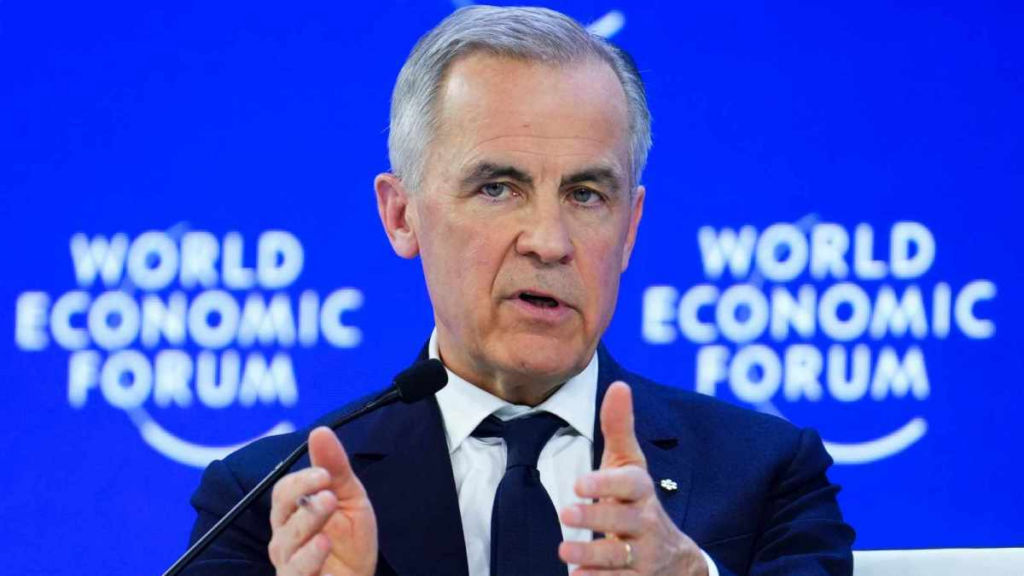
Canada’s Prime Minister Mark Carney used the global stage at the 2026 World Economic Forum in Davos to deliver one of the starkest assessments yet of the international order. In a speech that earned a standing ovation, Carney argued that the US-led rules-based system that shaped global politics for decades is no longer merely evolving; it is breaking apart.
His message to countries like Canada was blunt: in a world defined by intensifying great power rivalry, middle powers cannot rely on compliance, nostalgia, or neutrality for protection.
What did Mark Carney say at Davos?
Speaking to political and financial leaders in Switzerland, Carney described the current global moment as a “rupture, not a transition.” He warned that the predictable system underpinned by US leadership since the Second World War is fading, replaced by a more coercive and transactional form of power politics.
“The strong do what they can, and the weak suffer what they must,” Carney said, capturing what he sees as the new reality of international relations.
While he did not name US President Donald Trump directly, the speech left little doubt about whom he was referencing. Carney has consistently argued that the world will not return to a pre-Trump version of global stability.
Why Mark Carney says the old US-led order is over
Carney acknowledged that countries like Canada benefited enormously from what he called American hegemony. He cited open sea lanes, a stable financial system, collective security arrangements, and dispute-resolution frameworks as public goods that the United States once helped sustain.
But that era, he argued, is finished.
“The old order is not coming back. We should not mourn it. Nostalgia is not a strategy,” Carney said.
Instead, he described a system where economic integration itself has become a tool of coercion and where powerful states increasingly dictate terms based on market size, military strength, and leverage.
What does “if not at the table, we’re on the menu” mean?
One of the most quoted lines from Carney’s address was his warning to middle powers.
“Middle powers must act together, because if we’re not at the table, we’re on the menu,” he said.
The phrase underscores a central concern: countries without the scale or force of great powers risk being sidelined, or exploited, if they act alone.
Why compliance no longer guarantees safety
Carney rejected the idea that smaller or mid-sized nations can secure themselves by simply following the rules or appeasing stronger states.
“Compliance will not buy safety,” he warned.
In his view, middle powers face a clear choice:
- Retreat inward and build higher economic and political walls
- Or pursue collective strategies that amplify their influence
Carney argued strongly for the second option, urging coordination among like-minded nations to shape outcomes rather than react to them.
How Mark Carney defines “middle powers”
While Carney cited Canada explicitly, his message applies to a broader group of countries that wield influence but lack decisive dominance.
These include:
- Advanced economies without a superpower military reach
- Democracies reliant on global trade and stable rules
- States are vulnerable to economic pressure from larger rivals
Canada’s stance on Greenland and Denmark
Carney also used the Davos platform to take a clear geopolitical position on Greenland, following renewed remarks by Donald Trump about taking control of the autonomous Danish territory.
“Canada stands firmly with Greenland and Denmark and fully supports their unique right to determine Greenland’s future,” he said.
The statement was widely seen as a rebuke to Trump’s earlier claim that US control of Greenland was inevitable. It also aligned with Carney’s broader argument that sovereignty and international norms are increasingly under strain.
Why the speech resonated in Davos
Carney’s address received a standing ovation from an audience that included senior policymakers, financiers, and media figures. Observers noted that his speech captured a growing unease among global elites about the erosion of collective problem-solving institutions built over the past 80 years.
Without naming Trump, Mark Carney echoed concerns that Washington is increasingly willing to dismantle or bypass multilateral frameworks when they conflict with short-term national interests.
Rising tensions between the US and Canada
Underlying Carney’s remarks is a more immediate concern: Canada’s relationship with its closest ally.
Following Trump’s 2024 election and return to office, he repeatedly referred to Canada as a potential “51st state,” arguing that a merger would benefit both countries. While such rhetoric has softened in recent months, it has not disappeared entirely.
Most recently, Trump posted an image on social media showing Canada and Venezuela covered in the US flag, a move widely interpreted as provocative, if symbolic.
Reports of Canadian contingency planning
Canada’s Globe and Mail reported, citing unnamed senior officials, that Ottawa has explored defensive models inspired by insurgency tactics used in Afghanistan against larger invading forces.
According to the report:
- US forces could overwhelm Canada’s strategic positions within days
- Canada’s planning emphasizes resilience and asymmetric responses
- The goal is deterrence, not confrontation
These reports underline the seriousness with which Canadian officials are reassessing long-held assumptions about security.
Why Carney’s warning matters globally
Carney’s speech goes beyond Canada. It reflects a broader reckoning among middle powers caught between competing giants.
His core argument is simple but unsettling: the world is entering a phase where power matters more than principle, and where sitting out is no longer an option.
For countries that once relied on stable rules and alliances, the challenge now is how to remain relevant, protected, and influential in a system that no longer guarantees fairness.
TL;DR
At Davos, Canadian Prime Minister Mark Carney declared that the US-led rules-based international order is undergoing a rupture, not a transition. Warning that “compliance will not buy safety,” he urged middle powers to act collectively, arguing that “if we’re not at the table, we’re on the menu.” His speech, which also reaffirmed support for Greenland and Denmark, highlighted growing anxiety over great power rivalry and the erosion of global norms.