

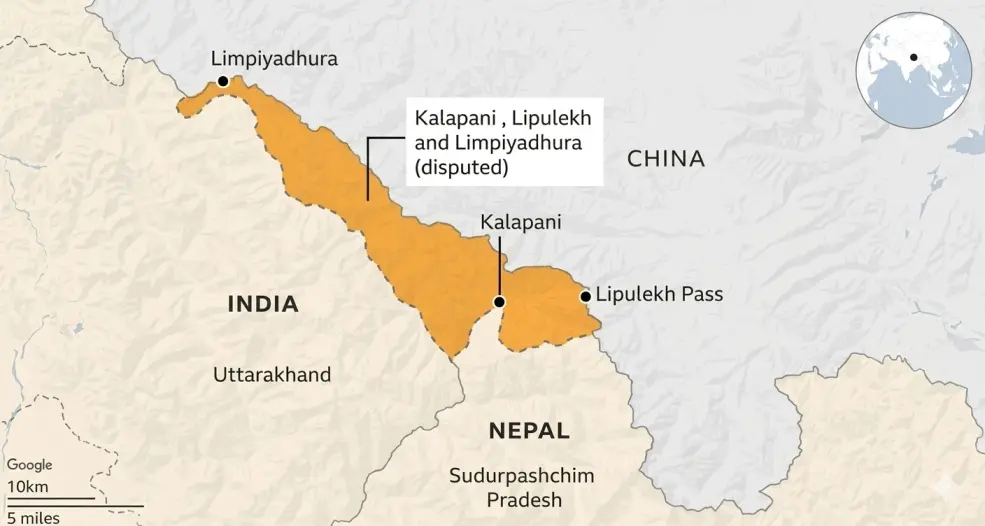
The decades-old India-Nepal Lipulekh dispute is back in focus after Nepal Prime Minister Balen Shah said both countries had encroached on each other’s territory during his first address to Parliament since taking office.
His comments come weeks after India and China announced that the 2026 Kailash Mansarovar Yatra would again operate through the strategically sensitive Lipulekh Pass — a Himalayan corridor near the India-Nepal-China trijunction that has long been at the center of competing territorial claims.
Shah’s remarks signal that Kathmandu intends to revive diplomatic pressure on New Delhi over the issue, while also linking the dispute to colonial-era border arrangements established under British rule.
What Did Nepal PM Balen Shah Say About the Lipulekh Dispute?
In his parliamentary address, Shah said both India and Nepal had encroached upon each other’s territories, a notably measured framing compared to previous nationalist rhetoric from Kathmandu.
He said Nepal had already sent a diplomatic note to India regarding disputed border areas, including Lipulekh, and called for the matter to be resolved through dialogue involving historians, experts, and diplomats.
Shah also suggested Nepal may raise aspects of the dispute with the United Kingdom because the roots of the disagreement trace back to maps and treaties drawn during British colonial administration in South Asia.
That comment is significant because it shifts the debate beyond a purely bilateral India-Nepal issue and reopens historical questions tied to the 1816 Sugauli Treaty.
Why Is the Lipulekh Pass So Important?
The Lipulekh Pass sits in Uttarakhand’s Pithoragarh district near Tibet and serves several strategic purposes at once:
- It is a key Himalayan trade route between India and China.
- It is one of the main access points for the Kailash Mansarovar Yatra, a major Hindu and Buddhist pilgrimage.
- It lies close to a sensitive trijunction involving India, Nepal, and China-controlled Tibet.
- The area has military importance because of its high-altitude location and proximity to the India-China frontier.
For India, the route is both strategic and operationally established. For Nepal, the issue is tied to sovereignty and national identity.
That combination has made Lipulekh one of the most emotionally and politically charged border disputes in South Asia.
What Is the Core of the India-Nepal Lipulekh Dispute?
At the heart of the India-Nepal Lipulekh dispute is one deceptively simple question: Where does the Kali River begin?
The Sugauli Treaty Disagreement
The 1816 Sugauli Treaty between British India and Nepal defined the Kali River as the western boundary of Nepal.
Nepal argues that territories east of the river — including Lipulekh, Kalapani, and Limpiyadhura — belong to Nepal.
India disputes Nepal’s interpretation and maintains that the current boundary alignment is historically and administratively valid.
The disagreement intensified because different historical maps identified different origins of the Kali River.
The British-Era Border Shift
In 1865, British authorities reportedly altered the border alignment near Lipulekh by moving it toward the watershed of the Kalapani stream.
That adjustment later became central to Nepal’s claim that colonial-era mapping unfairly shifted territory away from Nepal.
After India gained independence in 1947, the region remained under Indian administration and security control.
Today, India continues to maintain both military and administrative presence in the area.
Why Did the Dispute Resurface in 2026?
The immediate trigger was India and China’s decision to conduct the 2026 Kailash Mansarovar Yatra through the Lipulekh route.
Nepal objected because Kathmandu considers the pass part of its sovereign territory.
This is not the first time the pilgrimage route has sparked tensions.
The 2015 India-China Agreement
Back in 2015, India and China agreed to expand trade through Lipulekh. Nepal protested that agreement as well, arguing that the two countries had discussed territory claimed by Nepal without Kathmandu’s consent.
The issue triggered political backlash inside Nepal and fueled nationalist sentiment against both neighbors.
The same sensitivities are resurfacing now as the pilgrimage route returns to the headlines.
What Is India’s Position on Lipulekh?
India has repeatedly rejected Nepal’s territorial claims over Lipulekh and Kalapani.
The Indian government maintains that:
- The Kailash Mansarovar Yatra has used the Lipulekh route since 1954.
- India’s position on the border issue is “consistent and clear.”
- Existing administrative control supports India’s claim.
Last month, India’s Ministry of External Affairs reiterated that the pilgrimage route through Lipulekh is not a new arrangement.
MEA spokesperson Randhir Jaiswal said the yatra has operated through the route for decades and referred reporters to earlier official statements.
India has also said it remains open to dialogue with Nepal over unresolved border concerns.
Why the Dispute Matters Beyond Geography
The Lipulekh dispute is about far more than a mountain pass.
Nationalism in Nepal
Border disputes with India often become politically sensitive issues inside Nepal, where concerns about sovereignty and dependence on New Delhi regularly shape domestic politics.
Successive Nepalese governments have used territorial issues to signal independence from India’s influence.
India-China Strategic Competition
Lipulekh also sits close to one of Asia’s most sensitive geopolitical fault lines.
India and China continue to compete for strategic influence across the Himalayan region following years of military tensions along their disputed border.
Any territory near a major Himalayan transit corridor automatically gains military significance.
Religious and Economic Importance
The route is also tied to pilgrimage tourism and cross-border trade.
The Kailash Mansarovar Yatra carries deep religious importance for Hindus, Buddhists, Jains, and followers of Bon traditions. Trade access through Himalayan passes also affects local economies in border regions.
That means the dispute touches diplomacy, security, religion, and economics simultaneously.
Can India and Nepal Resolve the Lipulekh Dispute?
Despite recurring tensions, both countries have historically avoided letting the issue spiral into a full-scale diplomatic crisis.
India and Nepal share unusually close ties built on:
- Open borders
- Cultural and religious links
- Economic interdependence
- Labor migration
- Security cooperation
But the dispute remains unresolved largely because neither side wants to appear politically weak at home.
Nepal lacks physical control over Lipulekh and Kalapani, while India continues to administer the territory on the ground. That creates a diplomatic stalemate where negotiations continue but practical realities remain unchanged.
Experts say a long-term resolution would likely require:
- Joint historical review of treaty documents
- Agreement on river-source interpretation
- Bilateral boundary negotiations
- Political willingness from both governments
For now, neither side appears ready to fundamentally alter its position.
The Bigger Picture
The return of the India-Nepal Lipulekh dispute highlights how colonial-era borders continue to shape modern geopolitics across South Asia.
More than 200 years after the Sugauli Treaty, disagreements over old maps, river origins, and mountain boundaries still influence relations between neighbouring countries.
And because Lipulekh sits at the intersection of India, Nepal, and China, even seemingly local disputes quickly acquire regional strategic significance.
As pilgrimage routes reopen and Himalayan geopolitics become more competitive, the controversy surrounding Lipulekh is unlikely to disappear anytime soon.
TL;DR
- Nepal PM Balen Shah said India and Nepal have encroached on each other’s territory.
- The remarks revived focus on the long-running India-Nepal Lipulekh dispute.
- Nepal claims Lipulekh, Kalapani, and Limpiyadhura based on its interpretation of the 1816 Sugauli Treaty.
- India maintains administrative and military control over the region.
- The issue resurfaced after India and China announced the 2026 Kailash Mansarovar Yatra route through Lipulekh.
- The dispute has strategic, religious, and geopolitical implications involving India, Nepal, and China.




